MCIA-LEVEL1 Exam Details
-
Exam Code
:MCIA-LEVEL1 -
Exam Name
:MuleSoft Certified Integration Architect - Level 1 -
Certification
:Mulesoft Certifications -
Vendor
:Mulesoft -
Total Questions
:290 Q&As -
Last Updated
:Jul 08, 2026
Mulesoft MCIA-LEVEL1 Online Questions & Answers
-
Question 231:
An integration Mute application consumes and processes a list of rows from a CSV file. Each row must be read from the CSV file, validated, and the row data sent to a JMS queue, in the exact order as in the CSV file.
If any processing step for a row falls, then a log entry must be written for that row, but processing of other rows must not be affected.
What combination of Mute components is most idiomatic (used according to their intended purpose) when Implementing the above requirements?
A. Scatter-Gather component On Error Continue scope
B. VM connector first Successful scope On Error Propagate scope
C. For Each scope On Error Continue scope
D. Async scope On Error Propagate scope -
Question 232:
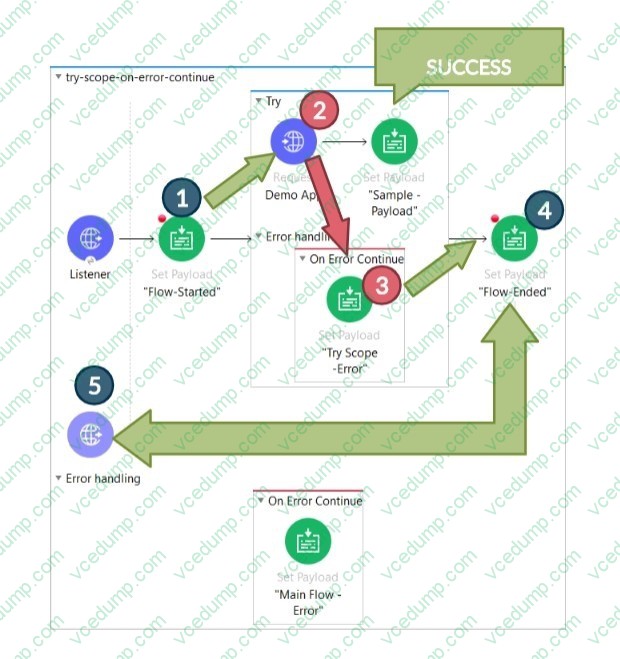
Refer to the exhibit.

A business process involves the receipt of a file from an external vendor over SFTP. The file needs to be parsed and its content processed, validated, and ultimately persisted to a database. The delivery mechanism is expected to change in the future as more vendors send similar files using other mechanisms such as file transfer or HTTP POST.
What is the most effective way to design for these requirements in order to minimize the impact of future change?
A. Use a MuleSoft Scatter-Gather and a MuleSoft Batch Job to handle the different files coming from different sources
B. Create a Process API to receive the file and process it using a MuleSoft Batch Job while delegating the data save process to a System API
C. Create an API that receives the file and invokes a Process API with the data contained In the file, then have the Process API process the data using a MuleSoft Batch Job and other System APIs as needed
D. Use a composite data source so files can be retrieved from various sources and delivered to a MuleSoft Batch Job for processing -
Question 233:
Which Exchange asset type represents a complete API specification in RAML or OAS format?
A. Connectors
B. REST APIs
C. API Spec Fragments
D. SOAP APIs -
Question 234:
A developer is examining the responses from a RESTful web service that is compliant with the Mypertext Transfer Protocol (HTTP/1.1) a8 defined by the Internet Engineering Task Force (IETF).
In this HTTP/1.1-compliant web service, which class of HTTP response status codes should be specified to indicate when client requests are successfully received, understood, and accepted by the web service?
A. 3xx
B. 2xx
C. 4xx
D. 5xx -
Question 235:
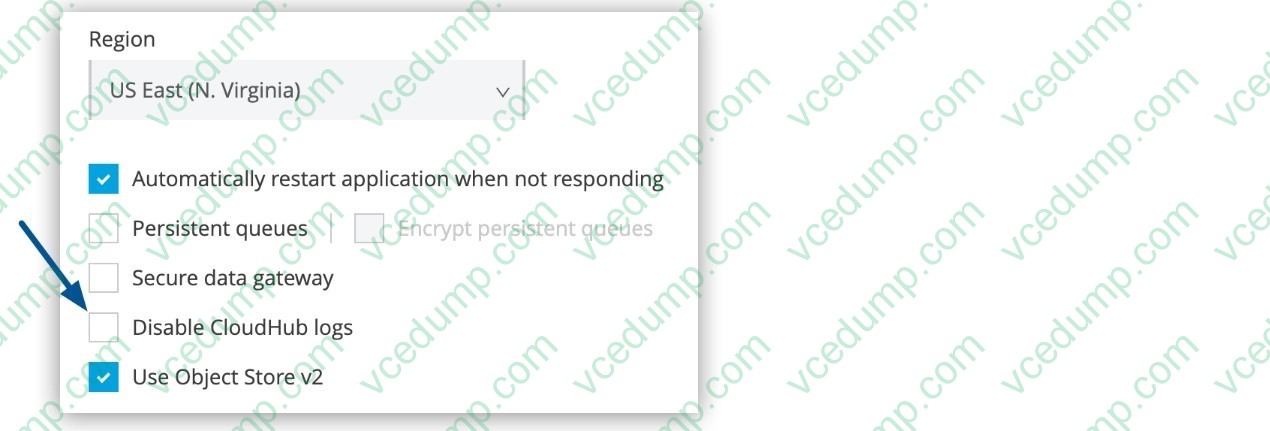
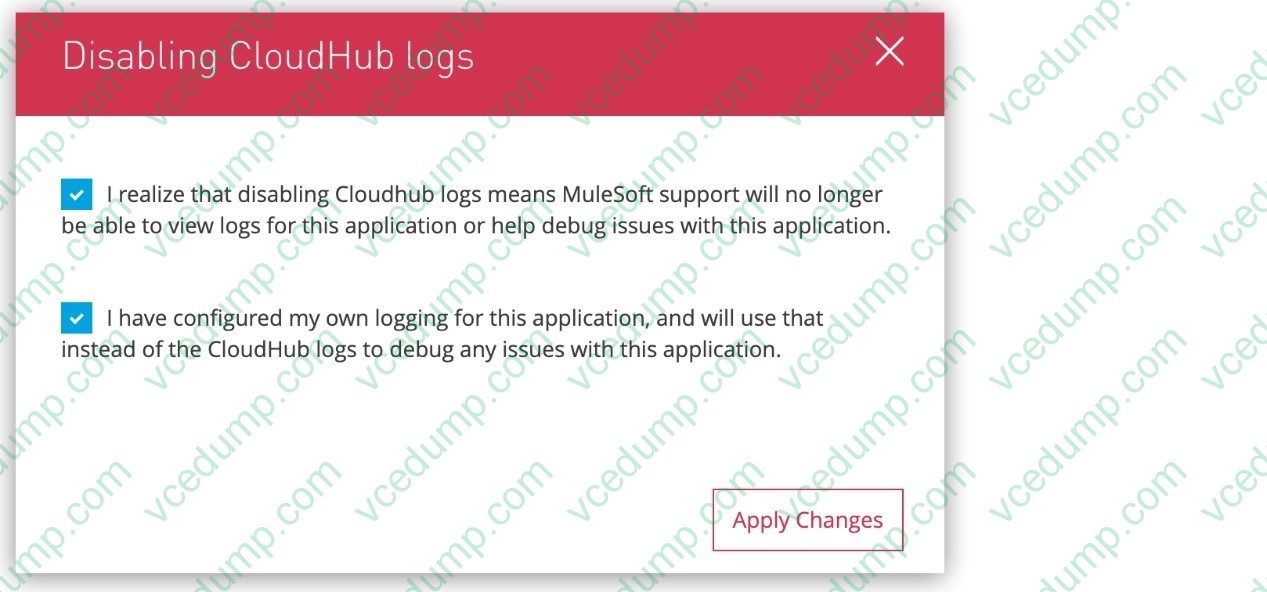
What aspect of logging is only possible for Mule applications deployed to customer-hosted Mule runtimes, but NOT for Mule applications deployed to CloudHub?
A. To send Mule application log entries to Splunk
B. To change tog4j2 tog levels in Anypoint Runtime Manager without having to restart the Mule application
C. To log certain messages to a custom log category
D. To directly reference one shared and customized log4j2.xml file from multiple Mule applications -
Question 236:
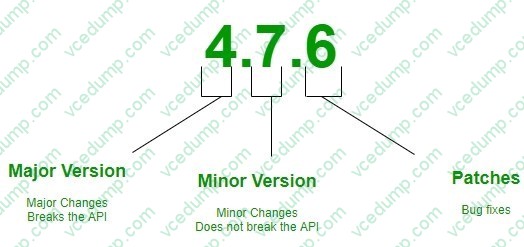
An API has been updated in Anypoint Exchange by its API producer from version 3.1.1 to 3.2.0 following accepted semantic versioning practices and the changes have been communicated via the API's public portal. The API endpoint does NOT change in the new version. How should the developer of an API client respond to this change?
A. The update should be identified as a project risk and full regression testing of the functionality that uses this API should be run.
B. The API producer should be contacted to understand the change to existing functionality.
C. The API producer should be requested to run the old version in parallel with the new one.
D. The API client code ONLY needs to be changed if it needs to take advantage of new features. -
Question 237:
Which component is responsible for collecting and visualizing metrics such as CPU and memory usage for Mule applications?
A. Anypoint Exchange
B. API Manager
C. Anypoint Monitoring
D. Anypoint CLI -
Question 238:
A leading e-commerce giant will use Mulesoft API's on runtime fabric (RTF) to process customer orders. Some customer's sensitive information such as credit card information is also there as a part of a API payload. What approach minimizes the risk of matching sensitive data to the original and can convert back to the original value whenever and wherever required?
A. Apply masking to hide the sensitive information and then use API
B. manager to detokenize the masking format to return the original value
C. create a tokenization format and apply a tokenization policy to the API Gateway
D. Used both masking and tokenization
E. Apply a field level encryption policy in the API Gateway -
Question 239:
An organization's IT team follows an API-led connectivity approach and must use Anypoint Platform to implement a System AP\ that securely accesses customer data. The organization uses Salesforce as the system of record for all customer data, and its most important objective is to reduce the overall development time to release the System API. The team's integration architect has identified four different approaches to access the customer data from within the implementation of the System API by using different Anypoint Connectors that all meet the technical requirements of the project.
A. Use the Anypoint Connector for Database to connect to a MySQL database to access a copy of the customer data
B. Use the Anypoint Connector for HTTP to connect to the Salesforce APIs to directly access the customer data
C. Use the Anypoint Connector for Salesforce to connect to the Salesforce APIs to directly access the customer data
D. Use the Anypoint Connector tor FTP to download a file containing a recent near-real time extract of the customer data -
Question 240:
According to MuteSoft, which principle is common to both Service Oriented Architecture (SOA) and API-led connectivity approaches?
A. Service centralization
B. Service statefulness
C. Service reusability
D. Service interdependence

Related Exams:
-
MCD-ASSOC
MuleSoft Certified Developer - Integration and API Associate (Mule 3) -
MCD-LEVEL1
MuleSoft Certified Developer - Level 1 (Mule 4) -
MCD-LEVEL1-DELTA
MuleSoft Certified Developer - Level 1 (Mule 4) DELTA -
MCD-LEVEL2
MuleSoft Certified Developer - Level 2 (Mule 4) -
MCIA-LEVEL1
MuleSoft Certified Integration Architect - Level 1 -
MCIA-LEVEL1-MAINTENANCE
MuleSoft Certified Integration Architect - Level 1 MAINTENANCE -
MCPA-LEVEL1
MuleSoft Certified Platform Architect - Level 1 -
MCPA-LEVEL1-MAINTENANCE
MuleSoft Certified Platform Architect - Level 1 MAINTENANCE
Tips on How to Prepare for the Exams
Nowadays, the certification exams become more and more important and required by more and more enterprises when applying for a job. But how to prepare for the exam effectively? How to prepare for the exam in a short time with less efforts? How to get a ideal result and how to find the most reliable resources? Here on Vcedump.com, you will find all the answers. Vcedump.com provide not only Mulesoft exam questions, answers and explanations but also complete assistance on your exam preparation and certification application. If you are confused on your MCIA-LEVEL1 exam preparations and Mulesoft certification application, do not hesitate to visit our Vcedump.com to find your solutions here.