MCIA-LEVEL1 Exam Details
-
Exam Code
:MCIA-LEVEL1 -
Exam Name
:MuleSoft Certified Integration Architect - Level 1 -
Certification
:Mulesoft Certifications -
Vendor
:Mulesoft -
Total Questions
:290 Q&As -
Last Updated
:Jul 08, 2026
Mulesoft MCIA-LEVEL1 Online Questions & Answers
-
Question 261:
A Mule application contains a Batch Job with two Batch Steps (Batch_Step_l and Batch_Step_2). A payload with 1000 records is received by the Batch Job.
How many threads are used by the Batch Job to process records, and how does each Batch Step process records within the Batch Job?
A. Each Batch Job uses SEVERAL THREADS for the Batch Steps Each Batch Step instance receives ONE record at a time as the payload, and RECORDS are processed IN PARALLEL within and between the two Batch Steps
B. Each Batch Job uses a SINGLE THREAD for all Batch steps Each Batch step instance receives ONE record at a time as the payload, and RECORDS are processed IN ORDER, first through Batch_Step_l and then through Batch_Step_2
C. Each Batch Job uses a SINGLE THREAD to process a configured block size of record Each Batch Step instance receives A BLOCK OF records as the payload, and BLOCKS of records are processed IN ORDER
D. Each Batch Job uses SEVERAL THREADS for the Batch Steps Each Batch Step instance receives ONE record at a time as the payload, and BATCH STEP INSTANCES execute IN PARALLEL to process records and Batch Steps in ANY order as fast as possible -
Question 262:
Refer to the exhibit.
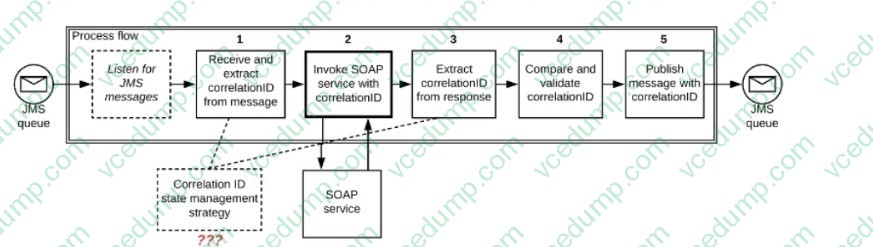
A Mule application is deployed to a multi-node Mule runtime cluster. The Mule application uses the competing consumer pattern among its cluster replicas to receive JMS messages from a JMS queue. To process each received JMS message, the following steps are performed in a flow:
Step l: The JMS Correlation ID header is read from the received JMS message.
Step 2: The Mule application invokes an idempotent SOAP webservice over HTTPS, passing the JMS Correlation ID as one parameter in the SOAP request.
Step 3: The response from the SOAP webservice also returns the same JMS Correlation ID.
Step 4: The JMS Correlation ID received from the SOAP webservice is validated to be identical to the JMS Correlation ID received in Step 1.
Step 5: The Mule application creates a response JMS message, setting the JMS Correlation ID message header to the validated JMS Correlation ID and publishes that message to a response JMS queue.
Where should the Mule application store the JMS Correlation ID values received in Step 1 and Step 3 so that the validation in Step 4 can be performed, while also making the overall Mule application highly available, fault-tolerant, performant, and maintainable?
A. Both Correlation ID values should be stored in a persistent object store
B. Both Correlation ID values should be stored In a non-persistent object store
C. The Correlation ID value in Step 1 should be stored in a persistent object store The Correlation ID value in step 3 should be stored as a Mule event variable/attribute
D. Both Correlation ID values should be stored as Mule event variable/attribute -
Question 263:
An organization's governance process requires project teams to get formal approval from all key stakeholders for all new Integration design specifications. An integration Mule application Is being designed that interacts with various backend systems. The Mule application will be created using Anypoint Design Center or Anypoint Studio and will then be deployed to a customer-hosted runtime. What key elements should be included in the integration design specification when requesting approval for this Mule application?
A. SLAs and non-functional requirements to access the backend systems
B. Snapshots of the Mule application's flows, including their error handling
C. A list of current and future consumers of the Mule application and their contact details
D. The credentials to access the backend systems and contact details for the administrator of each system -
Question 264:
Anypoint Exchange is required to maintain the source code of some of the assets committed to it, such as Connectors, Templates, and API specifications. What is the best way to use an organization's source-code management (SCM) system in this context?
A. Organizations should continue to use an SCM system of their choice, in addition to keeping source code for these asset types in Anypoint Exchange, thereby enabling parallel development, branching, and merging
B. Organizations need to use Anypoint Exchange as the main SCM system to centralize versioning and avoid code duplication
C. Organizations can continue to use an SCM system of their choice for branching and merging, as long as they follow the branching and merging strategy enforced by Anypoint Exchange
D. Organizations need to point Anypoint Exchange to their SCM system so Anypoint Exchange can pull source code when requested by developers and provide it to Anypoint Studio -
Question 265:
A mule application designed to fulfil two requirements
A. Use Cloud hub persistent queues for FTPS files processing There is no need to configure VM queues for the batch jobs scope as it uses by default the worker's disc for VM queueing
B. Use Cloud hub persistent VM queue for FTPS file processing There is no need to configure VM queues for the batch jobs scope as it uses by default the worker's JVM memory for VM queueing
C. Use Cloud hub persistent VM queues for FTPS file processing Disable VM queue for the batch job scope
D. Use VM connector persistent queues for FTPS file processing Disable VM queue for the batch job scope -
Question 266:
An organization uses one specific CloudHub (AWS) region for all CloudHub deployments. How are CloudHub workers assigned to availability zones (AZs) when the organization's Mule applications are deployed to CloudHub in that region?
A. Workers belonging to a given environment are assigned to the same AZ within that region.
B. AZs are selected as part of the Mule application's deployment configuration.
C. Workers are randomly distributed across available AZs within that region.
D. An AZ is randomly selected for a Mule application, and all the Mule application's CloudHub workers are assigned to that one AZ -
Question 267:
An API has been unit tested and is ready for integration testing. The API is governed by a Client ID Enforcement policy in all environments.
What must the testing team do before they can start integration testing the API in the Staging environment?
A. They must access the API portal and create an API notebook using the Client ID and Client Secret supplied by the API portal in the Staging environment
B. They must request access to the API instance in the Staging environment and obtain a Client ID and Client Secret to be used for testing the API
C. They must be assigned as an API version owner of the API in the Staging environment
D. They must request access to the Staging environment and obtain the Client ID and Client Secret for that environment to be used for testing the API -
Question 268:
An application deployed to a runtime fabric environment with two cluster replicas is designed to periodically trigger of flow for processing a high-volume set of records from the source system and synchronize with the SaaS system using the Batch job scope.
After processing 1000 records in a periodic synchronization of 1 lakh records, the replicas in which batch job instance was started went down due to unexpected failure in the runtime fabric environment
What is the consequence of losing the replicas that run the Batch job instance?
A. The remaining 99000 records will be lost and left and processed
B. The second replicas will take over processing the remaining 99000 records
C. A new replacement replica will be available and will be process all 1,00,000 records from scratch leading to duplicate record processing
D. A new placement replica will be available and will take or processing the remaining 99,000 records -
Question 269:
An organization has strict unit test requirement that mandate every mule application must have an MUnit test suit with a test case defined for each flow and a minimum test coverage of 80%.
A developer is building Munit test suit for a newly developed mule application that sends API request to an external rest API.
What is the effective approach for successfully executing the Munit tests of this new application while still achieving the required test coverage for the Munit tests?
A. Invoke the external endpoint of the rest API from the mule floors
B. Mark the rest API invocations in the Munits and then call the mocking service flow that simulates standard responses from the REST API
C. Mock the rest API invocation in the Munits and return a mock response for those invocations
D. Create a mocking service flow to simulate standard responses from the rest API and then configure the mule flows to call the marking service flow -
Question 270:
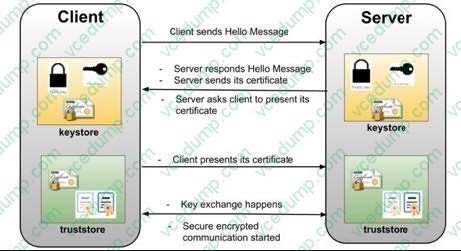
What requires configuration of both a key store and a trust store for an HTTP Listener?
A. Support for TLS mutual (two-way) authentication with HTTP clients
B. Encryption of requests to both subdomains and API resource endpoints fhttPs://aDi.customer.com/ and https://customer.com/api)
C. Encryption of both HTTP request and HTTP response bodies for all HTTP clients
D. Encryption of both HTTP request header and HTTP request body for all HTTP clients
Related Exams:
-
MCD-ASSOC
MuleSoft Certified Developer - Integration and API Associate (Mule 3) -
MCD-LEVEL1
MuleSoft Certified Developer - Level 1 (Mule 4) -
MCD-LEVEL1-DELTA
MuleSoft Certified Developer - Level 1 (Mule 4) DELTA -
MCD-LEVEL2
MuleSoft Certified Developer - Level 2 (Mule 4) -
MCIA-LEVEL1
MuleSoft Certified Integration Architect - Level 1 -
MCIA-LEVEL1-MAINTENANCE
MuleSoft Certified Integration Architect - Level 1 MAINTENANCE -
MCPA-LEVEL1
MuleSoft Certified Platform Architect - Level 1 -
MCPA-LEVEL1-MAINTENANCE
MuleSoft Certified Platform Architect - Level 1 MAINTENANCE
Tips on How to Prepare for the Exams
Nowadays, the certification exams become more and more important and required by more and more enterprises when applying for a job. But how to prepare for the exam effectively? How to prepare for the exam in a short time with less efforts? How to get a ideal result and how to find the most reliable resources? Here on Vcedump.com, you will find all the answers. Vcedump.com provide not only Mulesoft exam questions, answers and explanations but also complete assistance on your exam preparation and certification application. If you are confused on your MCIA-LEVEL1 exam preparations and Mulesoft certification application, do not hesitate to visit our Vcedump.com to find your solutions here.