MCIA-LEVEL1 Exam Details
-
Exam Code
:MCIA-LEVEL1 -
Exam Name
:MuleSoft Certified Integration Architect - Level 1 -
Certification
:Mulesoft Certifications -
Vendor
:Mulesoft -
Total Questions
:290 Q&As -
Last Updated
:Jul 08, 2026
Mulesoft MCIA-LEVEL1 Online Questions & Answers
-
Question 11:
An API client makes an HTTP request to an API gateway with an Accept header containing the value'' application''. What is a valid HTTP response payload for this request in the client requested data format?
A. healthy
B. {"status" "healthy"}
C. status(`healthy")
D. status: healthy -
Question 12:
A global organization operates datacenters in many countries. There are private network links between these datacenters because all business data (but NOT metadata) must be exchanged over these private network connections.
The organization does not currently use AWS in any way.
The strategic decision has Just been made to rigorously minimize IT operations effort and investment going forward.
What combination of deployment options of the Anypoint Platform control plane and runtime plane(s) best serves this organization at the start of this strategic journey?
A. MuleSoft-hosted Anypoint Platform control plane CloudHub Shared Worker Cloud in multiple AWS regions
B. Anypoint Platform - Private Cloud Edition Customer-hosted runtime plane in each datacenter
C. MuleSoft-hosted Anypoint Platform control plane Customer-hosted runtime plane in multiple AWS regions
D. MuleSoft-hosted Anypoint Platform control plane Customer-hosted runtime plane in each datacenter -
Question 13:
An architect is designing a Mule application to meet the following two requirements:
1.
The application must process files asynchronously and reliably from an FTPS server to a back-end database using VM intermediary queues for load-balancing Mule events.
2.
The application must process a medium rate of records from a source to a target system using a Batch Job scope.
To make the Mule application more reliable, the Mule application will be deployed to two CloudHub 1.0 workers.
Following MuleSoft-recommended best practices, how should the Mule application deployment typically be configured in Runtime Manger to best upport the performance and reliability goals of both the Batch Job scope and the file processing VM queues?
A. Check the Persistent VM queues checkbox in the application deployment configuration
B. Check the Non-persistent VM queues checkbox in the application deployment configuration
C. In the Runtime Manager Properties tab, disable persistent VM queues for Batch Job scopes
D. In the Runtime Manager Properties tab, enable persistent VM queues for the FTPS connector -
Question 14:
The ABC company has an Anypoint Runtime Fabric on VMs/Bare Metal (RTF-VM) appliance installed on its own customer-hosted AWS infrastructure.
Mule applications are deployed to this RTF-VM appliance. As part of the company standards, the Mule application logs must be forwarded to an external log management tool (LMT).
Given the company's current setup and requirements, what is the most idiomatic (used for its intended purpose) way to send Mule application logs to the external LMT?
A. In RTF-VM, install and configure the external LTM's log-forwarding agent
B. In RTF-VM, edit the pod configuration to automatically install and configure an Anypoint Monitoring agent
C. In each Mule application, configure custom Log4j settings
D. In RTF-VM. configure the out-of-the-box external log forwarder -
Question 15:
Refer to the exhibit.
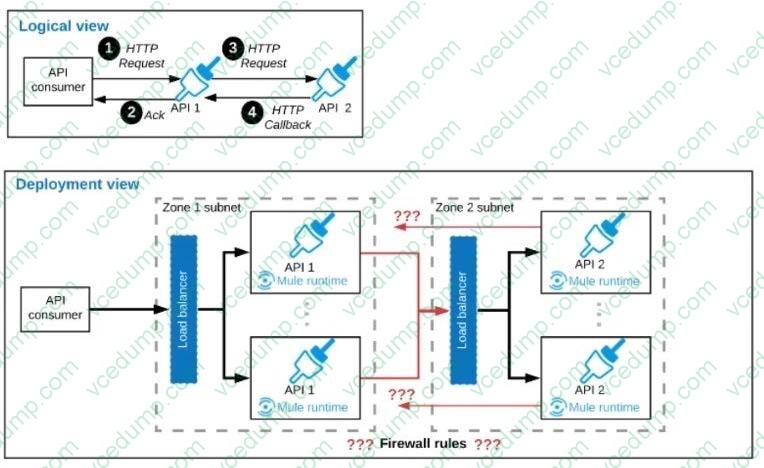
A business process involves two APIs that interact with each other asynchronously over HTTP. Each API is implemented as a Mule application. API 1 receives the initial HTTP request and invokes API 2 (in a fire and forget fashion) while API 2, upon completion of the processing, calls back into API l to notify about completion of the asynchronous process.
Each API Is deployed to multiple redundant Mule runtimes and a separate load balancer, and is deployed to a separate network zone.
In the network architecture, how must the firewall rules be configured to enable the above Interaction between API 1 and API 2?
A. To authorize the certificate to be used both APIs
B. To enable communication from each API's Mule Runtimes and Network zone to the load balancer of the other API
C. To open direct two-way communication between the Mule Runtimes of both API's
D. To allow communication between load balancers used by each API -
Question 16:
Additional nodes are being added to an existing customer-hosted Mule runtime cluster to improve performance. Mule applications deployed to this cluster are invoked by API clients through a load balancer.
What is also required to carry out this change?
A. A new load balancer must be provisioned to allow traffic to the new nodes in a round- robin fashion
B. External monitoring tools or log aggregators must be configured to recognize the new nodes
C. API implementations using an object store must be adjusted to recognize the new nodes and persist to them
D. New firewall rules must be configured to accommodate communication between API clients and the new nodes -
Question 17:
What is an advantage of using OAuth 2.0 client credentials and access tokens over only API keys for API authentication?
A. If the access token is compromised, the client credentials do not to be reissued.
B. If the access token is compromised, I can be exchanged for an API key.
C. If the client ID is compromised, it can be exchanged for an API key
D. If the client secret is compromised, the client credentials do not have to be reissued. -
Question 18:
An integration team uses Anypoint Platform and follows MuleSoft's recommended approach to full lifecycle API development. Which step should the team's API designer take before the API developers implement the AP! Specification?
A. Generate test cases using MUnit so the API developers can observe the results of running the API
B. Use the scaffolding capability of Anypoint Studio to create an API portal based on the API specification
C. Publish the API specification to Exchange and solicit feedback from the API's consumers
D. Use API Manager to version the API specification -
Question 19:
Mule application is deployed to Customer Hosted Runtime. Asynchronous logging was implemented to improved throughput of the system. But it was observed over the period of time that few of the important exception log messages which were used to rollback transactions are not working as expected causing huge loss to the Organization. Organization wants to avoid these losses. Application also has constraints due to which they cant compromise on throughput much. What is the possible option in this case?
A. Logging needs to be changed from asynchronous to synchronous
B. External log appender needs to be used in this case
C. Persistent memory storage should be used in such scenarios
D. Mixed configuration of asynchronous or synchronous loggers should be used to log exceptions via synchronous way -
Question 20:
According to the Internet Engineering Task Force (IETF), which supporting protocol does File Transfer Protocol (FTP) use for reliable communication?
A. A Secure Sockets Layer (SSL)
B. B Transmission Control Protocol (TCP)
C. Lightweight Directory Access Protocol (LDAP)
D. Hypertext Transfer Protocol (HTTP)
Related Exams:
-
MCD-ASSOC
MuleSoft Certified Developer - Integration and API Associate (Mule 3) -
MCD-LEVEL1
MuleSoft Certified Developer - Level 1 (Mule 4) -
MCD-LEVEL1-DELTA
MuleSoft Certified Developer - Level 1 (Mule 4) DELTA -
MCD-LEVEL2
MuleSoft Certified Developer - Level 2 (Mule 4) -
MCIA-LEVEL1
MuleSoft Certified Integration Architect - Level 1 -
MCIA-LEVEL1-MAINTENANCE
MuleSoft Certified Integration Architect - Level 1 MAINTENANCE -
MCPA-LEVEL1
MuleSoft Certified Platform Architect - Level 1 -
MCPA-LEVEL1-MAINTENANCE
MuleSoft Certified Platform Architect - Level 1 MAINTENANCE
Tips on How to Prepare for the Exams
Nowadays, the certification exams become more and more important and required by more and more enterprises when applying for a job. But how to prepare for the exam effectively? How to prepare for the exam in a short time with less efforts? How to get a ideal result and how to find the most reliable resources? Here on Vcedump.com, you will find all the answers. Vcedump.com provide not only Mulesoft exam questions, answers and explanations but also complete assistance on your exam preparation and certification application. If you are confused on your MCIA-LEVEL1 exam preparations and Mulesoft certification application, do not hesitate to visit our Vcedump.com to find your solutions here.