MCIA-LEVEL1 Exam Details
-
Exam Code
:MCIA-LEVEL1 -
Exam Name
:MuleSoft Certified Integration Architect - Level 1 -
Certification
:Mulesoft Certifications -
Vendor
:Mulesoft -
Total Questions
:290 Q&As -
Last Updated
:Jul 08, 2026
Mulesoft MCIA-LEVEL1 Online Questions & Answers
-
Question 241:
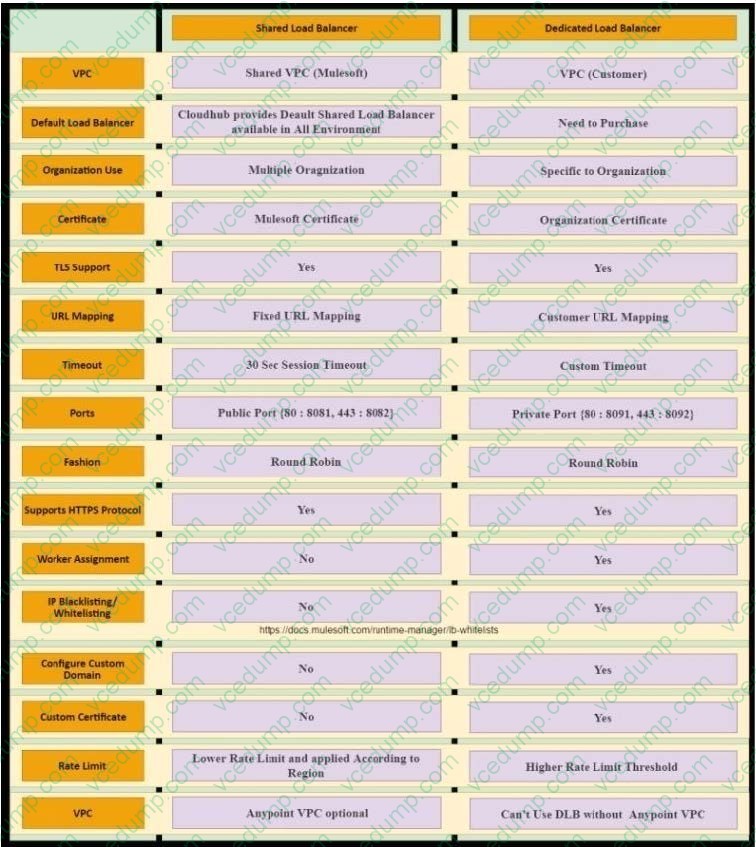
An organization is evaluating using the CloudHub shared Load Balancer (SLB) vs creating a CloudHub dedicated load balancer (DLB). They are evaluating how this choice affects the various types of certificates used by CloudHub deployed Mule applications, including MuleSoft-provided, customer-provided, or Mule application-provided certificates. What type of restrictions exist on the types of certificates for the service that can be exposed by the CloudHub Shared Load Balancer (SLB) to external web clients over the public internet?
A. Underlying Mule applications need to implement own certificates
B. Only MuleSoft provided certificates can be used for server side certificate
C. Only self signed certificates can be used
D. All certificates which can be used in shared load balancer need to get approved by raising support ticket -
Question 242:
An organization has just developed a Mule application that implements a REST API. The mule application will be deployed to a cluster of customer hosted Mule runtimes.
What additional infrastructure component must the customer provide in order to distribute inbound API requests across the Mule runtimes of the cluster?
A. A message broker
B. An HTTP Load Balancer
C. A database
D. An Object Store -
Question 243:
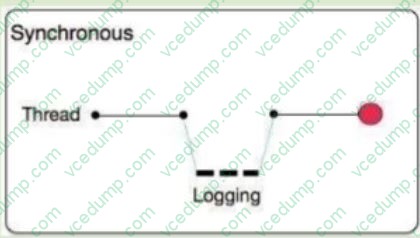
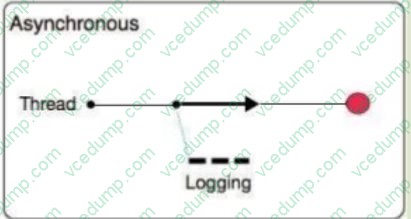
What is a key difference between synchronous and asynchronous logging from Mule applications?
A. Synchronous logging writes log messages in a single logging thread but does not block the Mule event being processed by the next event processor
B. Asynchronous logging can improve Mule event processing throughput while also reducing the processing time for each Mule event
C. Asynchronous logging produces more reliable audit trails with more accurate timestamps
D. Synchronous logging within an ongoing transaction writes log messages in the same thread that processes the current Mule event -
Question 244:
An organization requires that all Mule applications deployed to customer-hosted runtimes be highly available and able to scale horizontally. What deployment architecture best satisfies this requirement?
A. Single Mule runtime with vertical scaling
B. Mule runtime deployed in standalone mode with backups
C. Multi-node Mule runtime cluster behind a load balancer
D. CloudHub with a single worker -
Question 245:
A company is building an application network and has deployed four Mule APIs: one experience API, one process API, and two system APIs. The logs from all the APIs are aggregated in an external log aggregation tool. The company wants to trace messages that are exchanged between multiple API implementations. What is the most idiomatic (based on its intended use) identifier that should be used to implement Mule event tracing across the multiple API implementations?
A. Mule event ID
B. Mule correlation ID
C. Client's IP address
D. DataWeave UUID -
Question 246:
Following MuleSoft best practices, what MuleSoft runtime deployment option best meets the company's goals to begin its digital transformation journey?
A. Runtime Fabric on VMs/bare metal
B. CloudHub runtimes
C. Customer-hosted runtimes provisioned by a MuleSoft services partner
D. Customer-hosted self-provisioned runtimes -
Question 247:
An organization currently uses a multi-node Mule runtime deployment model within their datacenter, so each Mule runtime hosts several Mule applications. The organization is planning to transition to a deployment model based on Docker containers in a Kubernetes cluster. The organization has already created a standard Docker image containing a Mule runtime and all required dependencies (including a JVM), but excluding the Mule application itself.
What is an expected outcome of this transition to container-based Mule application deployments?
A. Required redesign of Mule applications to follow microservice architecture principles
B. Required migration to the Docker and Kubernetes-based Anypoint Platform - Private Cloud Edition
C. Required change to the URL endpoints used by clients to send requests to the Mule applications
D. Guaranteed consistency of execution environments across all deployments of a Mule application -
Question 248:
An Organization has previously provisioned its own AWS VPC hosting various servers. The organization now needs to use Cloudhub to host a Mule application that will implement a REST API once deployed to Cloudhub, this Mule application must be able to communicate securely with the customer-provisioned AWS VPC resources within the same region, without being interceptable on the public internet. What Anypoint Platform features should be used to meet these network communication requirements between Cloudhub and the existing customer-provisioned AWS VPC?
A. Add a Mulesoft hosted Anypoint VPC configured and with VPC Peering to the AWS VPC
B. Configure an external identity provider (IDP) in Anypoint Platform with certificates from the customer provisioned AWS VPC
C. Add a default API Whitelisting policy to API Manager to automatically whitelist the customer provisioned AWS VPC IP ranges needed by the Mule applicaton
D. Use VM queues in the Mule application to allow any non-mule assets within the customer provisioned AWS VPC to subscribed to and receive messages -
Question 249:
A popular retailer is designing a public API for its numerous business partners. Each business partner will invoke the API at the URL 58. https://api.acme.com/partnefs/vl. The API implementation is estimated to require deployment to 5 CloudHub workers.
The retailer has obtained a public X.509 certificate for the name apl.acme.com, signed by a reputable CA, to be used as the server certificate.
Where and how should the X.509 certificate and Mule applications be used to configure load balancing among the 5 CloudHub workers, and what DNS entries should be configured in order for the retailer to support its numerous business partners?
A. Add the X.509 certificate to the Mule application's deployable archive, then configure a CloudHub Dedicated Load Balancer (DLB) for each of the Mule application's CloudHub workers Create a CNAME for api.acme.com pointing to the DLB's A record
B. Add the X.509 certificate to the CloudHub Shared Load Balancer (SLB), not to the Mule application Create a CNAME for api.acme.com pointing to the SLB's A record
C. Add the X.509 certificate to a CloudHub Dedicated Load Balancer (DLB), not to the Mule application Create a CNAME for api.acme.com pointing to the DLB's A record
D. Add the x.509 certificate to the Mule application's deployable archive, then configure the CloudHub Shared Load Balancer (SLB) for each of the Mule application's CloudHub workers Create a CNAME for api.acme.com pointing to the SLB's A record -
Question 250:
In Anypoint Platform, a company wants to configure multiple identity providers(Idps) for various lines of business (LOBs) Multiple business groups and environments have been defined for the these LOBs. What Anypoint Platform feature can use multiple Idps access the company's business groups and environment?
A. User management
B. Roles and permissions
C. Dedicated load balancers
D. Client Management
Related Exams:
-
MCD-ASSOC
MuleSoft Certified Developer - Integration and API Associate (Mule 3) -
MCD-LEVEL1
MuleSoft Certified Developer - Level 1 (Mule 4) -
MCD-LEVEL1-DELTA
MuleSoft Certified Developer - Level 1 (Mule 4) DELTA -
MCD-LEVEL2
MuleSoft Certified Developer - Level 2 (Mule 4) -
MCIA-LEVEL1
MuleSoft Certified Integration Architect - Level 1 -
MCIA-LEVEL1-MAINTENANCE
MuleSoft Certified Integration Architect - Level 1 MAINTENANCE -
MCPA-LEVEL1
MuleSoft Certified Platform Architect - Level 1 -
MCPA-LEVEL1-MAINTENANCE
MuleSoft Certified Platform Architect - Level 1 MAINTENANCE
Tips on How to Prepare for the Exams
Nowadays, the certification exams become more and more important and required by more and more enterprises when applying for a job. But how to prepare for the exam effectively? How to prepare for the exam in a short time with less efforts? How to get a ideal result and how to find the most reliable resources? Here on Vcedump.com, you will find all the answers. Vcedump.com provide not only Mulesoft exam questions, answers and explanations but also complete assistance on your exam preparation and certification application. If you are confused on your MCIA-LEVEL1 exam preparations and Mulesoft certification application, do not hesitate to visit our Vcedump.com to find your solutions here.