MCAT-TEST Exam Details
-
Exam Code
:MCAT-TEST -
Exam Name
:Medical College Admission Test: Verbal Reasoning, Biological Sciences, Physical Sciences, Writing Sample -
Certification
:Medical Tests Certifications -
Vendor
:Medical Tests -
Total Questions
:812 Q&As -
Last Updated
:
Medical Tests MCAT-TEST Online Questions & Answers
-
Question 721:
Fireworks have been used for centuries in celebrations around the world. One of the primary components of these devices, black powder, was developed by the Chinese over a thousand years ago and is still used today as a propellant and explosive. Black powder is composed of potassium nitrate (KNO3), charcoal (primarily C) and sulfur (S8) in a 75:15:10 ratio by weight. It is very stable if kept dry but can easily be ignited by a spark or burning fuse to undergo the following reaction: Reaction 1 The basic firework is shown in Figure 1. Fireworks rely on a particular kind of combustion in which oxygen is supplied by oxidizing agents included in the pyrotechnic mixture. When ignited, the solid propellant begins to liquefy and vaporize allowing the fuel and oxidizing agents to interact more intimately leading to rapid expansion of gases. Delay fuses time the ignition of the other compartments to occur when the shell is high above ground.

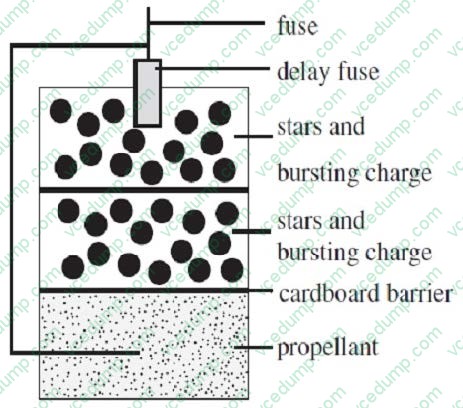
Figure 1
The light generating units of the firework are called stars and are dispersed and ignited by the bursting charge in each compartment. The intense colors of modern fireworks are generated by molecular emitters. For example, barium chloride emits green light (510?30 nm) and strontium chloride emits vibrant red light (605?50 nm). Many of the molecular emitters are unstable at room temperature and so cannot be placed directly into the firework. Instead, they are synthesized in the flame of the pyrotechnic reaction and exist for a short time before decomposing. The flame temperature must be carefully adjusted so that these emitters do not decompose too rapidly.

Flares, a particular kind of pyrotechnic device, can burn underwater. Most materials, like wood, cannot burn underwater. Which of the following provides the best explanation for this difference?
A. The combustion of wood has a lower H.
B. Flares have a lower ignition temperature and can be easily ignited by a spark or fuse.
C. Combustion of wood requires oxygen which is not provided by water.
D. Water is a powerful flame retardant that extinguishes flames by increasing the activation energy of combustion. -
Question 722:
Many nutrients required by plants exist in soil as basic cations:

A soil's cation-exchange capacity is a measure of its ability to adsorb these basic cations as well as exchangeable hydrogen and aluminum ions. The cation-exchange capacity of soil is derived from two sources: small clay particles called micelles consisting of alternating layers of alumina and silica crystals, and organic colloids.

Replacement of + and + by other cations of lower valence creates a net negative charge within the inner layers of the micelles. This is called the soil's permanent charge. For example, replacement of an atom of aluminum by calcium within a section where the net charge was previously zero, as shown below, produces a net charge of ?, to which other cations can become adsorbed.

Figure 1
A pH-dependent charge develops when hydrogen dissociates from hydroxyl moieties on the outer surfaces of the clay micelles. This leaves negatively-charged oxygen atoms to which basic cations may adsorb. Likewise, a large pH-
dependent charge develops when hydrogen dissociates from carboxylic acids and phenols in organic matter.
In most clays, permanent charges brought about by substitution account for anywhere from half to nearly all of the total cation-exchange capacity. Soils very high in organic matter contain primarily pH-dependent charges. In a research study,
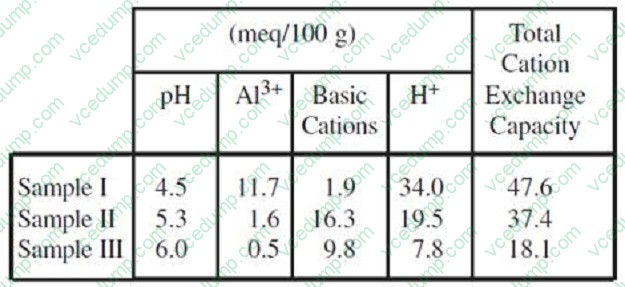
three samples of soil were leached with a 1 N solution of neutral KCl, and the displaced A13+ and basic cations measured. The sample was then leached again with a buffered solution of BaCl2 and triethanolamine at pH 8.2, and the
displaced H+ measured. Table 1 gives results for three soils tested by this method.
Table 1
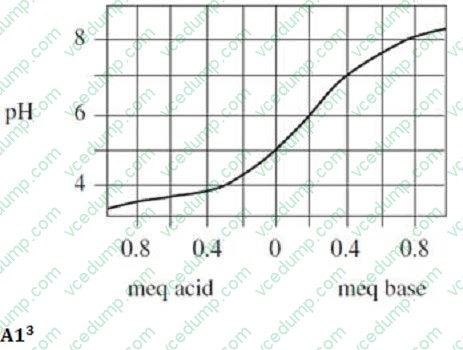
Due to the buffering effect of the soil's cationexchange capacity, just measuring the soil solution's pH will not indicate how much base is needed to change the soil pH. In another experiment, measured amounts of acid and base were added to 10-gram samples of well-mixed soil that had been collected from various locations in a field. The volumes of the samples were equalized by adding water. The results were recorded in Figure 2.
Figure 2.
Which of the following would probably NOT displace + in soil micelles?
A. Option A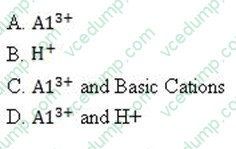
B. Option B
C. Option C
D. Option D -
Question 723:
Several models have been developed for relating changes in dissociation constants to changes in the tertiary and quaternary structures of oligomeric proteins. One model suggests that the protein's subunits can exist in either of two distinct conformations, R and T. At equilibrium, there are few R conformation molecules: 10 000 T to 1 R and it is an important feature of the enzyme that this ratio does not change. The substrate is assumed to bind more tightly to the R form than to the T form, which means that binding of the substrate favors the transition from the T conformation to R.
The conformational transitions of the individual subunits are assumed to be tightly linked, so that if one subunit flips from T to R the others must do the same. The binding of the first molecule of substrate thus promotes the binding of the second and if substrate is added continuously, all of the enzyme will be in the R form and act on the substrate. Because the concerted transition of all of the subunits from T to R or back, preserves the overall symmetry of the protein, this model is called the symmetry model. The model further predicts that allosteric activating enzymes make the R conformation even more reactive with the substrate while allosteric inhibitors react with the T conformation so that most of the enzyme is held back in the T shape.
Experiment Evaluating Non-Symmetry Model Enzymes
Experiments were performed with enzyme conformers that did not obey the symmetry model. The data is summarized in Figure 1.
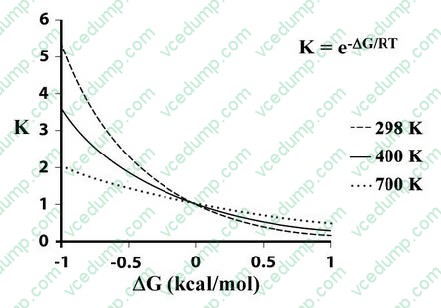
Figure 1: Equilibrium distribution of two conformers at different temperatures given the free energy of their interconversion. (modified from Mr.Holmium). All of the following statements are consistent with Figure 1 EXCEPT:
A. the products must have less free energy than the reactants in the exergonic reactions at the various temperatures.
B. the equation for the equilibrium constant K used to construct the graph is derived from G = -RT ln K
C. the 3 different temperature curves intersect at a point where the reaction is at equilibrium.
D. higher temperatures favor relatively more of the more stable conformer. -
Question 724:
How many electrons can fit into the third shell of an atom?
A. 16
B. 4
C. 2
D. 18 -
Question 725:
The correct formula of 'Plaster of Paris' is:
A. CaSO4H2O
B. CaSO42H2O
C. CaSO43H2O
D. CaSO4. 紿2O -
Question 726:
The kinetic molecular theory describes gases as composed of randomly moving particles. According to this theory, at constant temperature, the pressure of a gas in a cylinder increases when the volume is decreased because:
A. the kinetic energy of the gas increases.
B. the collisions of gas particles with the cylinder become more energetic.
C. the mass of the particles increases to compensate for the decrease in volume.
D. the collisions of gas particles with the cylinder increase in frequency. -
Question 727:
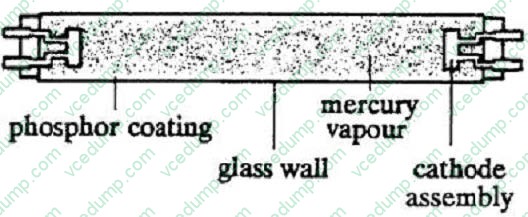
When light in the ultraviolet region of the spectrum is shone on a type of material known as a phosphor, it fluoresces and emits light in the visible region of the spectrum. Lamps that utilize this property, known as fluorescent lamps, are very efficient light sources. The arrangement of a typical fluorescent lamp is shown below. The lamp is a glass tube whose inside walls are covered with a phosphor. The tube has an appreciable length-to-diameter ratio so as to reduce the power losses at each end, and it is filled with argon gas mixed with mercury vapor. Inside each end of the tube are tungsten electrodes covered with an emission material.
Electrons are liberated at the cathode and accelerated by an applied electric field. These free electrons encounter the gas mixture, ionizing some mercury atoms and exciting others. Since it requires more energy to ionize the atoms than to excite the electrons, more excitation than ionization occurs. When the excited electrons revert to their ground state, they radiate ultraviolet photons with a wavelength of 253.7 nm. These photons impinge on the phosphor coating of the tube and excite electrons in the phosphor to higher energy states. The excited electrons in the phosphor return to their ground state in two or more steps, producing radiation in the visible region of the spectrum. Not every fluorescent lamp emits the same color of radiation; the color is dependent on the relative percentages of different heavy metal compounds in the phosphor.
The fluorescent lamp shown operates at 100 volts and draws 400 milliamps of current during normal operation. Of the total power that the lamp consumes, only 25% is converted to light, while the remaining 75% is dissipated as heat. This energy keeps the lamp at its optimum working temperature of 40°C. In the lamp shown, the phosphor coating is calcium metasilicate, which emits orange to yellow light.
If the fluorescent light is left on for 4 hours, how much useful energy is emitted as light?
A. 144 kJ
B. 432 kJ
C. 576 kJ
D. 900 kJ -
Question 728:
At a recent meeting of the American Public Transit Association, the Environmental Protection Agency unveiled stringent new standards for pollution control. The transit authorities were particularly concerned about the implementation of a proposed "Clean Air Act." They believed the provisions of the Clean Air Act could severely affect basic services to their local communities. Many transit agencies were concerned that it would be difficult to comply with the pollution and emissions control standards while continuing to operate within realistic budgets. The aim of the Clean Air Act is to assure that by the year 2000, there will be a reduction of at least 10 million tons of sulfur dioxide from 1980 levels. The bill also calls for a reduction in pollutants that contribute to the depletion of ozone. Strict regulations of toxic air emissions would have to be established and enforced. Additionally, the Clean Air Act would establish specific acid-rain reduction quotas and enforce severe penalties for transgressors of any of the new clean air regulations. There is little doubt that mass-transit suppliers will be considerably affected by this new legislation, just as the chemical and petroleum industries have already been affected by similar legislation. Transit authorities are challenged to strike a difficult balance between complying with the government's new standards and developing an official concern for the environment, while continuing to fulfill the transportation needs of the general population. Among the areas addressed by the Clean Air Act, the topic of mobile resources is of particular interest to mass transit authorities. Provisions contained in the Act under this title are aimed at encouraging the development and practical use of alternative fuel sources, like solar energy and methane fuel. The goal of this section of the Act is to eradicate toxic fuel emissions in order to provide cleaner air and a more favorable environment. The Act even goes so far as to declare that in cities like New York, Los Angeles and Houston -- where air quality is particularly noxious and toxins exceed the limits of federal regulations -- forms of mass transit should run on so-called "clean-burning fuels" by the year 2000. Such fuels include reformulated gasoline, propane, electricity, natural gas, ethanol, methanol, or any similar type of low-emission fuel. In addition, the Act proposes that, by 1994, all new urban buses in cities with populations exceeding one million must operate solely on clean-burning fuels. The topics of alternative fuels and alternative fuel vehicles represent, by far, the most controversial issue in the Clean Air Act. President Bush has called alternative fuels "bold and innovative" means to control pollution, but according to many transportation experts, the Act's proposals on alternative fuel usage are unrealistic. The transit authorities recognize that concern for the environment and health hazards like pollution are global issues. However, most transit officials concur that inventing and developing new ways to fuel mass transit will take at least 50 years to realize. They point out that the Act does not mention the political and social ramifications of usurping the role of the petroleum industries. The Act does not mention if or how the thousands of people employed by the oil industry will get retrained to produce and implement the use of "clean" fuel. No one disputes the fact that people need some form of transportation to get from place to place. Preserving the environment should be a priority, yet we need to remember that even if toxic emissions are completely eliminated sometime in the future, the challenge of moving mass numbers of people where they want to go will still exist and must remain a priority. Transit authorities contend that unless the Clean Air Act also acknowledges this, and develops a way to encourage mass transit over personal transportation, the problems of pollution might not be significantly altered. They suggest that there are many areas in this country that have little or no mass transit and that, if the Clean Air Act's goal is to reduce pollution, perhaps the most practical and realistic means to achieve that goal is to encourage the development and maintenance of mass transit systems.
According to the passage, the main goal of the Clear Air Act was to:
A. make sure that pollution was completely eradicated by the year 2000.
B. reduce the amount of sulfur dioxide levels in the air by at least 10 million tons from 1980s levels.
C. eliminate all pollution.
D. enforce harsh penalties for transgressors of any of the new clean air regulations. -
Question 729:
Artificial kidneys have been used for almost 50 years to treat patients with different forms of renal failure. The artificial kidney (dialysis machine) removes unwanted substances from the blood by diffusion. A patient's blood is passed through channels bounded by a porous, semi-permeable membrane that allows the free diffusion in both directions of all plasma constituents except the plasma proteins. Erythrocytes and other cellular components of blood cannot pass through the membrane. The other side of the membrane is exposed to the dialyzing fluid which carries away the unwanted materials. If the concentration of a material in the blood is greater than in the dialyzing fluid, there will be a net flow of the material from the plasma to the dialyzing fluid. If the concentration of a material in the blood is less than in the dialyzing fluid, there will be a net flow of the material from the dialyzing fluid into the blood. The composition of normal plasma, plasma in an individual suffering renal failure, and dialyzing fluid are shown in Table 1.
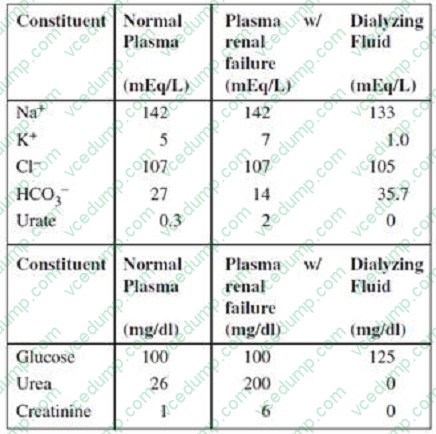
Table 1
Dialysis replaces some functions of the kidneys and attempts to correct the effects of renal failure. For example, patients with renal failure develop acidosis due to a buildup of metabolically produced acids in the circulation. Without dialysis,
the pH of the blood will drop and coma may occur. Dialyzing fluid contains a relatively high concentration of bicarbonate which diffuses into the circulation and neutralizes the acid.
In order to prevent the net movement of water between the blood and the dialyzing fluid, the dialyzing fluid:
A. is hypoosmotic to blood.
B. is isoosmotic to blood.
C. contains a higher concentration of solutes than blood.
D. contains hydrophilic proteins. -
Question 730:
The Russian wheat aphid, Diuraphis noxia, is a small green insect discovered in southern Russia around the turn of the century. Agricultural researchers are not quite sure, but they believe the Russian aphid adapted itself to wheat about ten thousand years ago, when the crop was first domesticated by man. What is not in doubt is the insect's destructiveness. Spread by both wind and human transport, the Russian aphid has destroyed wheat fields throughout Asia, Africa, and Latin America. Until a few years ago, the United States had been free of this pest. But in the spring of 1986, a swarm of Russian aphids crossed the Mexican border and settled a few hundred miles north, in central Texas. From there, it quickly spread to other Western states, destroying wheat fields all along its path. In fact, the level of destruction has been so great over the past five years that entomologists are calling the Russian aphid the greatest threat to American agriculture since the Hessian fly, Phytophaga destructor, was inadvertently brought to the colonies on ships by German mercenary troops during the Revolutionary War. A combination of several factors have made it particularly difficult to deal with the threat posed by this aphid. First, Russian aphids reproduce asexually at a phenomenal rate. This process, known as parthenogenesis, often results in as many as twenty generations of insects in a single year. Although most generations remain in a limited geographic area because they have no wings, a few generations are born with wings, allowing the insect to spread to new areas. Second, because wheat is a crop with a very low profit margin, most American farmers do not spray it with pesticides; it simply is not economical to do so. And since the Russian aphid has only recently entered the United States, it has no natural enemies among North American insects or animals. As a result, there have been no man-made or natural obstacles to the spread of the Russian aphid in the United States. Agricultural researchers seeking to control the Russian aphid have looked to its place of origin for answers. In the Soviet Union, the Russian aphid has been kept in check by predators which have evolved alongside it over many thousands of years. One species of wasp seems to be particularly efficient at destroying the aphid. The pregnant females of the species search the Russian aphid's home, the interior of a wheat stalk, sting the aphid into paralysis, and then inject an egg into its body. When the egg hatches the wasp larva feeds off of the aphid, killing it in the process.
The introduction of predators like the wasp, coupled with the breeding of new strains of insect-resistant wheat, may substantially curb the destructiveness of the Russian aphid in the future. For the time being, however, American farmers are left to their own devices when it comes to protecting their wheat crops
According to the passage, the Russian wheat aphid and the Hessian fly are comparable with respect to:
I. the amount of destruction they have caused.
II. the means by which they reproduce.
III.
the ways in which they entered the United States.
A. I only
B. II only
C. I and II only
D. I and III only
I. the amount of destruction they have caused. II. the means by which they reproduce. III. the ways in which they entered the United States.
Related Exams:
Tips on How to Prepare for the Exams
Nowadays, the certification exams become more and more important and required by more and more enterprises when applying for a job. But how to prepare for the exam effectively? How to prepare for the exam in a short time with less efforts? How to get a ideal result and how to find the most reliable resources? Here on Vcedump.com, you will find all the answers. Vcedump.com provide not only Medical Tests exam questions, answers and explanations but also complete assistance on your exam preparation and certification application. If you are confused on your MCAT-TEST exam preparations and Medical Tests certification application, do not hesitate to visit our Vcedump.com to find your solutions here.