MCAT-TEST Exam Details
-
Exam Code
:MCAT-TEST -
Exam Name
:Medical College Admission Test: Verbal Reasoning, Biological Sciences, Physical Sciences, Writing Sample -
Certification
:Medical Tests Certifications -
Vendor
:Medical Tests -
Total Questions
:812 Q&As -
Last Updated
:Jul 16, 2026
Medical Tests MCAT-TEST Online Questions & Answers
-
Question 621:
Although we know more about so-called Neanderthal men than about any other early population, their exact relation to present-day human beings remains unclear. Long considered sub-human, Neanderthals are now known to have been fully human. They walked erect, used fire, and made a variety of tools. They lived partly in the open and partly in caves. The Neanderthals are even thought to have been the first humans to bury their dead, a practice which has been interpreted as demonstrating the capacity for religious and abstract thought. The first monograph on Neanderthal anatomy, published by Marcelling Boule in 1913, presented a somewhat misleading picture. Boule took the Neanderthals' lowvaulted cranium and prominent brow ridges, their heavy musculature, and the apparent overdevelopment of certain joints as evidence of a prehuman physical appearance. In postulating for the Neanderthal such "primitive" characteristics as a stooping, bent-kneed posture, a rolling gait, and a forward-hanging head, Boule was a victim of the rudimentary state of anatomical science. Modern anthropologists recognize the Neanderthal bone structure as that of a creature whose bodily orientation and capacities were very similar to those of present-day human beings. The differences in the size and shape of the limbs, shoulder blades, and other body parts are simply adaptations which were necessary to handle the Neanderthal's far more massive musculature. Current taxonomy considers the Neanderthals to have been fully human and thus designates them not as a separate species, Homo neanderthalensis, but as a subspecies of Homo sapiens: Homo sapiens neanderthalensis. The rise of the Neanderthals occurred over some 100,000 years -- a sufficient period to account for evolution of the specifically Neanderthal characteristics through free interbreeding over a broad geographical range. Fossil evidence suggests that the Neanderthals inhabited a vast area from Europe through the Middle East and into Central Asia from approximately 100,000 years ago until 35,000 years ago. Then, within a brief period of five to ten thousand years, they disappeared. Modern human, not found in Europe prior to about 33,000 years ago, thenceforth became the sole inhabitants of the region. Anthropologists do not believe that the Neanderthals evolved into modern human beings. Despite the similarities between Neanderthal and modern human anatomy, the differences are great enough that, among a population as broad-ranging as the Neanderthals, such an evolution could not have taken place in a period of only ten thousand years. Furthermore, no fossils of types intermediate between Neanderthals and moderns have been found. A major alternative hypothesis, advanced by E. Trinkaus and W.W. Howells, is that of localized evolution. Within a geographically concentrated population, free interbreeding could have produced far more pronounced genetic effects within a shorter time. Thus modern human could have evolved relatively quickly, either from Neanderthals or from some other ancestral type, in isolation from the main Neanderthal population. These humans may have migrated throughout the Neanderthal areas, where they displaced or absorbed the original inhabitants. One hypothesis suggests that these "modern" humans immigrated to Europe from the Middle East. No satisfactory explanation of why modern human beings replaced the Neanderthals has yet been found. Some have speculated that the modern humans wiped out the Neanderthals in warfare; however, there exists no archeological evidence of a hostile encounter. It has also been suggested that the Neanderthals failed to adapt to the onset of the last Ice Age; yet their thick bodies should have been heat-conserving and thus well-adapted to extreme cold. Finally, it is possible that the improved tools and hunting implements of the late Neanderthal period made the powerful Neanderthal physique less of an advantage than it had been previously. At the same time, the Neanderthals' need for a heavy diet to sustain this physique put them at a disadvantage compared to the less massive moderns. If this was the case, then it was improvements in human culture -- including some introduced by the Neanderthals themselves -- that made the Neanderthal obsolete.
By inference from the passage, the most important evidence that Neanderthals did NOT evolve into modern humans is the:
A. major anatomical differences between Neanderthals and modern humans.
B. brief time in which Neanderthals disappeared.
C. difference in the geographical ranges of Neanderthals and modern humans.
D. gap of many thousands of years between the age of the latest Neanderthal fossils and that of the earliest modern human fossils. -
Question 622:
Artificial kidneys have been used for almost 50 years to treat patients with different forms of renal failure. The artificial kidney (dialysis machine) removes unwanted substances from the blood by diffusion. A patient's blood is passed through channels bounded by a porous, semi-permeable membrane that allows the free diffusion in both directions of all plasma constituents except the plasma proteins. Erythrocytes and other cellular components of blood cannot pass through the membrane. The other side of the membrane is exposed to the dialyzing fluid which carries away the unwanted materials. If the concentration of a material in the blood is greater than in the dialyzing fluid, there will be a net flow of the material from the plasma to the dialyzing fluid. If the concentration of a material in the blood is less than in the dialyzing fluid, there will be a net flow of the material from the dialyzing fluid into the blood. The composition of normal plasma, plasma in an individual suffering renal failure, and dialyzing fluid are shown in Table 1.
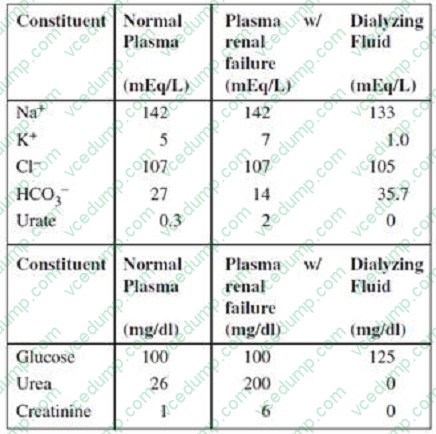
Table 1
Dialysis replaces some functions of the kidneys and attempts to correct the effects of renal failure. For example, patients with renal failure develop acidosis due to a buildup of metabolically produced acids in the circulation. Without dialysis, the pH of the blood will drop and coma may occur. Dialyzing fluid contains a relatively high concentration of bicarbonate which diffuses into the circulation and neutralizes the acid.
All of the following are removed from the plasma by dialysis EXCEPT:
A. Na+
B. K+
C. Urea
D. Glucose -
Question 623:
Each of the following are aspects of the McDonaldization of Society EXCEPT:
A. Rationalization of decisions into cost/benefit analysis structures and away from traditional modes of thinking
B. Bureaucratic organization that formalizes well-establish division of labor and impersonal structures
C. A dissolution of hierarchical modes of authority into collaborative team-based decision protocols
D. An intense effort on achieving sameness across diverse markets -
Question 624:
Light traveling from air into a new medium is refracted away from the normal. This medium might be:
A. glass.
B. water.
C. steel.
D. a vacuum. -
Question 625:
In an experiment to study frictional forces, a student attached a spring scale to identical bricks wrapped in different kinds of paper: brown paper, waxed paper and sand paper. Holding the spring scale, the student pulled the bricks across a table and measured the force required to pull the bricks across the table. The student wrapped the bricks in different paper to change the frictional forces between which two objects?
A. The bricks and the spring scale.
B. The paper and the bricks.
C. The wrapped bricks and the table.
D. None of these. -
Question 626:
How much average force should be applied to 2500 Kg car, having velocity of 30 m/s, in order to stop the in 15 seconds?
A. 1000 N
B. 6000 N
C. 5000 N
D. 8000 N -
Question 627:
Just as the ingestion of nutrients is mandatory for human life, so is the excretion of metabolic waste products. One of these nutrients, protein, is used for building muscle, nucleic acids, and countless compounds integral to homeostasis. However, the catabolism of the amino acids generated from protein digestion produces ammonia, which, if not further degraded, can become toxic. Similarly, if the same salts that provide energy and chemical balance to cells are in excess, fluid retention will occur, damaging the circulatory, cardiac, and pulmonary systems.
One of the most important homeostatic organs is the kidney, which closely regulates the excretion and reabsorption of many essential ions and molecules. One mechanism of renal function involves the secretion of antidiuretic hormone (ADH).
Diabetes insipidus (DI), is the condition that occurs when ADH is ineffective. As a result, the kidneys are unable to concentrate urine, leading to excessive water loss. There are two types of DI -- central and nephrogenic. Central DI occurs when there is a deficiency in the quantity or quality of ADH produced. Nephrogenic DI occurs when the kidney tubules are unresponsive to ADH. To differentiate between these two conditions, a patient's urine osmolarity is measured both prior to therapy and after a 24-hour restriction on fluid intake. Exogenous ADH is then administered and urine osmolarity is measured again. The table below gives the results of testing on four patients. Assume that a urine osmolarity of 285 mOsm/L of H2O is normal.
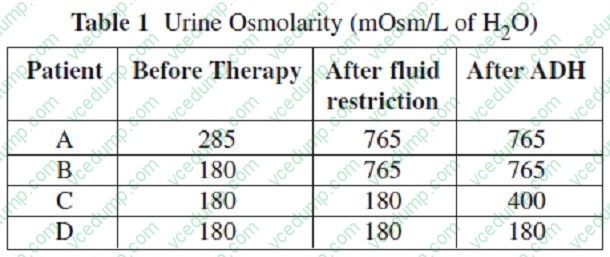
What is the most likely cause of Patient B's dilute urine before therapy?
A. Excessive water intake
B. Dehydration
C. Nephrogenic DI
D. Central DI -
Question 628:
Exocrine secretions of the pancreas:
A. raise blood glucose levels.
B. lower blood glucose levels.
C. regulate metabolic rate.
D. aid in protein and fat digestion. -
Question 629:
Early experimentation on the single-celled organism Acetabularia led to important discoveries about the role of the nucleus in regulating cell function. Acetabularia is an enormous single cell with three distinct regions: a cap, a root-like rhizoid, and a stalk which connects the two. The following experiments were conducted to study the development of the cell:
Experiment 1
The stalk of an Acetabularia was cut, fragmenting the cell. The fragment which included the cap died shortly afterwards while the fragment containing the rhizoid regenerated to form a complete Acetabularia.
Experiment 2
The nucleus from Acetabularia mediterranea, which has a flat cap, was transplanted into Acetabularia crenulata, which has a tufted cap, following removal of the Acetabularia crenulata nucleus. The Acetabularia crenulata cap eventually assumed the flat shape.
Experiment 3
The nucleus of Acetabularia mediterranea was removed from the young cell before it first formed a cap. A normal cap formed several weeks later. The cell proved to be inviable and died shortly thereafter.
Experiment 4
A young Acetabularia was fractioned into a number of portions before it first formed a cap. Several weeks later, both the portion containing the nucleus and the portion containing the apical tip of the stalk formed caps. The other portions did not form caps.
Which of the following conclusions can be logically drawn from the fact that the Acetabularia segment containing the rhizoid regenerated a complete and viable Acetabularia in Experiment 1?
A. The cell nucleus is located in the rhizoid.
B. Acetabularia reproduces by budding.
C. The Acetabularia cap is a vestigial structure.
D. Cap-coding mRNA is stored in the rhizoid. -
Question 630:
A researcher investigated the equilibrium between CO2, C, and CO as a function of temperature. The equation is given below:

CO2(g) + C(s) 2 CO(g) Carbon dioxide, at 298 K and 1 atm, and an excess of powdered carbon were introduced into a furnace, which was then sealed so that pressure would increase as the temperature rose. The furnace was heated to, and held constant at, a predetermined temperature. The pressure within the furnace chamber was recorded after it had remained unchanged for one hour. The table below shows the pressures recorded for a series of temperatures together with the pressures expected if no reaction had taken place. Table 1
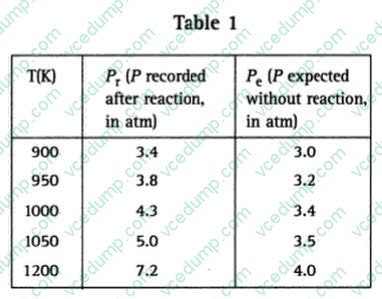
What can be said about the value of S?of the reaction?
A. It is positive.
B. It is negative.
C. It is zero.
D. It cannot be determined from the information given.
Related Exams:
Tips on How to Prepare for the Exams
Nowadays, the certification exams become more and more important and required by more and more enterprises when applying for a job. But how to prepare for the exam effectively? How to prepare for the exam in a short time with less efforts? How to get a ideal result and how to find the most reliable resources? Here on Vcedump.com, you will find all the answers. Vcedump.com provide not only Medical Tests exam questions, answers and explanations but also complete assistance on your exam preparation and certification application. If you are confused on your MCAT-TEST exam preparations and Medical Tests certification application, do not hesitate to visit our Vcedump.com to find your solutions here.