MCAT-TEST Exam Details
-
Exam Code
:MCAT-TEST -
Exam Name
:Medical College Admission Test: Verbal Reasoning, Biological Sciences, Physical Sciences, Writing Sample -
Certification
:Medical Tests Certifications -
Vendor
:Medical Tests -
Total Questions
:812 Q&As -
Last Updated
:Jul 16, 2026
Medical Tests MCAT-TEST Online Questions & Answers
-
Question 611:
...[TV Guide's] immediate concern was the television quiz show scandal, which had reached its climax two weeks earlier when Charles Van Doren, the appealing young man who'd taught viewers the value of learning while winning big on MCA's Twenty-one, stood before a House committee and admitted he was a fraud. But the issue went well beyond rigged quiz shows. The charge was that through their stranglehold on talent, MCA and William Morris monopolized the medium to the detriment of their clients, the industry, and the public at large. This was why the Justice Department had launched a secret investigation of both agencies more than two years before. The Morris Agency had started the quiz show vogue in 1955, when it packaged The $64,000 Question for Revlon and sold it to CBS. While the show won praise for its "educational" nature, the real source of its appeal was in its crapshoot format -- the idea that once contestants' winnings hit the $32,000 mark, they had to decide whether to go double or nothing on the final, $64,000 question, or play it safe and go home. The response was tremendous. Within weeks, the show knocked I Love Lucy out of the number-one slot in the ratings. Casinos in Vegas emptied out when it went on the air. Bookies took odds on whether the first contestant to go for the big one -- a marine captain whose specialty was cooking -- would get the answer right. (He did.) Revlon sold so much Living Lipstick that its factory was unable to meet the demand. The $64,000 Question quickly inspired imitators, among them an MCA package called Twenty-one. Based on the card game, more or less, Twenty-one was a dismal failure at first. "Do whatever you have to do," the sponsor ordered angrily, so the producers put the fix in. In December 1956, when Charles Van Doren, a boyishly attractive English instructor at Columbia University, beat Herb Stempel, a short, squat, nerdy grad at City College, Van Doren became the first intellectual hero of the television age. Honors and acclaim poured in -- the covers of Time, letters by the hundreds, offers of movie roles and tenured professorships and a regular guest spot on The Today Show. But Herb Stempel didn't like being told to lose, especially to some Ivy League snot. He went to the press. The DA's office started to investigate. The walls began to close in. Meanwhile, the show's producers agreed to sell the rights to NBC for $2 million. One of them started to feel queasy about selling the show without letting the network know the score, so he went to Sonny Werblin, MCA's top man in New York, and asked his advice. Werblin, the man behind such hits as The Ed Sullivan Show and The Jackie Gleason Show, ran the television department as if it were a football team coached by Attila the Hun. "Dan," he asked the producer, "have I ever asked you whether the show was rigged?" No, he hadn't. "And has NBC ever asked you whether the show is rigged?" No, they hadn't either. "Well," Werblin concluded, "the reason that none of us has asked is because we don't want to know." And with good reason. Not only was Twenty-one an MCA package and Van Doren himself an MCA client; Werblin had a special relationship with NBC's president, Robert Kintner. Kintner had been president of ABC until...ABC's chairman forced him out in his determination to move the network out of third place. MCA used its influence to place him at NBC, where he proved an extremely pliant customer. In the spring of 1957, when the networks were putting together their schedules for the next season, Werblin went to a meeting of NBC programming executives led by Kintner and his boss, RCA chairman Robert Sarnoff. "Sonny, look at the schedule for next season," Kintner said when he walked in, "here are the empty slots, you fill them."
Which of the following is neither supported nor contradicted in the passage?
A. Charles Van Doren received assistance that enabled him to win.
B. Sonny Werblin was the sole creator of The Ed Sullivan Show.
C. The $64,000 Question quickly dethroned I Love Lucy from the top of the television ratings.
D. Robert Kintner had worked with another network before NBC. -
Question 612:
There are two opposing theories of light: the particle theory and the wave theory. According to the particle theory, light is composed of a stream of tiny particles that are subject to the same physical laws as other types of elementary particles.
One consequence of this is that light particles should travel in a straight line unless an external force acts on them. According to the wave theory, light is a wave that shares the characteristics of other waves. Among other things, this means
that light waves should interfere with each other under certain conditions.
In support of the wave theory of light, Thomas Young's double slit experiment proves that light does indeed exhibit interference. Figure 1 shows the essential features of the experiment. Parallel rays of monochromatic light pass through two
narrow slits and are projected onto a screen. Constructive interference occurs at certain points on the screen, producing bright areas of maximum light intensity. Between these maxima, destructive interference produces light intensity minima.
The positions of the maxima are given by the equation dsin = n, where d is the distance between the slits, is the angle shown in Figure 1, the integer n specifies the particular maxima, and is the wavelength of the incident light. (Note: sin tan
for small angles.).

Figure 1
According to the modern theory of light, a beam of light may be described either as a stream of particles or as a wave, depending on the circumstances. Which of the following correctly states a connection between the two descriptions?
A. The number of light particles that pass by per second is proportional to the frequency of the light wave.
B. The mass of each particle of light is proportional to the intensity of the light wave.
C. The size of each particle of light is proportional to the wavelength of the light wave.
D. The energy of each particle of light is proportional to the frequency of the light wave. -
Question 613:
A researcher in a molecular biology lab planned to carry out an extraction procedure known as an alkaline plasmid prep, which is designed to purify plasmids, small pieces of the hereditary material DNA, from bacterial cells. The bacteria are first placed into a test tube containing liquid nutrient medium and allowed to grow until they reach a high population density. The culture, which consists of solid cells suspended in the medium, is then centrifuged; a solid pellet is formed. The supernatant is poured out, leaving the pellet behind, and the cells are resuspended in a mL of lysis buffer solution (50 mM glucose, 25 mM Tris buffer and 10 mM ethylenediaminetetraacetic acid (EDTA), with 5 mg of the enzyme lysozyme added). They are then incubated for 30 minutes at 0°C, during which time the bacterial cell walls break down and the cell contents are released into the solution. After incubation, 1 mL of 0.4 N sodium hydroxide and 1 mL of 2% sodium dodecyl sulfate (SDS) are added, and the solution is again incubated on ice for 10 minutes. 2 mL of 3 M sodium acetate are added and the mixture is incubated for 30 minutes at 0°C. The test tube is centrifuged once more and the supernatant is decanted into a clean tube, leaving behind the protein and most other cell components in the pellet. Finally, 10 mL of pure ethanol are added to the supernatant from the previous step to precipitate out the DNA, and the test tube is incubated at –20°C for 60 minutes, during which the mixture remains liquid. The mixture is centrifuged a final time and the supernatant removed. The translucent precipitate that results is washed with 70% ethanol (70% ethanol and 30% water by volume), allowed to dry, and resuspended in 1 mL of TE buffer (10 mM Tris, 1 mM EDTA). In preparation for this experiment, the researcher prepared stock solutions of the various chemicals that she will need in the experiment. Stock solutions are highly concentrated solutions of commonly used chemicals in water from which dilute solutions are prepared for daily use. Table 1 shows the chemicals, their molecular formulas and weights, and the composition of commonly used stock solutions.
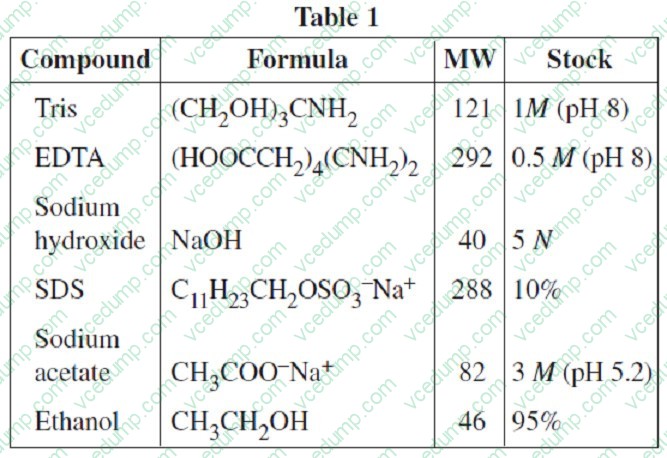
What is the molality of a stock solution that is 10% SDS by mass?
A. 0.028 m
B. 0.100 m
C. 0.347 m
D. 0.385 m -
Question 614:
Which type of isomerism is shown by the following compounds?
CH3-CH2-O-CH2-CH3 CH3-CH2-CH2-O-CH3
A. Position isomerism
B. Chain isomerism
C. Metamerism
D. Functional isomerism -
Question 615:
Elephants have large flat feet. It helps them, having heavy weight, in walking properly on ground and maintaining proper body posture by:
A. reducing ground friction on their feet.
B. reducing their pressure on ground.
C. increasing feet penetration into ground.
D. none of the above. -
Question 616:
One of the basic principles of ecology is that population size is to some extent a function of available food resources. Recent field experiments demonstrate that the interrelationship may be far more complex than hitherto imagined. Specifically, the browsing of certain rodents appears to trigger biochemical reactions in the plants they feed on that help regulate the size of the rodent populations. Two such examples of phytochemical regulation (regulation involving plant chemistry) have been reported so far. Patricia Berger and her colleagues at the University of Utah have demonstrated that instrumentality of 6- methoxybenzoxazolinone (6-MBOA) in triggering reproductive behavior in the mountain vole (Microtus montanus), a small rodent resembling the field mouse. 6-MBOA forms in young mountain grasses in response to browsing by predators such as voles. The experimenters fed rolled oats coated with 6-MBOA to non-breeding winter populations of Microtus. After three weeks, the sample populations revealed a high incidence of pregnancy among the females and pronounced swelling of the testicles among the males. Control populations receiving no 6- MBOA revealed no such signs. Since the timing of reproductive effort is crucial to the short-lived vole in an environment in which the onset of vegetative growth can vary by as much as two months, the phytochemical triggering of copulatory behavior in Microtus represents a significant biological adaptation. A distinct example is reported by John Bryant of the University of Alaska. In this case, plants seem to have adopted a form of phytochemical self-defense against the depredations of the snowshoe hare (Lepus americanus) of Canada and Alaska. Every ten years or so, for reasons that are not entirely understood, the Lepus population swells dramatically. The result is intense overbrowsing of early and mid-successional deciduous trees and shrubs. Bryant has shown that, as if in response, four common boreal forest trees favored by Lepus produce adventitious shoots high in terpene and phenolic resins which effectively discourage hare browsing. He treated mature, non-resinous willow twigs with resinous extracts from the adventitious shoots of other plants and placed treated and untreated bundles at hare feeding stations, weighing them at the end of each day. Bryant found that bundles containing only half the resin concentration of natural twigs were left untouched. The avoidance of these unpalatable resins, he concludes, may play a significant role in the subsequent decline in the Lepus population to its normal level. These results suggest obvious areas for further research. For example, observational data should be reviewed to see whether the periodic population explosions among the prolific lemming (like the vole and the snowshoe hare, a small rodent in a marginal northern environment) occur during years in which there is an early onset of vegetative growth; if so, a triggering mechanism similar to that found in the vole may be involved.
The author describes the effect of 6-MBOA on voles as a "significant biological adaptation" (lines 27?8) because it:
A. limits reproductive behavior in times of food scarcity.
B. leads the vole population to seek available food resources.
C. tends to ensure the survival of the species in a situation of fluctuating food supply.
D. maximizes the survival prospects of individual voles. -
Question 617:
Which option occurs as a result of inbreeding?
A. heterozygosity increases
B. homozygosity decreases
C. homozygosity increases
D. none of these -
Question 618:
If KE =絤v2, express the unit of KE using the SI units of the terms in the equation.
A. kg2 x m2 x s-2
B. kg x m-2 x s2
C. kg x m2 x s-2
D. kg x m x s -
Question 619:
A continuous spectrum of light, sometimes called blackbody radiation, is emitted from a region of the Sun called the photosphere. Although the continuous spectrum contains light of all wavelengths, the intensity of the emitted light is much
greater at some wavelengths than at others. The relationship between the most intense wavelength of blackbody radiation and the temperature of the emitting body is given by Wien's law, λ = 2.9 x 10⁶ /T, where λ is the wavelength in
nanometers and T is the temperature in kelvins.
As the blackbody radiation from the Sun passes through the cooler gases in the Sun's atmosphere, some of the photons are absorbed by the atoms in these gases. A photon will be absorbed if it has just enough energy to excite an electron
from a lower energy state to a higher one. The absorbed photon will have an energy equal to the energy difference between these two states. The energy of a photon is given by E = hf = hc/λ where h = 6.63 × 10⁻³⁴ J•s, Planck's constant,
and c = 3 × 10⁸ m/s, the speed of light in a vacuum.
The Sun is composed primarily of hydrogen. Electron transitions in the hydrogen atom from energy state n = 2 to higher energy states are listed below along with the energy of the absorbed photon:
Final Energy State
Energy (x 10-19 J)
n = 3
3.02
n = 4
4.08
n = 5
4.57 n = 6
4.84
n = ∞
5.44
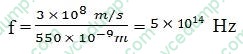
At the center of the visible spectrum is light with a wavelength of 550 nm. What is the frequency of this light?
A. 9.0 x 10⁸ Hz
B. 1.8 x 10¹² Hz
C. 5.4 x 10¹⁴ Hz
D. 1.8 x 10¹⁶ Hz -
Question 620:
Metals lose electrons more easily than non-metals because of:
A. high ionization potential.
B. high electron affinity.
C. low ionization potential.
D. low electron negativity.
Related Exams:
Tips on How to Prepare for the Exams
Nowadays, the certification exams become more and more important and required by more and more enterprises when applying for a job. But how to prepare for the exam effectively? How to prepare for the exam in a short time with less efforts? How to get a ideal result and how to find the most reliable resources? Here on Vcedump.com, you will find all the answers. Vcedump.com provide not only Medical Tests exam questions, answers and explanations but also complete assistance on your exam preparation and certification application. If you are confused on your MCAT-TEST exam preparations and Medical Tests certification application, do not hesitate to visit our Vcedump.com to find your solutions here.