MCAT-TEST Exam Details
-
Exam Code
:MCAT-TEST -
Exam Name
:Medical College Admission Test: Verbal Reasoning, Biological Sciences, Physical Sciences, Writing Sample -
Certification
:Medical Tests Certifications -
Vendor
:Medical Tests -
Total Questions
:812 Q&As -
Last Updated
:Jul 16, 2026
Medical Tests MCAT-TEST Online Questions & Answers
-
Question 601:
Which of the following statements identifies a chemically based sensory system?
I. Gustatory system
II. Auditory system
III.
Olfactory system
A. I only
B. II only
C. III only
D. I and III only
I. Gustatory system II. Auditory system III. Olfactory system -
Question 602:
Musical instruments generate vibrations in the air that are perceived as musical tones. In many kinds of drums, these vibrations are created by a standing waves in a vibrating membrane. In a timpani drum, membrane vibration is coupled to the vibration of an enclosed volume of air. There may also be a second membrane whose vibration is coupled to that of the first by the enclosed air space, as in a snare drum. An idealized circular membrane will vibrate at normal mode frequencies given by Equation 1 where T is the membrane tension, r is the membrane radius, is the mass per unit area of the membrane, and frel is the relative frequency shown under each mode in Figure 1. The pitch of drums can be tuned by adjusting the membrane tension.
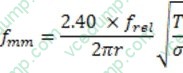
Equation 1
The modes are designated by two numbers, m and n. m indicates the number of diameter nodes, and n indicates the number of circular nodes. Several modes of vibration are shown in Figure 1.
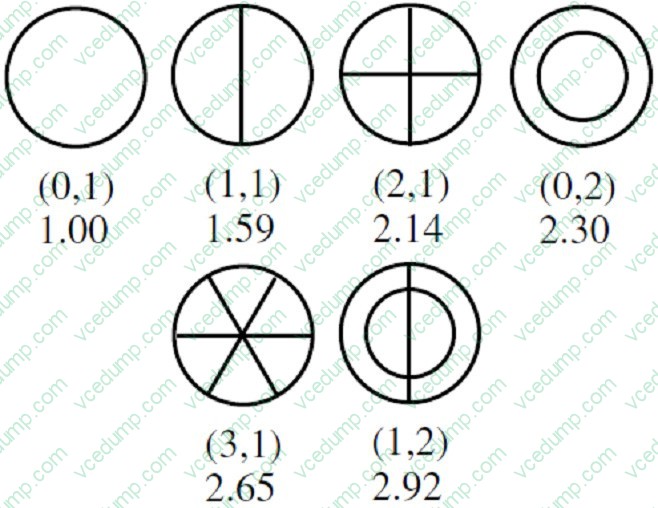
Figure 1
If the tension of a drum membrane is increased by a factor of four and the radius is increased by a factor of two, then the (1,1) modal frequency would:
A. not change.
B. increase by a factor of 1.59.
C. increase by a factor of 2.
D. increase by a factor of 4. -
Question 603:
An individual is born with a mutation causing her to partially retain a form of fetal hemoglobin into adulthood. Compared to a normal individual, this person would exhibit:
A. no differences from a normal adult.
B. significantly reduced oxygen binding in the lungs.
C. no symptoms, since retention of fetal hemoglobin would be fatal.
D. increased oxygen binding to hemoglobin in the tissues. -
Question 604:
The combination of the cornea and the crystalline lens shown below serves as a converging lens.
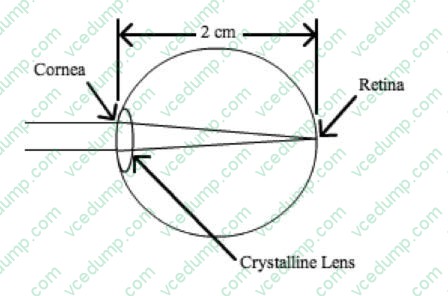
In a perfectly functioning eye, an image is projected at a fixed distance on the retina, which is approximately 2cm from the lens. What is the power of the converging lens when a person without any visual impairment stares at a distant object?
A. 0.5 diopters
B. 10 diopters
C. 25 diopters
D. 50 diopters -
Question 605:
What is the function of the gall bladder?
A. to produce insulin
B. to store insulin
C. to store bile
D. to produce bile -
Question 606:
X-rays are produced by a device which beams electrons with an energy between 103 and 106 eV at a metal plate. The electrons interact with the metal plate and are stopped by it. Much of the energy of the incoming electrons is released in the form of X-rays, which are high-energy photons of electromagnetic radiation. An example of such a device is shown below. Electrons are accelerated from the cathode towards the anode by an electric field.

There are two mechanisms by which the X-rays are produced within the metal. The first mechanism is called bremsstrahlung, which is German for "breaking radiation." X-rays are emitted by the electrons as they are brought to rest by
interactions with the positive nuclei of the anode.
The second mechanism occurs when an incoming electron knocks an inner electron out of one of the metal atoms of the anode. This electron is replaced by an electron from a higher energy level of the atom, and a photon making up the
energy difference is emitted.
X-rays are absorbed by a material when they pass through it. The amount of X-rays absorbed increases with the density of the material. In addition, lower energy X-rays are more likely to be absorbed than higher energy X-rays. (Note: 1 eV =
1.6 x 10¹⁹ J; Planck's constant h = 4.1 x 10⁻¹⁵ eV•s; speed of light c = 3 x 10⁸ m/s.)
What is the direction of the electric field that accelerates the electrons?
A. From the anode toward the cathode
B. From the cathode toward the anode
C. Into the page
D. Out of the page -
Question 607:
According to Erik Erikson, identity formation is intense during what stage of life?
A. early childhood
B. early adulthood
C. birth through 2 years
D. adolescence -
Question 608:
The time has come to acknowledge the ascendancy of the humanistic psychology movement. The so- called "Third Stream" emerged at mid-century, asserting itself against the opposition of a pair of mighty, long-established currents, psychoanalysis and behaviorism. The hostility between these two older schools, as well as divisiveness within each of them, probably helped enable humanistic psychology to survive its early years. But the movement flourished because of its wealth of insights into the nature of this most inexact science.
Of the three major movements in the course of 20th century psychology, psychoanalysis is the oldest and most introspective. Conceived by Sigmund Freud as a means of treating mental and emotional disorders, psychoanalysis is based on the theory that people experience unresolved emotional conflicts in infancy and early childhood. Years later, although these experiences have largely disappeared from conscious awareness, they may continue to impair a person's ability to function in daily life. The patient experiences improvement when the psychoanalyst eventually unlocks these long-repressed memories of conflict and brings them to the patient's conscious awareness.
In the heyday of behaviorism, which occurred between the two world wars, the psychoanalytic movement was heavily criticized for being too concerned with inner subjective experience. Behavioral psychologists, dismissing ideas and feelings as unscientific, tried to deal only with observable and quantifiable facts. They perceived the human being merely as an organism which generated responses to stimuli produced by its body and the environment around it. Patients' neuroses no longer needed analysis; they could instead by modified by behavioral conditioning. Not even babies were safe: B.F. Skinner devised a container in which infants could be raised under "ideal" conditions -- if a sound-proof box can be considered the ideal environment for child-rearing. By mid-century, a number of psychologists had grown dissatisfied with both the deterministic Freudian perspective and the mechanistic approach of behaviorism. They questioned the idea that human personality becomes permanently fixed in the first few years of life. They wondered if the purpose of psychology was really to reduce people to laboratory specimens. Was it not instead possible that human beings are greater than the sum of their parts? That psychology should speak to their search for fulfillment and meaning in life?
It is questions like these that members of the Third Stream have sought to address. While the movement cannot be simplified down to a single theoretical position, it does spring from certain fundamental propositions. Humanistic psychologists believe that conscious experience, rather than outward behavior, is the proper subject of psychology. We recognize that each human being is unique, capable of change and personal growth. We see maturity as a process dependent on the establishment of a set of values and the development of self. And we believe that the more aspects of self which are satisfactorily developed, the more positive the individual's self-image.
Abraham Maslow, a pioneer of the Third Stream, articulated a hierarchy of basic human needs, starting with food, water and air, progressing upward through shelter and security, social acceptance and belonging, to love, esteem and self-expression. Progress toward the higher stages cannot occur until all of the more basic needs have been satisfied. Individuals atop the pyramid, having developed their potential to the highest possible extent, are said to be "self-actualized".
If this humanist theoretical perspective is aimed at empowering the individual, so too are the movement's efforts in the practical realm of clinical psychology. Believing that traditional psychotherapists tend to lead patients toward predetermined resolutions of their problems, Carl Rogers pressed for objective evaluations of both the process and outcome of psychotherapeutic treatment. Not content to function simply as a reformer, Rogers also pioneered the development of "client-centered" or nondirective therapy, which emphasizes the autonomy of the client (i.e., patient). In client-centered therapy, clients choose the subjects for discussion, and are encouraged to create their own solutions to their problems.
Psychoanalysts and humanistic psychologists would be most likely to disagree about:
A. the effects of internal conflicts on childhood behavior.
B. the necessity of proper training for psychologists.
C. the relevance and utility of clinical psychology.
D. the significance of conscious experience. -
Question 609:
There are two opposing theories of light: the particle theory and the wave theory. According to the particle theory, light is composed of a stream of tiny particles that are subject to the same physical laws as other types of elementary particles.
One consequence of this is that light particles should travel in a straight line unless an external force acts on them. According to the wave theory, light is a wave that shares the characteristics of other waves. Among other things, this means
that light waves should interfere with each other under certain conditions.
In support of the wave theory of light, Thomas Young's double slit experiment proves that light does indeed exhibit interference. Figure 1 shows the essential features of the experiment. Parallel rays of monochromatic light pass through two
narrow slits and are projected onto a screen. Constructive interference occurs at certain points on the screen, producing bright areas of maximum light intensity. Between these maxima, destructive interference produces light intensity minima.
The positions of the maxima are given by the equation dsin = n, where d is the distance between the slits, is the angle shown in Figure 1, the integer n specifies the particular maxima, and is the wavelength of the incident light. (Note: sin tan
for small angles.)

Figure 1
A beam of electrons can also produce an interference pattern. Which one of the following expressions gives a consistent definition of an electron's "wavelength" if it has a total energy given by E? (Note: h = 6.6 ?10-34 J?s is Planck's constant and v is the speed of the electrons.)
A. hvE
B. hE/v
C. hv/E
D. E/hv -
Question 610:
A student conducts a chemical analysis of the components of a popular soft drink. The beverage label shows that the drink contains carbonated water, phosphoric acid, caffeine, and caramel color, but does not indicate the concentrations of these chemicals.
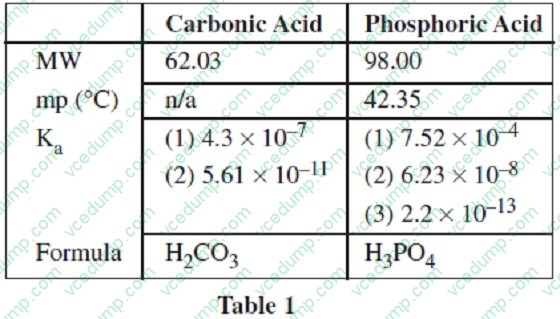
Dissolved carbon dioxide will react reversibly with water to form carbonic acid. In an attempt to analyze the beverage composition, the student conducts the following experiments on a one liter sample of the beverage.
Experiment 1
The sample is placed in a sealed beaker cooled to 10?C and a vacuum is created in the space above the beverage. The gas pumped from this space is passed through a solution of BaCl2, producing a white precipitate. The process
continues until no more precipitate forms. The precipitate is dried and found to have a mass of 9.5 grams.
Experiment 2
The remaining solution left in the sealed beaker is then titrated with 0.01 M NaOH to give the titration curve shown in Figure 1.
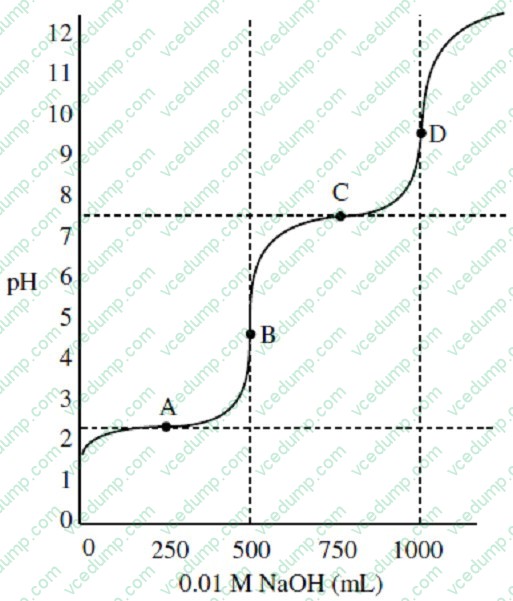
Figure 1

is completely insoluble in aqueous solution. Addition of barium chloride to a phosphoric acid solution will decrease the pH because:
A. barium acts as a Lewis base.
B. barium chloride reduces the concentration of hydrogen ions in solution.
C. chloride ion acts to stabilize the hydrogen ions in solution.
D. the precipitation of barium phosphate drives the acid dissociation to completion.



Related Exams:
Tips on How to Prepare for the Exams
Nowadays, the certification exams become more and more important and required by more and more enterprises when applying for a job. But how to prepare for the exam effectively? How to prepare for the exam in a short time with less efforts? How to get a ideal result and how to find the most reliable resources? Here on Vcedump.com, you will find all the answers. Vcedump.com provide not only Medical Tests exam questions, answers and explanations but also complete assistance on your exam preparation and certification application. If you are confused on your MCAT-TEST exam preparations and Medical Tests certification application, do not hesitate to visit our Vcedump.com to find your solutions here.