MCAT-TEST Exam Details
-
Exam Code
:MCAT-TEST -
Exam Name
:Medical College Admission Test: Verbal Reasoning, Biological Sciences, Physical Sciences, Writing Sample -
Certification
:Medical Tests Certifications -
Vendor
:Medical Tests -
Total Questions
:812 Q&As -
Last Updated
:Jul 16, 2026
Medical Tests MCAT-TEST Online Questions & Answers
-
Question 201:
Hypoxia refers to a physiological condition in which the body lacks sufficient oxygen for normal cellular functioning. Prolonged hypoxia generally leads to an inhibition of mental capacity and a reduction in the work capacity of muscle. Severe cases of hypoxia can lead to coma or even death. Depending on the cause, hypoxia can be classified into four general types:
Hypoxic hypoxia is a type of hypoxia that occurs when the partial pressure of oxygen in the blood is too low. For example, climbers at high altitude, where the air contains less oxygen, might experience hypoxic hypoxia because the partial pressure of oxygen in the air inhaled is very low, leading to insufficient partial pressure of oxygen in the blood.
Anemic hypoxia describes a diminished ability of the blood to transport oxygen. Several factors can influence the oxygen-carrying capacity of the blood. Primary causes of anemic hypoxia include a lower than normal number of functional erythrocytes or an insufficient quantity of hemoglobin, the oxygen- carrying molecules of the blood. Abnormal hemoglobin can also decrease the blood's capacity to carry oxygen and lead to anemic hypoxia.
Ischemic hypoxia is caused by a decreased delivery of blood to the tissues. Localized circulatory deficiencies, such as blood clots, and global circulatory deficiencies, such as heart failure, decrease the delivery of blood to the tissues, and can therefore cause ischemic hypoxia.
Histotoxic hypoxia results from the inability of cells to utilize the oxygen available in the blood. Causes of histotoxic hypoxia include the poisoning of cellular enzymes involved in aerobic respiration, as well as the decreased metabolic capacity of the oxidative enzymes due to vitamin deficiency. Cyanide poisoning causes histotoxic hypoxia by blocking the action of cytochrome oxidase in the electron transport chain so that tissues cannot use oxygen even though it is available.
The passages of the respiratory tract which do not participate in gas exchange are called the physiological dead space. Compared to air in the alveoli, air in the physiological dead space will have:
A. Option A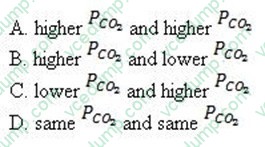
B. Option B
C. Option C
D. Option D -
Question 202:
Nitric oxide, NO, has recently been found to have widespread physiological effects, acting as a major regulator in the nervous, cardiovascular, and immune systems. The production of NO in the body is regulated by specific NOS enzymes which exist in at least three different isoforms -- bNOS, eNOS, and macNOS. Each of these isoforms differ in location and function and serve to mediate different physiological responses to NO. Some physiological roles of NO have been demonstrated as follows:
I. In the central nervous system, NO production is regulated by bNOS. Calcium ion concentrations of 200- 400 nM in the central nervous system activate bNOS to catalyze the formation of NO. NO exerts definite effects on brain function although its specific roles are not well established. bNOS inhibitors have been found to block the release of neurotransmitter from presynaptic neurons. Excess levels of NO are also thought to contribute to neurodegenerative disorders such as Alzheimer's disease.
II. In the blood vessels, NO is produced by eNOS which is activated by Ca2+ concentrations of 200-400 nM. NO acts as the major endogenous vasodilator in blood vessels. It diffuses into smooth muscle cells and leads to muscle relaxation by stimulating cGMP formation through activation of guanylyl cyclase. In addition, NO regulates the vascular system by inhibiting platelet aggregation and adhesion.
III. The role of NO in the immune system is regulated by macNOS through a pathway that is not Ca2+ dependent. Rather, exposure to cytokines, including interleukin-1 and interferon- , leads to synthesis of large amounts of NO by activation of macNOS in response to inflammatory stimuli. The NO produced plays a definitive role in the mediation of the activities of macrophages and neutrophils. NO also acts to inhibit the mechanism of viral replication.
A "knock out" mouse with a mutant bNOS protein was generated by recombination techniques. The mutant protein was identical to the wild-type protein except for the identity of amino acid 675; the mutated bNOS has Tryptophan instead of Cysteine at position 675. Which of the following is responsible for the mutant protein?
A. Frame shift mutation
B. Single base-pair deletion
C. Point mutation
D. Nonsense mutation
I. In the central nervous system, NO production is regulated by bNOS. Calcium ion concentrations of 200- 400 nM in the central nervous system activate bNOS to catalyze the formation of NO. NO exerts definite effects on brain function although its specific roles are not well established. bNOS inhibitors have been found to block the release of neurotransmitter from presynaptic neurons. Excess levels of NO are also thought to contribute to neurodegenerative disorders such as Alzheimer's disease. II. In the blood vessels, NO is produced by eNOS which is activated by Ca2+ concentrations of 200-400 nM. NO acts as the major endogenous vasodilator in blood vessels. It diffuses into smooth muscle cells and leads to muscle relaxation by stimulating cGMP formation through activation of guanylyl cyclase. In addition, NO regulates the vascular system by inhibiting platelet aggregation and adhesion. III. The role of NO in the immune system is regulated by macNOS through a pathway that is not Ca2+ dependent. Rather, exposure to cytokines, including interleukin-1 and interferon- , leads to synthesis of large amounts of NO by activation of macNOS in response to inflammatory stimuli. The NO produced plays a definitive role in the mediation of the activities of macrophages and neutrophils. NO also acts to inhibit the mechanism of viral replication. A "knock out" mouse with a mutant bNOS protein was generated by recombination techniques. The mutant protein was identical to the wild-type protein except for the identity of amino acid 675; the mutated bNOS has Tryptophan instead of Cysteine at position 675. Which of the following is responsible for the mutant protein? -
Question 203:
Artificial kidneys have been used for almost 50 years to treat patients with different forms of renal failure. The artificial kidney (dialysis machine) removes unwanted substances from the blood by diffusion. A patient's blood is passed through channels bounded by a porous, semi-permeable membrane that allows the free diffusion in both directions of all plasma constituents except the plasma proteins. Erythrocytes and other cellular components of blood cannot pass through the membrane. The other side of the membrane is exposed to the dialyzing fluid which carries away the unwanted materials. If the concentration of a material in the blood is greater than in the dialyzing fluid, there will be a net flow of the material from the plasma to the dialyzing fluid. If the concentration of a material in the blood is less than in the dialyzing fluid, there will be a net flow of the material from the dialyzing fluid into the blood. The composition of normal plasma, plasma in an individual suffering renal failure, and dialyzing fluid are shown in Table 1.
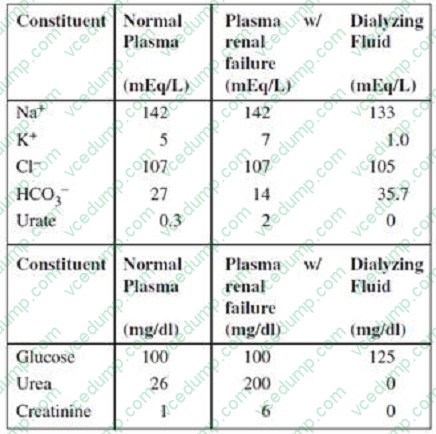
Table 1
Dialysis replaces some functions of the kidneys and attempts to correct the effects of renal failure. For example, patients with renal failure develop acidosis due to a buildup of metabolically produced acids in the circulation. Without dialysis, the pH of the blood will drop and coma may occur. Dialyzing fluid contains a relatively high concentration of bicarbonate which diffuses into the circulation and neutralizes the acid.
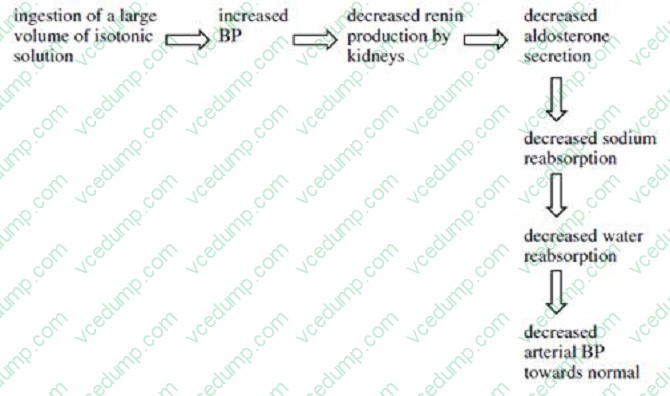
Healthy kidneys secrete the hormone renin in response to decreased arterial pressure. Renin secretion leads to aldosterone secretion by the adrenal cortex. The body would most likely respond to ingestion of a large volume of isotonic solution by:
A. decreasing renin secretion and increasing sodium and water reabsorption.
B. decreasing renin secretion and decreasing sodium and water reabsorption.
C. increasing renin secretion and increasing sodium and water reabsorption.
D. increasing renin secretion and decreasing sodium and water reabsorption. -
Question 204:
If an atom undergoes alpha decay, by how many units will its mass number decrease?
A. 2
B. 3
C. 4
D. 1 -
Question 205:
Assuming the circulatory system in humans obeys Bernoulli's principle of fluid dynamics, which of the statements most accurately compares the blood pressure in a capillary of the neck to a capillary with an equal cross-sectional area in the right knee?
A. The pressure in the neck is greater than the pressure in the knee because of the increase in pressure head.
B. The pressure in the neck is equal to the pressure in the knee because of the equal dynamic pressure according to the continuity equation.
C. The pressure in the knee is greater than the pressure in the neck because of the increase in pressure head.
D. An accurate comparison cannot be given without knowledge of the fluid's density and viscosity. -
Question 206:
Several techniques have been developed to determine the order of a reaction. The rate of a reaction cannot be predicted on the basis of the overall equation, but can be predicted on the basis of the rate-determining step. For instance, the following reaction can be broken down into three steps.
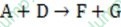
Step 1

(Slow)
Step 2
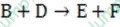
(fast)
Step 3

(fast)
Reaction 1 In this case, the first step in the reaction pathway is the rate-determining step. Therefore, the overall rate of the reaction must equal the rate of the first step, k1 [A] where k1 is the rate constant for the first step. (Rate constants of the different steps are denoted by kx , where x is the step number.)
In some cases, it is desirable to measure the rate of a reaction in relation to only one species. In a second-order reaction, for instance, a large excess of one species is included in the reaction vessel. Since a relatively small amount of this large concentration is reacted, we assume that the concentration essentially remains unchanged. Such a reaction is called a pseudo first-order reaction. A new rate constant, k', is established, equal to the product of the rate constant of the original reaction, k, and the concentration of the species in excess. This approach is often used to analyze enzyme activity.
In some cases, the reaction rate may be dependent on the concentration of a short-lived intermediate. This can happen if the rate-determining step is not the first step. In this case, the concentration of the intermediate must be derived from the equilibrium constant of the preceding step. For redox reactions, the equilibrium can be correlated with the voltage produced by two half-cells by means of the Nernst equation. This equation states that at any given moment:
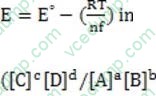
Equation 1 When

Reaction 2
Note: R = 8.314 J/K•mol; F = 9.6485 x 10⁴ C/mol.)
Catalysts are effective in increasing the rate of a reaction because they:
A. increase the energy of the activated complex.
B. increase the value of the equilibrium constant.
C. decrease the number of collisions between reactant molecules.
D. lower the activation energy -
Question 207:
Several models have been developed for relating changes in dissociation constants to changes in the tertiary and quaternary structures of oligomeric proteins. One model suggests that the protein's subunits can exist in either of two distinct conformations, R and T. At equilibrium, there are few R conformation molecules: 10 000 T to 1 R and it is an important feature of the enzyme that this ratio does not change. The substrate is assumed to bind more tightly to the R form than to the T form, which means that binding of the substrate favors the transition from the T conformation to R.
The conformational transitions of the individual subunits are assumed to be tightly linked, so that if one subunit flips from T to R the others must do the same. The binding of the first molecule of substrate thus promotes the binding of the second and if substrate is added continuously, all of the enzyme will be in the R form and act on the substrate. Because the concerted transition of all of the subunits from T to R or back, preserves the overall symmetry of the protein, this model is called the symmetry model. The model further predicts that allosteric activating enzymes make the R conformation even more reactive with the substrate while allosteric inhibitors react with the T conformation so that most of the enzyme is held back in the T shape.
Experiment Evaluating Non-Symmetry Model Enzymes
Experiments were performed with enzyme conformers that did not obey the symmetry model. The data is summarized in Figure 1.
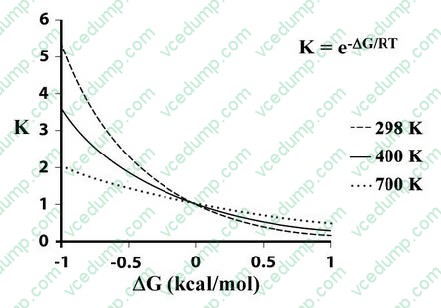
Figure 1: Equilibrium distribution of two conformers at different temperatures given the free energy of their interconversion. (modified from Mr.Holmium).
The substrate binds more tightly to R because:
A. T has a higher affinity for the substrate than R.
B. R has a higher affinity for the substrate than T.
C. there are 10 000 times more T conformation molecules than R conformation molecules.
D. the value of the equilibrium constant does not change. -
Question 208:
As we move away from nucleus, the distance between the shells:
A. remains same.
B. increases.
C. decreases.
D. sometimes increase and sometime decreases. -
Question 209:
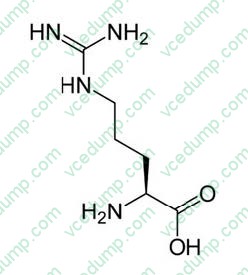
Arginine is one of the 20 most common natural amino acids. Most healthy people do not need to supplement with arginine because the body usually produces sufficient quantities. The pathway for arginine synthesis was studied using cells from a red bread mold. This natural form of arginine is illustrated below.
The red bread mold Neurospora crassa grows well on a cultural plate with "minimal" medium which is a fluid containing only a few simple sugars, inorganic salts, and vitamin. Neurospora that grows normally in nature (wild type) has enzymes that convert these simple substances into the amino acids necessary for growth. Mutating any one of the genes that makes an enzyme can produce a Neurospora strain that cannot grow on minimal medium. The mutant would only grow if the enzyme product were to be added as a supplement. On the other hand, if a "complete" medium is provided, containing all required amino acids, then Neurospora would grow, with or without mutation.
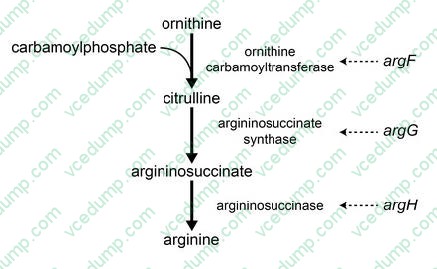
Figure 1 A synthesis pathway for the amino acid arginine. Each gene in italics in the diagram produces one enzyme necessary for the synthesis of this essential amino acid required for growth.

Table 1 Growth response of mutant strains in "minimal" media with supplements (ornithine, citrulline, argininosuccinate, and arginine) as indicated. Strain growth is indicated by (+) and no strain growth is indicated by (-). Which of the following is most likely consistent with the overall synthetic pathway for arginine (accounting for coupled reactions)?
A. H < 0
B. G = 0
C. net ATP production
D. G > 0 -
Question 210:
Which part of the brain controls speech?
A. hypothalamus
B. cerebellum
C. occipital lobe
D. Broca's Area
Related Exams:
Tips on How to Prepare for the Exams
Nowadays, the certification exams become more and more important and required by more and more enterprises when applying for a job. But how to prepare for the exam effectively? How to prepare for the exam in a short time with less efforts? How to get a ideal result and how to find the most reliable resources? Here on Vcedump.com, you will find all the answers. Vcedump.com provide not only Medical Tests exam questions, answers and explanations but also complete assistance on your exam preparation and certification application. If you are confused on your MCAT-TEST exam preparations and Medical Tests certification application, do not hesitate to visit our Vcedump.com to find your solutions here.