MCAT-TEST Exam Details
-
Exam Code
:MCAT-TEST -
Exam Name
:Medical College Admission Test: Verbal Reasoning, Biological Sciences, Physical Sciences, Writing Sample -
Certification
:Medical Tests Certifications -
Vendor
:Medical Tests -
Total Questions
:812 Q&As -
Last Updated
:Jul 08, 2026
Medical Tests MCAT-TEST Online Questions & Answers
-
Question 91:
Our sense of smell is arguably the most powerful of our five senses, but it also the most elusive. It plays a vital yet mysterious role in our lives. Olfaction is rooted in the same part of the brain that regulates such essential functions as body metabolism, reaction to stress, and appetite. But smell relates to more than physiological function: its sensations are intimately tied to memory, emotion, and sexual desire. Smell seems to lie somewhere beyond the realm of conscious thought, where, intertwined with emotion and experience, it shapes both our conscious and unconscious lives.
The peculiar intimacy of this sense may be related to certain anatomical features. Smell reaches the brain more directly than do sensations of touch, sight, or sound. When we inhale a particular odor, air containing volatile odiferous molecules is warmed and humidified as it flows over specialized bones in the nose called turbinates. As odor molecules land on the olfactory nerves, these nerves fire a message to the brain. Thus olfactory neurons render a direct path between the stimulus provided by the outside environment and the brain, allowing us to rapidly perceive odors ranging from alluring fragrances to noisome fumes.
Certain scents, such as jasmine, are almost universally appealing, while others, like hydrogen sulfide (which emits a stench reminiscent of rotten eggs), are usually considered repellent, but most odors evoke different reactions from person to person, sometimes triggering strong emotional states or resurrecting seemingly forgotten memories. Scientists surmise that the reason why we have highly personal associations with smells is related to the proximity of the olfactory and emotional centers of our brain. Although the precise connection between emotion and olfaction remains a mystery, it is clear that emotion, memory, and smell are all rooted in a part of the brain called the limbic lobe.
Even though we are not always conscious of the presence of odors, and are often unable to either articulate or remember their unique characteristics, our brains always register their existence. In fact, such a large amount of human brain tissue is devoted to smell that scientists surmise the role of this sense must be profound. Moreover, neurobiological research suggests that smell must have an important function because olfactory neurons can regenerate themselves, unlike most other nerve cells. The importance of this sense is further supported by the fact that animals experimentally denied the olfactory sense do not develop full and normal brain function.
The significance of olfaction is much clearer in animals than in human beings. Animal behavior is strongly influenced by pheromones, which are odors that induce psychological or behavioral changes and often provide a means of communicating within a species. These chemical messages, often a complex blend of compounds, are of vital importance to the insect world. Honeybees, for example, organize their societies through odor: the queen bee exudes an odor that both inhibits worker bees from laying eggs and draws drones to her when she is ready to mate. Mammals are also guided by their sense of smell. Through odors emitted by urine and scent glands, many animals maintain their territories, identify one another, signal alarm, and attract mates.
Although our olfactory acuity can't rival that of other animal species, human beings are also guided by smell. Before the advent of sophisticated laboratory techniques, physicians depended on their noses to help diagnose illness. A century ago, it was common medical knowledge that certain bacterial infections carry the musty odor of wine, that typhoid smells like baking bread, and that yellow fever smells like meat. While medical science has moved away from such subjective diagnostic methods, in everyday life we continue to rely on our sense of small, knowingly or not, to guide us.
The sense of smell in animals is different from olfaction in humans in that animals:
A. are unable to make associations between smells and past experience.
B. only use smell to communicate outside their own species.
C. rely on olfaction only for mating purposes.
D. more clearly exhibit behavioral changes in response to odors. -
Question 92:
Aerobic respiration is the major process used by oxygen- requiring organisms to generate energy. During respiration, glucose is metabolized to generate chemical energy in the form of ATP:

The biochemical machinery necessary for cellular respiration is found in the mitochondria, small organelles scattered throughout the cytoplasm of most eukaryotic cells. The number of mitochondria per cell varies by tissue type and cell function.
Mitochondria are unusual in that they have their own genetic systems that are entirely separate from the cell's genetic material. However, mitochondrial replication is still dependent upon the cell's nuclear DNA to encode essential proteins required for replication. Despite this fact, mitochondria seem to replicate randomly, out of phase with both the cell cycle and other mitochondria.
The nature of the mitochondrial genome and protein synthesizing machinery has led many researchers to postulate that mitochondria may have arisen as the result of the ingestion of a bacterium by a primitive cell millions of years ago. It is postulated that the two may have entered into a symbiotic relationship and eventually became dependent on each another; the cell sustained the bacterium, while the bacterium provided energy for the cell. Gradually, the two evolved into the present-day eukaryotic cell, with the mitochondrion retaining some of its own DNA. This is known as the endosymbiotic hypothesis. Because mitochondrial DNA is inherited in a non-Mendelian fashion (mitochondria are inherited from the maternal parent, who supplies most of the cytoplasm to the fertilized egg), it has been used to look at evolutionary relationships among different organisms.
What is the net number of ATP molecules synthesized by an obligate anaerobe per molecule of glucose?
A. 2 ATP
B. 6 ATP
C. 8 ATP
D. 36 ATP -
Question 93:
The mind, just like the body, has its needs. The needs of the body are the foundations of society; those of the mind are its amenities. While government and laws provide for the safety and well-being of men when they gather together, the sciences and the arts, which are less despotic but perhaps more powerful, spread garlands of flowers over the iron chains that bind them, stifle in them the sense for that original liberty for which they seem to have been born, cause them to love their own enslavement, and turn them into so-called "civilized people." Necessity raised thrones; the sciences and the arts have strengthened them. O earthly powers: cherish talents and protect those who cultivate them. O civilized people, cultivate them: you happy slaves owe to them that delicate and refined taste of which you are so proud, that gentleness of character and urbanity of manner which make relations among you so amiable and easy -- in other words, that semblance of all the virtues, none of which you actually possess... ...How pleasant it would be to live among us, if our external appearance were always a reflection of what is in our hearts, if decency were virtue, if our maxims served as our rules, and if true philosophy were inseparable from the title of philosopher! But so many qualities are seldom found together, and virtue hardly ever walks in such great pomp. Richness of adornment may be the mark of a man of taste, but a healthy, robust man is known by other signs: it is beneath the rustic clothes of a farmer, and not the gilt of a courtier, that strength and vigor of the body will be found. Ornamentation is just as foreign to virtue, which is the strength and vigor of the soul. The good man is an athlete who prefers to compete in the nude: he disdains all those vile ornaments which would hinder the use of his strength, ornaments which were for the most part invented only to hide some deformity. Before art had molded our manners and taught our passions to speak an affected language, our customs were rustic but natural, and differences in conduct revealed clearly differences in character. Human nature, basically, was no better, but men found security in being able to see through each other easily, and this advantage, which we no longer appreciate, spared them many vices. Now that more subtle refinements and more delicate taste have reduced the art of pleasing to set rules, a base and deceptive uniformity prevails in our behavior, and all minds seem to have been cast in the same mold. Incessantly politeness and propriety make demands on us, and incessantly we follow usage but never our own inclinations. We no longer dare to appear as we are, and under this perpetual constraint, the men who form this herd called society, when placed in the same circumstances, will all act similarly unless stronger motives direct them to do otherwise. Therefore we will never know well those with whom we deal, for to know our friends we will have to wait for some crises to arise -- which is to say that we will have to wait until it is too late, as it is for these very crises that it is essential to know one's friends well. What vice would not accompany this uncertainty? No more sincere friendships, no more genuine esteem, no more well-based confidence. Suspicion, offenses, fears, coldness, reserve, hatred and betrayal will constantly hide under the same false veil of politeness, under that much touted urbanity which we owe to the enlightenment of our times. The name of the Master of the Universe will no longer be profaned by swearing, but insulted by blasphemies that will not offend our scrupulous ears. Men will not boast of their own merits, but belittle those of others. An enemy will not be crudely insulted, but adroitly slandered. National hatreds will die, but so will patriotism. A dangerous skepticism will take the place of the scorning of ignorance. Some excesses will be forbidden, some vices dishonored, but others will be dignified with the name of virtues, and one must either have them or feign them. Let those who want to praise the sobriety of the sages of our time do so; as for me, I see in it only a refinement of intemperance that is as unworthy of my praise as their hypocritical simplicity.
The author of this passage would most likely have the greatest respect for a person who:
A. is deterred from acting on his own inclinations by the needs of society.
B. does not dilute his natural reactions through the artifice of correct behavior.
C. exhibits his refinement through elaborate clothing and conversation.
D. boasts of his own merit rather than belittling that of others. -
Question 94:
Although nihilism is commonly defined as a form of extremist political thought, the term has a broader meaning. Nihilism is in fact a complex intellectual stance with venerable roots in the history of ideas, which forms the theoretical basis for many positive assertions of modern thought. Its essence is the systematic negation of all perceptual orders and assumptions. A complete view must account for the influence of two historical crosscurrents: philosophical skepticism about the ultimacy of any truth, and the mystical quest for that same pure truth. These are united by their categorical rejection of the "known". The outstanding representative of the former current, David Hume (1711?776), maintained that external reality is unknowable, since sense impressions are actually part of the contents of the mind. Their presumed correspondence to external "things" cannot be verified, since it can be checked only by other sense impressions. Hume further asserts that all abstract conceptions turn out, on examination, to be generalizations from sense impressions. He concludes that even such an apparently objective phenomenon as a cause-and-effect relationship between events may be no more than a subjective fabrication of the observer. Stanley Rosen notes: "Hume terminates in skepticism because he finds nothing within the subject but individual impressions and ideas." For mystics of every faith, the "experience of nothingness" is the goal of spiritual practice. Buddhist meditation techniques involve the systematic negation of all spiritual and intellectual constructs to make way for the apprehension of pure truth. St. John of the Cross similarly rejected every physical and mental symbolization of God as illusory. St. John's spiritual legacy is, as Michael Novak puts it, "the constant return to inner solitude, an unbroken awareness of the emptiness at the heart of consciousness. It is a harsh refusal to allow idols to be placed in the sanctuary. It requires also a scorching gaze upon all the bureaucracies, institutions, manipulators, and hucksters who employ technology and its supposed realities to bewitch and bedazzle the psyche." Novak's interpretation points to the way these philosophical and mystical traditions prepared the ground for the political nihilism of the nineteenth and twentieth centuries. The rejection of existing social institutions and their claims to authority is in the most basic sense made possible by Humean skepticism. The political nihilism of the Russian intelligentsia combined this radical skepticism with a near mystical faith in the power of a new beginning. Hence, their desire to destroy becomes a revolutionary affirmation; in the words of Stanley Rosen, "Nihilism is an attempt to overcome or repudiate the past on behalf of an unknown and unknowable, yet hoped-for, future." This fusion of skepticism and mystical re-creation can be traced in contemporary thought, for example as an element in the counterculture of the 1960s.
The passage implies that the two strands of nihilist thought:
A. are combined in nineteenth and twentieth century political nihilism.
B. remained essentially separate after the eighteenth century.
C. are necessary prerequisites for any positive modern social thought.
D. are derived from distinct Eastern and Western philosophical traditions. -
Question 95:
It is critical for the human body blood to maintain its pH at approximately 7.4. Decreased or increased blood pH are called acidosis and alkalosis respectively; both are serious metabolic problems that can cause death. The table below lists the major buffers found in the blood and/or kidneys. Table 1 Buffer pKa of a typical conjugate acid:* + Histidine side chains


Organic phosphates N-terminal amino groups

6.1
6.3
6.8
7.0
8.0
9.2

*For buffers in many of these categories, there is a range of actual values.
The relationship between blood pH and the of any buffer can be described by the Henderson-Hasselbalch equation:
pH = + log([conjugate base]/[conjugate acid]) Equation 1

Bicarbonate, the most important buffer in the plasma, enters the blood in the form of carbon dioxide, a byproduct of metabolism, and leaves in two forms: exhaled and excreted bicarbonate. Blood pH can be adjusted rapidly by changes
in the rate of exhalation. The reaction given below, which is catalyzed by carbonic anhydrase in the erythrocytes, describes how bicarbonate and interact in the blood.
+ + Reaction 1
If the pH of blood were to increase to 7.6, what would be the likely outcome?
A. Option A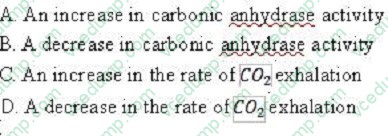
B. Option B
C. Option C
D. Option D -
Question 96:
Agonistic behavior, or aggression, is exhibited by most of the more than three million species of animals on this planet. Animal behaviorists still disagree on a comprehensive definition of the term, but aggressive behavior can be loosely described as any action that harms an adversary or compels it to retreat. Aggression may serve many purposes, such as food gathering, establishing territory, and enforcing social hierarchy. In a general Darwinian sense, however, the purpose of aggressive behavior is to increase the individual animal's -- and thus, the species' -- chance of survival. Aggressive behavior may be directed at animals of other species, or it may be conspecific--that is, directed at members of an animal's own species. One of the most common examples of conspecific aggression occurs in the establishment and maintenance of social hierarchies. In a hierarchy, social dominance is usually established according to physical superiority; the classic example is that of a pecking order among domestic fowl. The dominance hierarchy may be viewed as a means of social control that reduces the incidence of attack within a group. Once established, the hierarchy is rarely threatened by disputes because the inferior animal immediately submits when confronted by a superior. Two basic types of aggressive behavior are common to most species: attack and defensive threat. Each type involves a particular pattern of physiological and behavioral responses, which tends not to vary regardless of the stimulus that provokes it. For example, the pattern of attack behavior in cats involves a series of movements, such as stalking, biting, seizing with the forepaws and scratching with the hind legs, that changes very little regardless of the stimulus -- that is, regardless of who or what the cat is attacking. The cat's defensive threat response offers another set of closely linked physiological and behavioral patterns. The cardiovascular system begins to pump blood at a faster rate, in preparation for sudden physical activity. The eyes narrow and the ears flatten against the side of the cat's head for protection, and other vulnerable areas of the body such as the stomach and throat are similarly contracted. Growling or hissing noises and erect fur also signal defensive threat. As with the attack response, this pattern of responses is generated with little variation regardless of the nature of the stimulus. Are these aggressive patterns of attack and defensive threat innate, genetically programmed, or are they learned? The answer seems to be a combination of both. A mouse is helpless at birth, but by its 12th day of life can assume a defensive threat position by backing up on its hind legs. By the time it is one month old, the mouse begins to exhibit the attack response. Nonetheless, copious evidence suggests that animals learn and practice aggressive behavior; one need look no further than the sight of a kitten playing with a ball of string. All the elements of attack -- stalking, pouncing, biting and shaking -- are part of the game which prepares the kitten for more serious situations later in life.
According to the author, what is the most significant physiological change undergone by a cat assuming the defensive threat position?
A. An increase in cardiovascular activity
B. A sudden narrowing of the eyes
C. A contraction of the abdominal muscles
D. The author does not say which change is most significant -
Question 97:
Spiders can be distinguished from insects because they have:
A. two antennae.
B. eight legs.
C. jointed legs.
D. separated head, thorax and abdomen. -
Question 98:
By now the image of California in decline looms as large in the conventional media wisdom as the Golden State --triumphant clich閟 of a generation ago -- "this El Dorado," as Time magazine had put it in 1969, that was to be "the mirror of America as it will become." Hardly anyone mentions the sunshine these days, or the beaches, or the beautiful young families around the pool, or the new lifestyles that all Americans will soon emulate, or how the University of California is wall-to-wall with cyclotrons and Nobel laureates, or how the state's higher-education system is accommodating absolutely all comers at little or no cost.
Today, California classrooms are among the most crowded in the country; many schools operate without libraries, without counselors, without nurses, without art or music, with greatly diminished curricular offerings. And what's true for the schools is true for the other services that have no powerful constituencies: children's protective services, probation, public health. Many cities have shut down swimming and wading pools because they cannot be safely maintained, and fenced playgrounds have been shut because of the danger presented by cracked and splintered structures. The list could be extended indefinitely. As thousands of professors receive golden handshakes from the University of California and California State University, among them some of the stars recruited in the go- go Fifties, the crowding in the lecture halls has increased and the lines at the classroom door have gotten longer and longer ("Don't panic," says the T-shirt on a student waiting to enroll at a Sacramento junior college, but many have been in line since four in the morning). U.C. tuition, which was roughly $800 a year in the early 1980s, is now over $4,000, a figure not out of line with tuitions at public colleges in other states but a far cry from the cost of a California state education in the golden days -- and it is almost certain to increase again next year. More than 200,000 students -- roughly 10 percent -- have vanished from the rolls of the state's colleges and universities in the past two years. While per capita tax revenues have been effectively frozen, and while they have declined relative to other states, client rolls for state services -- schools, prisons, Medicaid, welfare -- have been rising faster than population, leaving a structural gap that no one has yet confronted, much less closed. Again this year, the governor and legislature borrowed $7 billion from the banks and rolled over a $5 billion budget deficit, for which few politicians have proposed any remedies. Thanks to the deficit, California, which a decade ago, had one of the highest bond ratings in the country, has one of the lowest. "Were California a corporation," said John Vasconcellos, the chairman of the State Assembly Ways and Means Committee, "it would have little option but to initiate some sort of bankruptcy proceeding." The new image of California is familiar enough: a state suffering from earthquakes, fires, drought, floods, urban riots, dirty air, schools as overcrowded as the freeways; a legislature -- once said to be the nation's most professional and progressive -- oozing with corruption and stuck in the budgetary gridlock; and of course, recession, unemployment, chronic budget deficits, and financial calamity. For those who know their Nathaniel West, their Raymond Chandler, and their Joan Didion, the California apocalypse imagery is hardly new; it was always there on the dark side of the dream. This was the place, as Didion wrote back in the 1960s, "in which a boom mentality and a sense of Chekhovian loss meet in uneasy suspension; in which the mind is troubled by some buried but ineradicable suspicion that things better work here, because here, beneath that immense bleached sky, is where we run out of continent." os Angeles has burnt before. If you believe people like Governor Wilson, most of the state's problems were created somewhere else, usually in Washington, where the Clinton Administration has, on the one hand, cost California hundreds of thousands of jobs through excessive defense cuts and, on the other, allowed a horde of illegal immigrants to overrun the state's schools and health facilities without paying them for the immense costs that come with them...much has been changed in California since the days of West and Chandler, but the capacity for denial and self-deception is undiminished. In fact, California's trouble is at once more prosaic and more complex than the political rhetoric claims or the apocalyptic imagery suggests. It began before the recent recession, the big 1991 fire in the Oakland hills or the San Francisco earthquake of 1989 (itself a rerun of a classic), before those L.A. cops beat up Rodney King or the riot and the fire that followed their acquittal in the first trial, before the eight-year drought that still may not be over. And contrary to what a lot of Californians believe, a lot of the damage didn't just happen to us: we inflicted it on ourselves.
Which of the following most weakens the image of California as an "El Dorado"?
A. "...the California apocalypse imagery...was always there on the dark side of the dream..."
B. "...the University of California is wall-to-wall with cyclotrons and Nobel laureates..."
C. "...U.C. tuition...is now over $4,000, a figure not out of line with tuitions at public colleges in other states..."
D. "...the new lifestyles that all Americans will soon emulate..." -
Question 99:
As Alice Echols went on to claim, "Nothing seems to conjure up the 1970s quite so effectively as disco. Even at the time, critics remarked upon disco's neat encapsulation of that decade's zeitgeist. `It must be clear by now to everyone with an ear or an eye that this era,' wrote journalist Andrew Kopkind in 1979, `is already the Disco Years, whether it will be called by that name or not.' A former sixties radical, Kopkind was by turns fascinated, bemused, and appalled by the disco epoch, and he likely imagined that in years to come fellow cultural critics would share his interest. But the seventies have not loomed large in our national imagination, except perhaps as comic relief. For many Americans, these were the forgettable years.
That forgettability owes a lot to the 1960s, the outsized decade that dwarfs all others in recent memory. The sixties will always be remembered for their audacity, whether found in the courage of civil rights protesters who put their bodies on the line or in those doomed but beautiful rock stars who tried breaking through to the other side. By contrast, the seventies seem the decade when nothing, or nothing good, happened ?an era memorable for the country's hapless presidents, declining prestige, bad fashions, ludicrous music, and such over-the-top narcissism that Tom Wolfe dubbed it the `Me Decade.' Before the decade was out, this narrative of decline had become routine. `After the poetry of the Beatles comes the monotonous bass-pedal bombardment of Donna Summer,' huffed one New York Times writer in 1979. It is a measure of the era's persistent bad press that a recent book challenging this view carries the pleading title Something Happened.
As for the sixties, it doesn't matter how much silliness went down, we still invest those times with seismic significance. Take Joe Cocker's performance at Woodstock. His spasmodic thrashing about and his vocals, slurred to the point of incomprehensibility, are something of a joke today. Cringe-inducing though it may be, however, Cocker's performance is never made to stand in for the whole of the sixties. The sixties remain enveloped in the gauzy sentimentalism of what might have been. Yet the iconic image of John Travolta as dance-floor king Tony Manero in white polyester suit, arm thrust to the disco heavens, has come to symbolize the narcissistic imbecility and inconsequentiality of the disco years.
Were it not for the Rubaiyat, I, too, might well regard the seventies as a lamentable and regrettable period in American history. The Rubaiyat was, yes, a disco. It was located in the heart of sixtiesland: Ann Arbor, Michigan, the home of the University of Michigan and legendary incubator of radical activism. At the height of the seventies, the town's annual Hash Bash ?a smoke-in to reform marijuana laws ?was still going strong and so were its two food co-ops-one reform, the other orthodox when it came to selling white foods (that is, rice, sugar, and flour of the white variety). Ann Arbor also had bookstores galore, including the original, wonderful Borders Bookstore, and any number of hippie-ish restaurants and bars such as the Fleetwood Diner, the Del Rio, and the Blind Pig. Musically, it prided itself on its vintage music (it hosted one of the earliest blues festivals), but at heart it was a rock town besotted with Iggy Pop and the Stooges and Sonic's Rendezvous, a band fronted by Patti Smith's future husband, Fred Smith. Its leading music store, Schoolkids' Records, stocked disco, but never played it. All of this is to say that disco-averse Ann Arbor came close to providing something of a safe haven from glitterball culture.
The Rubaiyat was no red-velvet-rope disco where fashionista doormen determined who was sufficiently fabulous to gain entry. This would never have worked in a town where down jackets and army surplus were hardly an unusual sight. The club did have some pretensions to classiness, but the mismatched, sagging booths and bordello red defeated occasional efforts at upmarket sophistication. What the Rubaiyat did have were better-than-average speakers, a heterogeneous client鑜e, and a weekend cover of three dollars."
Echols, A. (2011). Hot stuff: Disco and the Remaking of American Culture. New York: W. W. Norton.
What is the author's main argument in this passage about the public perception of disco?
A. The 70s were a time when people were becoming apathetic and shallow, so their music reflects this.
B. Disco has been made to stand in for the perceived silliness of the era as a whole.
C. While the music of the 70s had its foolish moments, the music and culture of the 60s have been overrated and were just as foolish.
D. Cultural critics in the 70s believed that their decade would become known as the "Disco Years," but they were proved wrong. -
Question 100:
Muzak, the intentionally unobtrusive music that most people associate with elevators and dentists' waiting rooms, represents the paradoxical success story of a product designed to be ignored. Although few people admit to enjoying its blandly melodic sounds, Muzak reaches over 100 million listeners in 14 countries and has played in the White House, the Apollo lunar spacecraft, and countless supermarkets, offices, and factories. This odd combination of criticism and widespread acceptance is not surprising, however, when one considers that Muzak is not created for the enjoyment of its listeners: rather, its purpose is to modify physiological and psychological aspects of an environment.
In the workplace, Muzak is credited with increasing both productivity and profitability. Research into the relationship between music and productivity can be traced to the earliest days of the Muzak Corporation. Developed by a military officer in 1922 as a way of transmitting music through electrical wires, Muzak blossomed in the 1930's following a study which reported that people work harder when they listen to certain kinds of music. Impressed by these findings, the BBC began to broadcast music in English munitions factories during World War II in an effort to combat fatigue. When workers assembling weapons increased their output by 6 percent, the U.S. War Production Board contracted the Muzak Corporation to provide uplifting music to American factories. Today, the corporation broadcasts its "Environmental Music" to countless businesses and institutions throughout the world. And while most people claim to dislike Muzak's discreet cadences, it seems to positively influence both productivity and job satisfaction.
Researchers speculate that listening to Muzak and other soft music improves morale and reduces stress by modifying our physiology. Physiological changes such as lowered heart rate and decreased blood pressure have been documented in hospital studies testing the effect of calming music on cardiac patients. In addition, certain kinds of music seem to effect one's sense of emotional, as well as physical, well being. It is just this sort of satisfaction which is thought to result in increased performance in the workplace. In a study of people performing repetitive clerical tasks, those who listened to music performed more accurately and quickly than those who worked in silence; those who listened to Muzak did better still. Moreover, while Muzak was conceived as a tool for productivity, it also seems to influence a business' profitability. In an experiment in which supermarket shoppers shopped to the mellow sounds of Muzak, sales were increased by as much as 12 percent. What makes Muzak unique is a formula by which familiar tunes are modified and programmed. Careful instrumentation adds to an overall sound that is neither monotonous nor rousing. But it is the precisely timed programming that separates Muzak from other "easy listening" formats. At the core of the programming is the concept of the "Stimulus Progression". Muzak programs are divided into quarter-hour groupings of songs, and are specifically planned for the time of day at which they will be heard. Each composition is assigned a mood rating between 1 and 6 called a stimulus value; a song with a rating of 2, for example, is slower and less invigorating than one with a value of 5. Approximately six compositions with ascending stimulus values play during any given quarter hour; each 15-minute segment ends in silence. Each segment of a 24-hour program is carefully planned. Segments that are considered more stimulating air at 11 a.m. and 3 p.m. (the times when workers typically tire), while more soothing segments play just after lunchtime and towards the end of the day, when workers are likely to be restless.
From the point of view of management, then, Muzak is a useful tool in the effort to maximize both productivity and profits. However, some people object to its presence, labeling it as a type of unregulated air pollution. Still others see it as an Orwellian nightmare, a manipulation of the subconscious. But Muzak's effectiveness seems to lie in the fact that most people never really listen to it. While it may be true that no one actually likes this carefully crafted aural atmosphere, many simply ignore it, allowing its forgettable sounds to soften the contours of the day.
According to the passage, Muzak differs from other "easy listening" formats in that Muzak:
I. produces measurable health benefits.
II. improves workers' job performances.
III.
is programmed in order to effect behavioral changes.
A. I only
B. II only
C. III only
D. II and III only.
I. produces measurable health benefits. II. improves workers' job performances. III. is programmed in order to effect behavioral changes.
Related Exams:
Tips on How to Prepare for the Exams
Nowadays, the certification exams become more and more important and required by more and more enterprises when applying for a job. But how to prepare for the exam effectively? How to prepare for the exam in a short time with less efforts? How to get a ideal result and how to find the most reliable resources? Here on Vcedump.com, you will find all the answers. Vcedump.com provide not only Medical Tests exam questions, answers and explanations but also complete assistance on your exam preparation and certification application. If you are confused on your MCAT-TEST exam preparations and Medical Tests certification application, do not hesitate to visit our Vcedump.com to find your solutions here.