JN0-663 Exam Details
-
Exam Code
:JN0-663 -
Exam Name
:Service Provider Routing and Switching, Professional (JNCIP-SP) -
Certification
:Juniper Certifications -
Vendor
:Juniper -
Total Questions
:96 Q&As -
Last Updated
:Jul 12, 2026
Juniper JN0-663 Online Questions & Answers
-
Question 31:
The link between CE1 and PE1 has a history of flapping. To avoid the impact that flapping causes to the network, you decide to use route damping. Which statement is correct in this scenario?
A. Dampening is enabled on interfaces.
B. Dampened routes decay at a sliding rate known as half-life.
C. Routes become dampened when the configured max-suppress value is reached.
D. Dampened routes become active when their figure of merit drops below the reuse value. -
Question 32:
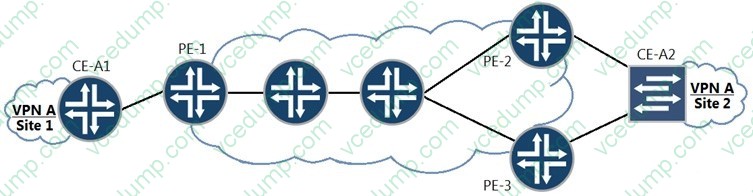
Referring to the exhibit, you need to implement VPLS between CE-A1 and CE-A2. You must ensure that no loops are created due to the multihoming of the connection from CE-A2 to PE2 and PE3. Based on the type of VPLS, which two solutions will satisfy this requirement? (Choose two.)
A. In an LDP VPLS, configure a primary and backup neighbor.
B. In an LDP VPLS, configure multihoming and local preference on PE-2 and PE-3.
C. In a BGP VPLS, configure multihoming and local preference on PE-2 and PE-3.
D. In a BGP VPLS, configure a primary and backup neighbor. -
Question 33:
You are considering different MPLS VPN connectivity options for a new customer deployment. Your customer requires shared LSPs, Layer 2 connectivity, and auto-provisioning. Which type of VPN satisfies the requirements?
A. BGP Layer 3 VPNs
B. circuit cross-connects
C. LDP Layer 2 circuits
D. BGP Layer 2 VPNs -
Question 34:
What are two reasons an IBGP learned route would be hidden? (Choose two.)
A. The route is suppressed by damping.
B. The route has a next hop of the local routing device.
C. The route is rejected by an export policy.
D. The route has an empty AS path. -
Question 35:
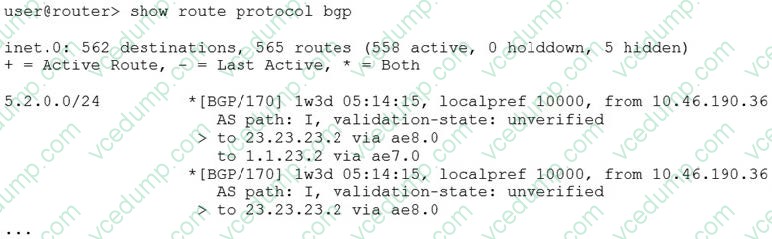
Referring to the exhibit, which statement is true?
A. This is a multipath route.
B. The route is learned from three different neighbors.
C. This is a multihop route.
D. The route is learned from only one neighbor. -
Question 36:
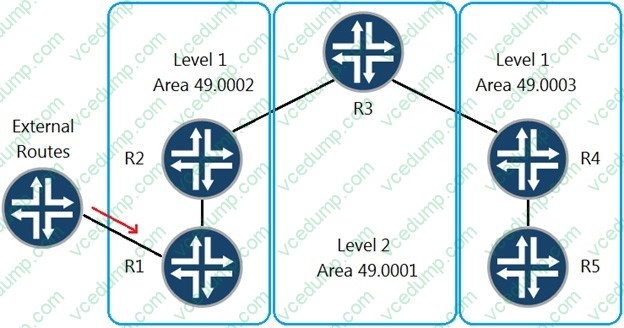
Referring to the exhibit, external routes are being received at R1. These routes must appear on R5. Which action will produce this result?
A. Write an export policy on R4 from level 2 to level 1 matching the external routes.
B. Turn on wide metrics on R1 and R2 and write an export policy on R4 from level 2 to level 1 matching the external routes.
C. Write an export policy on R2 from level 1 to level 2 matching the external routes.
D. Turn on wide metrics on R4 and R5 and write an export policy on R2 from level 1 to level 2 matching the external routes. -
Question 37:
Which two statements about virtual links are correct? (Choose two.)
A. Virtual links are point-to-point.
B. Virtual links are used for control plane traffic.
C. Virtual links are excluded from SPF calculations.
D. Virtual links are bidirectional. -
Question 38:
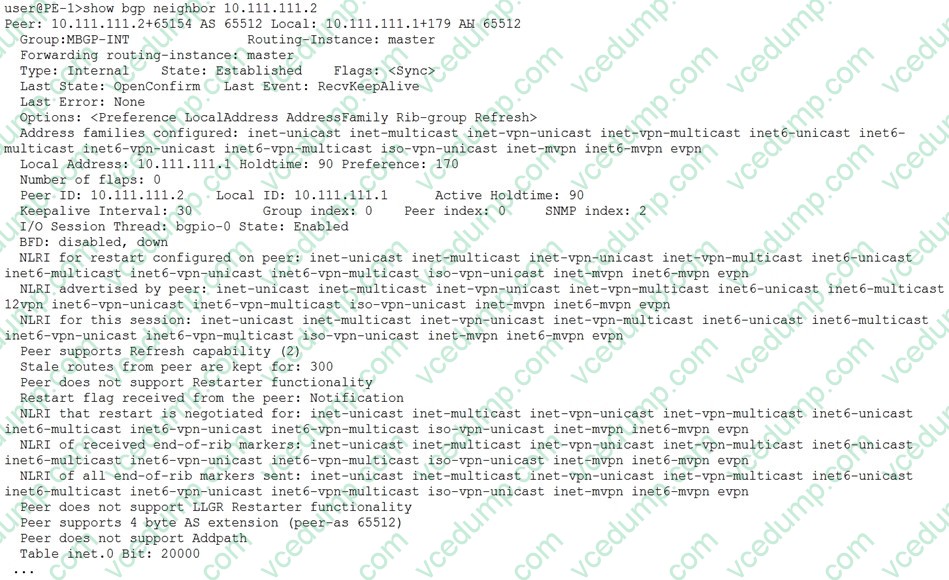
The exhibit shows a BGP peering session for two PE routers. The BGP session is up, but the hosts in the Layer 2 VPN that uses the BGP session are unable to communicate. What is the problem in this situation?
A. The BGP peer does not support the add-path feature.
B. There is a mismatch in the supported NLRI address families between the BGP peers.
C. The local BGP router does not support Layer 2 VPN and Layer 3 VPN NLRI address families at the same time.
D. The BGP peer does not support the restarter functionality. -
Question 39:
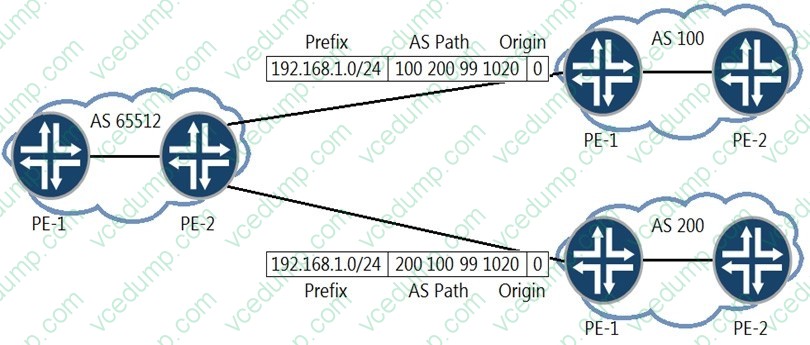
You are the administrator of AS 65512. You are learning the 192.168.1.0/24 prefix from both AS 100 and AS 200. You want traffic destined to the 192.168.1.0.0/24 prefix to exit your AS towards AS 200. How would you accomplish this task?
A. Configure an import routing policy on PE-2 to set a higher MED on the path learned from AS 100.
B. Configure an import routing policy on PE-2 to modify the origin attribute on the path learned from AS 100.
C. Configure an import routing policy on PE-2 to set a higher local preference value on the path learned from AS 200.
D. Configure an import routing policy on PE-2 to append the AS path attribute on the path learned from AS 100. -
Question 40:
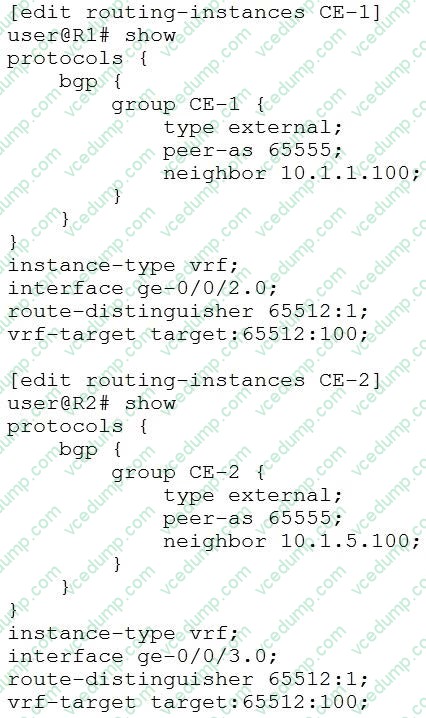
Referring to the exhibit, which two statements are true? (Choose two.)
A. The CE-1 and CE-2 routes will have the same route distinguisher, which will stop the BGP routes from being shared.
B. An AS loop will not exist between CE-1 and CE-2 and the BGP routes will be shared.
C. An AS loop will exist between CE-1 and CE-2 and the BGP routes will not be shared.
D. The CE-1 and CE-2 routes will have the same route distinguisher, which will not stop the BGP routes from being shared.
Related Exams:
-
JN0-102
Internet Associate, Junos(JNCIA-Junos) -
JN0-104
Junos, Associate (JNCIA-Junos) -
JN0-105
Junos, Associate (JNCIA-Junos) -
JN0-106
Junos - Associate (JNCIA-Junos) Junos OS 21.2 -
JN0-1101
Juniper Networks Certified Design Associate (JNCDA) -
JN0-1103
Design, Associate (JNCIA-Design) -
JN0-130
Juniper networks Certified internet specialist.e(jncis-e) -
JN0-1301
Data Center Design, Specialist (JNCDS-DC) -
JN0-1302
Data Center Design Specialist (JNCDS-DC) -
JN0-1331
Security Design, Specialist (JNCDS-SEC)
Tips on How to Prepare for the Exams
Nowadays, the certification exams become more and more important and required by more and more enterprises when applying for a job. But how to prepare for the exam effectively? How to prepare for the exam in a short time with less efforts? How to get a ideal result and how to find the most reliable resources? Here on Vcedump.com, you will find all the answers. Vcedump.com provide not only Juniper exam questions, answers and explanations but also complete assistance on your exam preparation and certification application. If you are confused on your JN0-663 exam preparations and Juniper certification application, do not hesitate to visit our Vcedump.com to find your solutions here.