JN0-663 Exam Details
-
Exam Code
:JN0-663 -
Exam Name
:Service Provider Routing and Switching, Professional (JNCIP-SP) -
Certification
:Juniper Certifications -
Vendor
:Juniper -
Total Questions
:96 Q&As -
Last Updated
:Jul 12, 2026
Juniper JN0-663 Online Questions & Answers
-
Question 41:
You are configuring a BGP signaled Layer 2 VPN across your MPLS enabled core network. In this scenario, which statement is correct?
A. This type of VPN is only supported over LSPs that are using traffic-engineering.
B. You must use a unique route distinguisher value on all PE devices in your environment.
C. You must ensure that all interfaces within the site's configuration are explicitly defined with their remote site identifier values.
D. This type of VPN requires the support of the 12vpn signaling NLRI on all route reflectors and participating PE devices. -
Question 42:
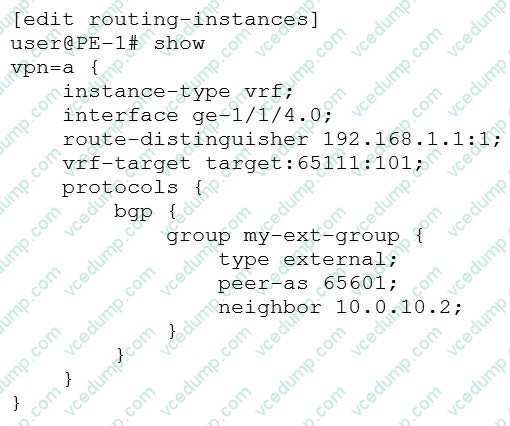
You have an established Layer 3 VPN between two PE devices. You are asked to only send certain routes from PE-1 over the VPN to the remote site while maintaining all the routes on the PE-1 device. You created a policy that matches the specific routes and then tags these routes with the appropriate target community values.
In this scenario, which configuration changes must be made to satisfy the requirement?
A. Configure the export parameter and apply the policy to the my-ext-group BGP group configuration.
B. Configure the vrf-export parameter and apply the policy under the edit routing-instances vpn-a hierarchy.
C. Configure a RIB group and apply the policy as an import policy to routes distributed into the bgp.13vpn.0 routing table.
D. Configure the import parameter and apply the policy to the my-ext-group BGP group configuration. -
Question 43:
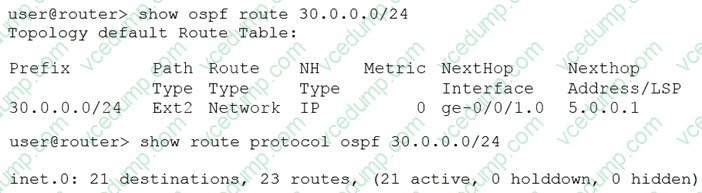
You notice an inconsistency between the routing table and the OSPF database, as shown in the exhibit. What are two reasons for this behavior? (Choose two.)
A. The LSA is a Type 4 LSA.
B. An OSPF export policy is being applied to the route.
C. An OSPF import policy is being applied to the route.
D. The LSA is a Type 5 LSA. -
Question 44:
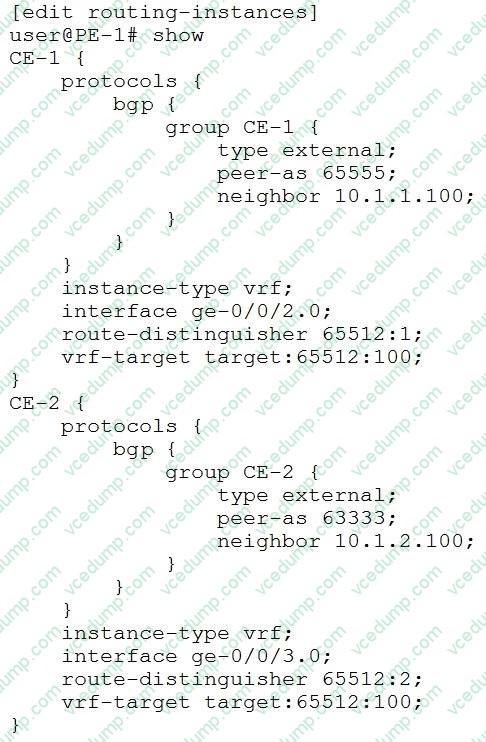
Two CE devices (CE-1 and CE-2) belong to the same customer and connect into a single PE device (PE-1). However, the CE devices cannot communicate with each other. You want to allow the CE devices to communicate with each other. Referring to the exhibit, which action would solve the problem?
A. Configure both routing instances with the set routing-options autonomous-system loops 3 statement.
B. Configure both routing instances with the as-override statement within the BGP protocol.
C. Configure both routing instances with the vrf-table-label statement.
D. Configure both routing instances with the set routing-options auto-export statement. -
Question 45:
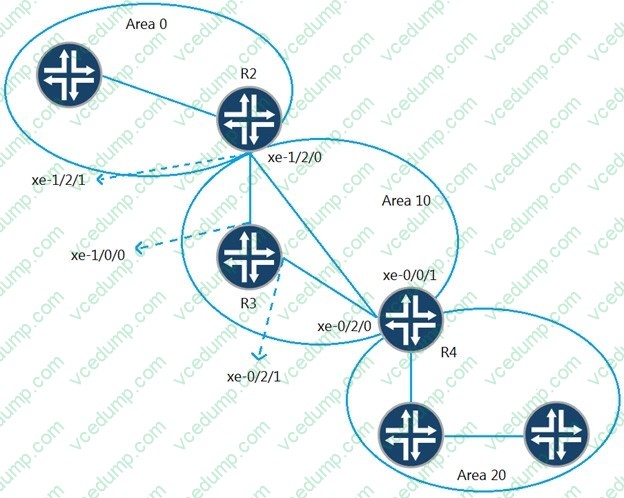
You must configure an OSPF virtual link to facilitate communication between Area 0 and Area 20.
Referring to the exhibit, which two addresses should you use as the neighbor IDs of the virtual link endpoints? (Choose two.)
A. The address that is associated with R4's xe-0/0/1 interface.
B. The address that is associated with R2's router ID.
C. The address that is associated with R2's xe-1/2/0 interface.
D. The address that is associated with R4's router ID. -
Question 46:
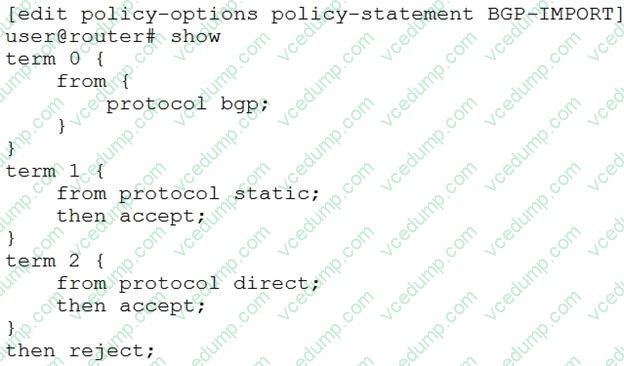
You are troubleshooting a problem with a BGP peer where BGP routes are not being accepted from that peer. Referring to the exhibit, which two statements are correct? (Choose two.)
A. Term 0 is missing a terminating action that allows BGP routes to be accepted.
B. Term 0 is missing a route-filter that specifies the allowed routes.
C. The reject at the end of the policy is preventing the routes from being accepted.
D. You cannot have terminating actions outside of terms. -
Question 47:
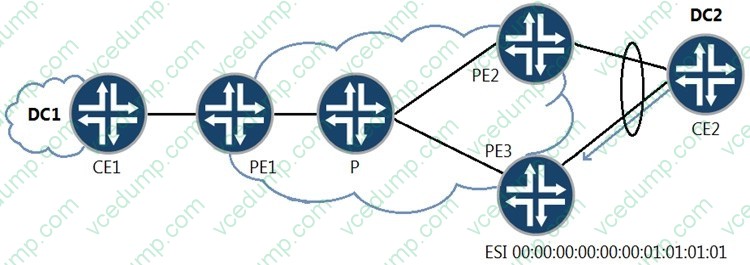
Referring to the exhibit, traffic sent from CE-A2 to PE3 does not loop back to CE-A2 through PE2. Winch two EVPN functions accomplish this task? (Choose two.)
A. multicast ingress replication
B. aliasing
C. split horizon
D. designated forwarder election -
Question 48:
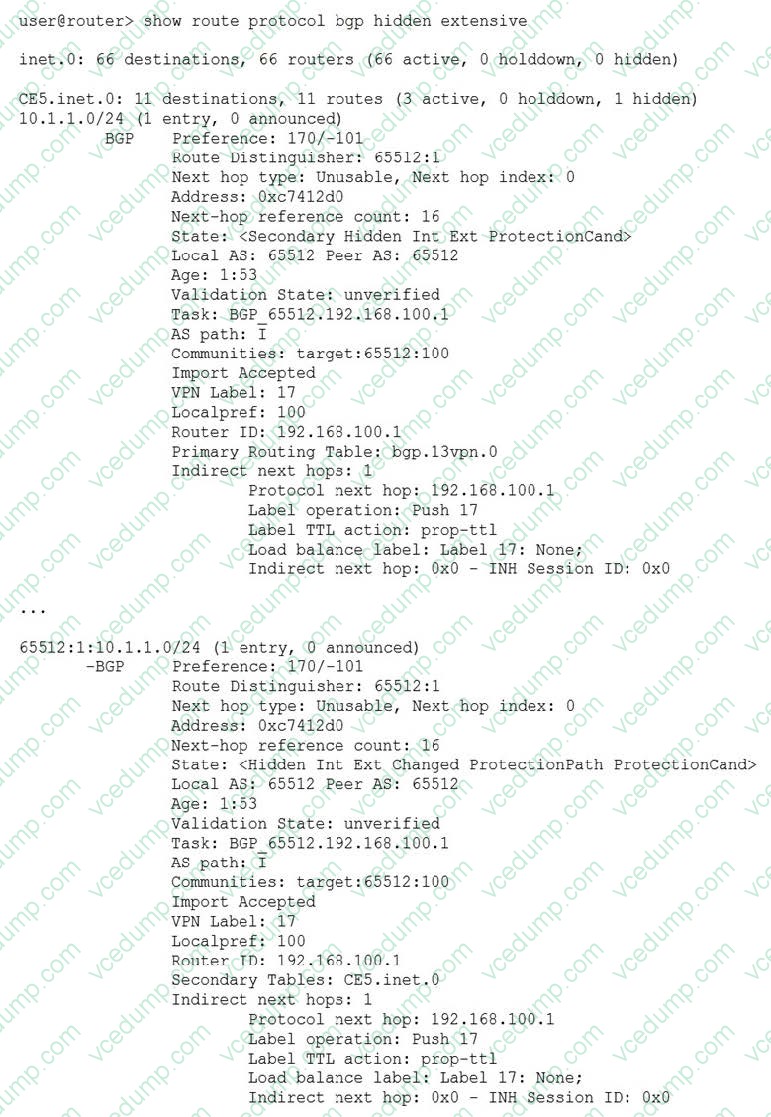
Referring to the exhibit, a Layer 3 VPN is configured, however, the routes are being hidden. What is the problem?
A. The BGP peer is not reachable through the IGP.
B. An active MPLS tunnel does not exist between the peers.
C. A route distinguisher mismatch exists between the peers.
D. A VRF target community mismatch exists between the peers. -
Question 49:
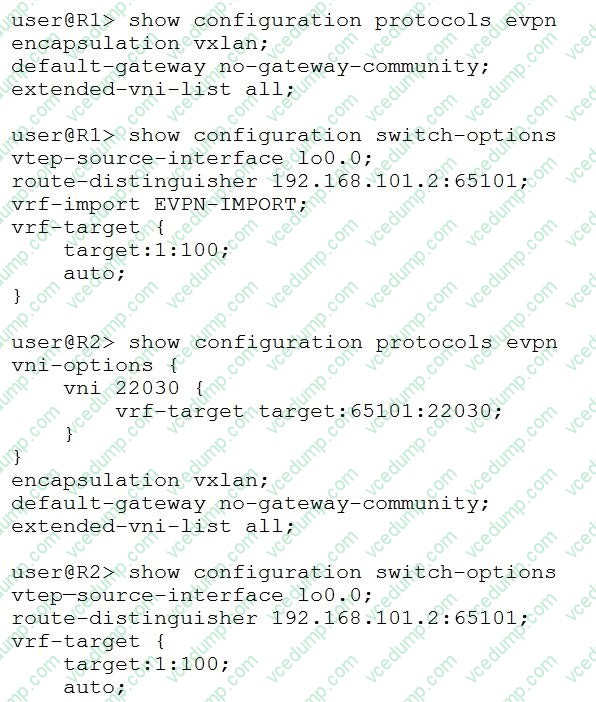
You are using EVPN to provide Layer 2 stretched VLANs between two sites. You notice that the MAC addresses in either site are not showing up on the remote site. Referring to the exhibit, what are two ways to solve this problem? (Choose two.)
A. On R1, issue the set switch-options vrf-target target:65101:22030 command.
B. On R2, issue the delete protocols evpn vni-options vni 22030 command.
C. On R2, issue the set switch-options vrf-target target:65101:22030 command.
D. On R1, issue the set protocols evpn vni-options vni 22030 vrf-target target :65101:22030 command. -
Question 50:
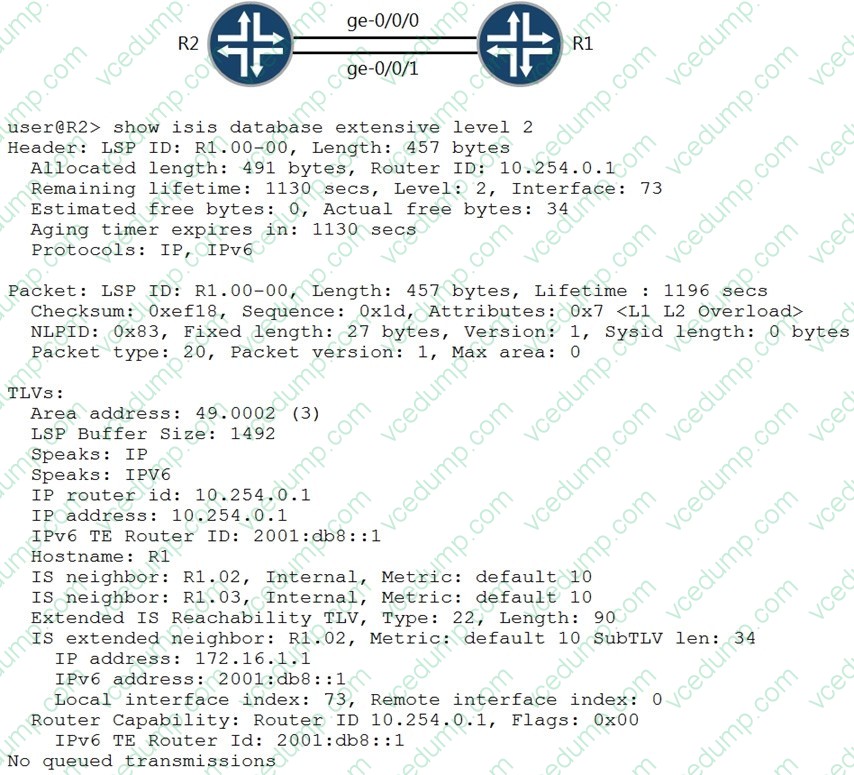
A network administrator is investigating why traffic from R2 is not being forwarded to R1.
Referring to the show isis database command output shown in the exhibit, what is causing this problem on the network?
A. R1 and R2 are in different IS-IS areas.
B. The preferred interface between R1 and R2 is experiencing errors.
C. R1 is configured to drop all incoming traffic.
D. R2 is ignoring specific LSPs from R1 in its SPF calculations.
Related Exams:
-
JN0-102
Internet Associate, Junos(JNCIA-Junos) -
JN0-104
Junos, Associate (JNCIA-Junos) -
JN0-105
Junos, Associate (JNCIA-Junos) -
JN0-106
Junos - Associate (JNCIA-Junos) Junos OS 21.2 -
JN0-1101
Juniper Networks Certified Design Associate (JNCDA) -
JN0-1103
Design, Associate (JNCIA-Design) -
JN0-130
Juniper networks Certified internet specialist.e(jncis-e) -
JN0-1301
Data Center Design, Specialist (JNCDS-DC) -
JN0-1302
Data Center Design Specialist (JNCDS-DC) -
JN0-1331
Security Design, Specialist (JNCDS-SEC)
Tips on How to Prepare for the Exams
Nowadays, the certification exams become more and more important and required by more and more enterprises when applying for a job. But how to prepare for the exam effectively? How to prepare for the exam in a short time with less efforts? How to get a ideal result and how to find the most reliable resources? Here on Vcedump.com, you will find all the answers. Vcedump.com provide not only Juniper exam questions, answers and explanations but also complete assistance on your exam preparation and certification application. If you are confused on your JN0-663 exam preparations and Juniper certification application, do not hesitate to visit our Vcedump.com to find your solutions here.