JN0-663 Exam Details
-
Exam Code
:JN0-663 -
Exam Name
:Service Provider Routing and Switching, Professional (JNCIP-SP) -
Certification
:Juniper Certifications -
Vendor
:Juniper -
Total Questions
:96 Q&As -
Last Updated
:Jul 12, 2026
Juniper JN0-663 Online Questions & Answers
-
Question 11:
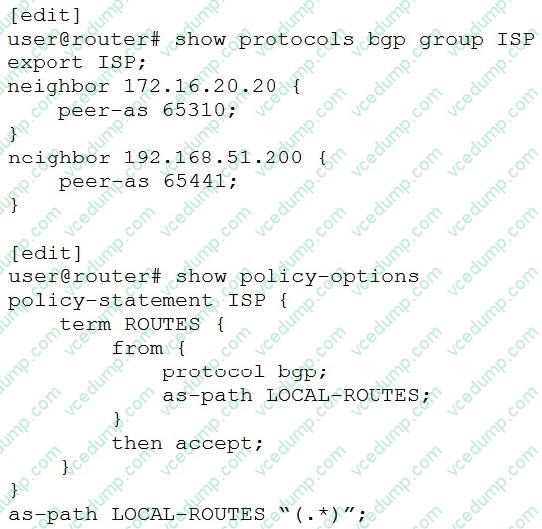
Your network is connected to two different ISPs and you notice that they are using your network for transit traffic. In this scenario, which two configuration statements will solve this problem? (Choose two.)
A. set policy-options policy-statement ISP term REST then reject
B. set policy-options policy-statement ISP term ROUTES then reject
C. set policy-options as-path LOCAL-ROUTES "()"
D. set policy-options as-path LOCAL-ROUTES "(65310|65441)+" -
Question 12:
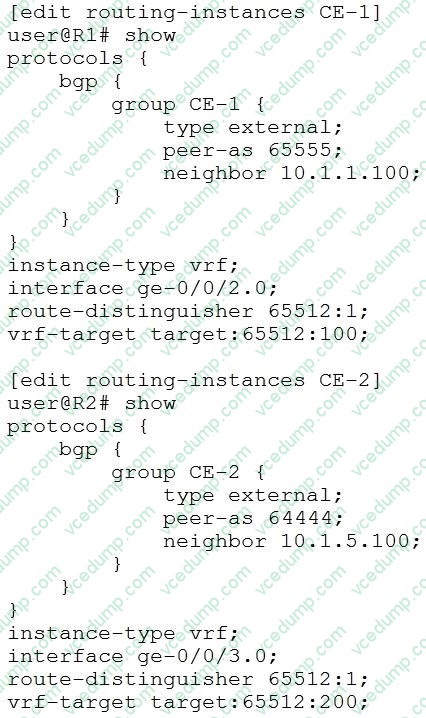
Referring to the exhibit, which two statements are true? (Choose two.)
A. The route-distinguisher configuration allows routes to be shared between CE-1 and CE-2.
B. The vrf-target configuration stops routes from being shared between CE-1 and CE-2.
C. The route-distinguisher configuration stops routes from being shared between CE-1 and CE-2.
D. The vrf-target configuration allows routes to be shared between CE-1 and CE-2. -
Question 13:
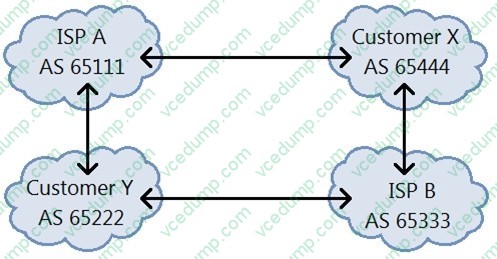
All networks shown in the exhibit contain more than one BGP speaker. You operate ISP A and must ensure that Customer Y sends their traffic to you over the directly connected link. Customer Y is not to be used for transit into your network. What would you do to accomplish this task?
A. Advertise routes to Customer X with the custom defined 0:0 community.
B. Advertise routes to Customer X with the well-known no-advertise community.
C. Advertise routes to Customer Y with the custom defined 65535:65535 community.
D. Advertise routes to Customer Y with the well-known no-export community. -
Question 14:
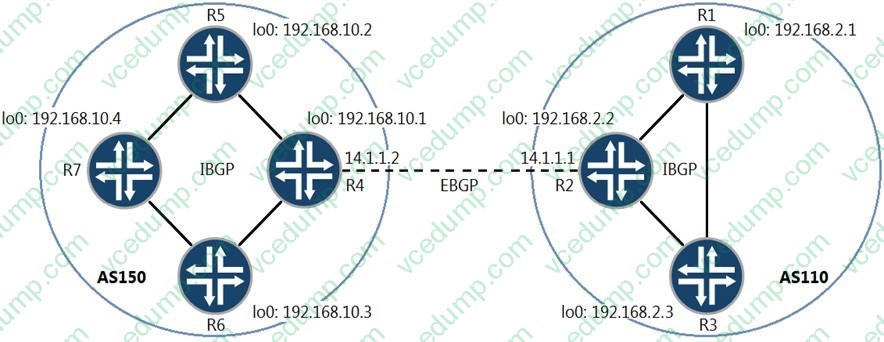
Referring to the exhibit, which two statements are correct for a route advertised by R1 towards R4? (Choose two.)
A. The BGP next hop is set to 14.1.1.1 by R2.
B. The AS path is set to 150 by R2.
C. The BGP next hop is set to 192.168.2.2 by R2.
D. The AS path is set to null by R2. -
Question 15:
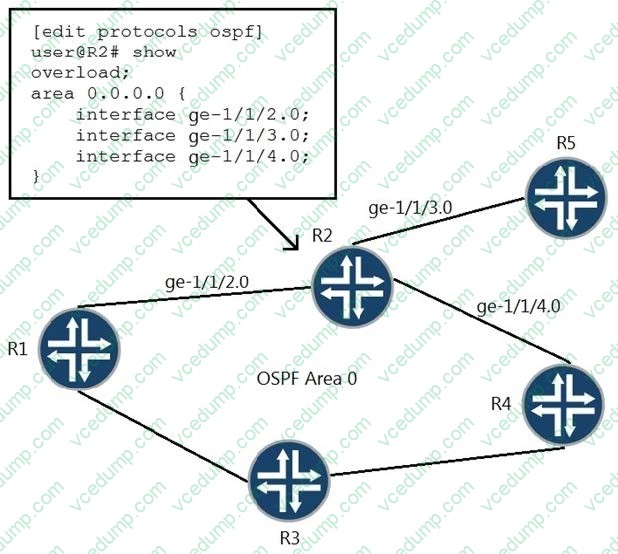
Referring to the exhibit, which two statements are correct? (Choose two.)
A. R2 stops sending LSAs into the network.
B. The OSPF interface metrics on R2 are all set to 65535.
C. R1 will never forward transit traffic through R2.
D. Transit traffic from R1 to R4 will traverse R3. -
Question 16:
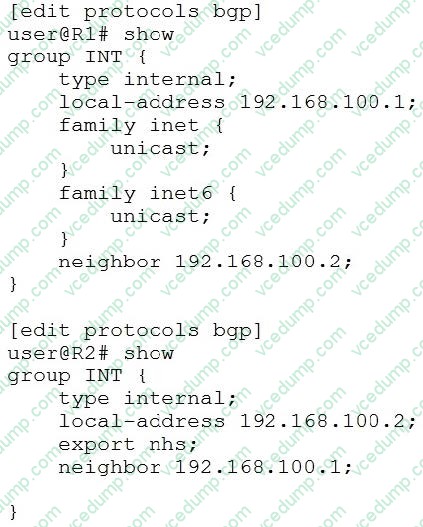
Referring to the exhibit, which statement is true?
A. The BGP session between R1 and R2 will establish correctly and only the inet6 unicast NLRI will pass routing information.
B. The BGP session between R1 and R2 will fail to establish correctly due to an NLRI mismatch.
C. The BGP session between R1 and R2 will establish correctly and the inet unicast and the inet6 unicast NLRIs will pass routing information.
D. The BGP session between R1 and R2 will establish correctly and only the inet unicast NLRI will pass routing information. -
Question 17:
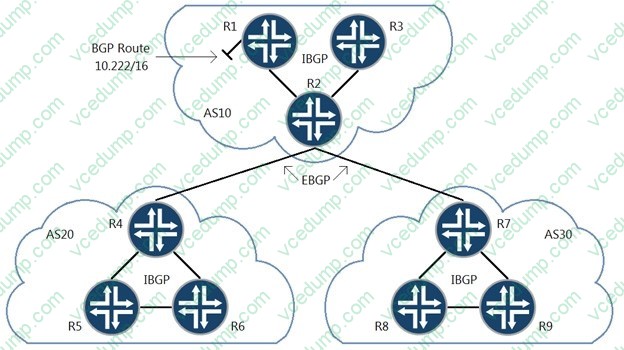
Referring to the exhibit, which three statements about route 10.222/16 are correct when using the default BGP advertisement rules? (Choose three)
A. R1 will prepend AS10 when advertising 10.222/16 to R2.
B. R2 will prepend AS10 when advertising 10.222/16 to R7.
C. R2 will advertise 10.222/16 to R4 with itself as the next hop.
D. R1 will advertise 10.222/16 to R2 with itself as the next hop.
E. R7 will advertise 10.222/16 to R9 with itself as the next hop. -
Question 18:
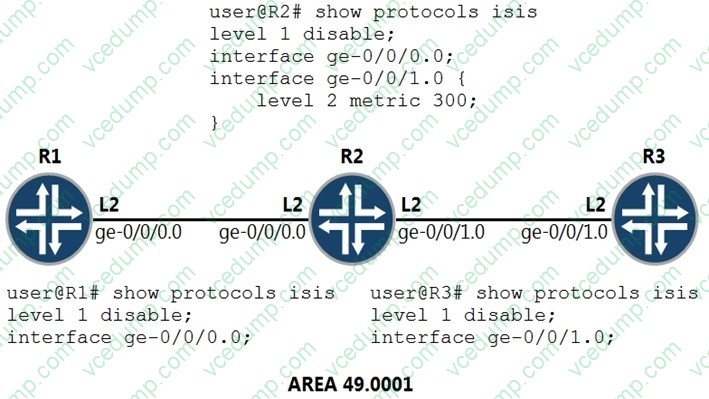
Referring to the exhibit, what will the IS-IS cost be for R1 to reach R3?
A. 73
B. 20
C. 301
D. 310 -
Question 19:
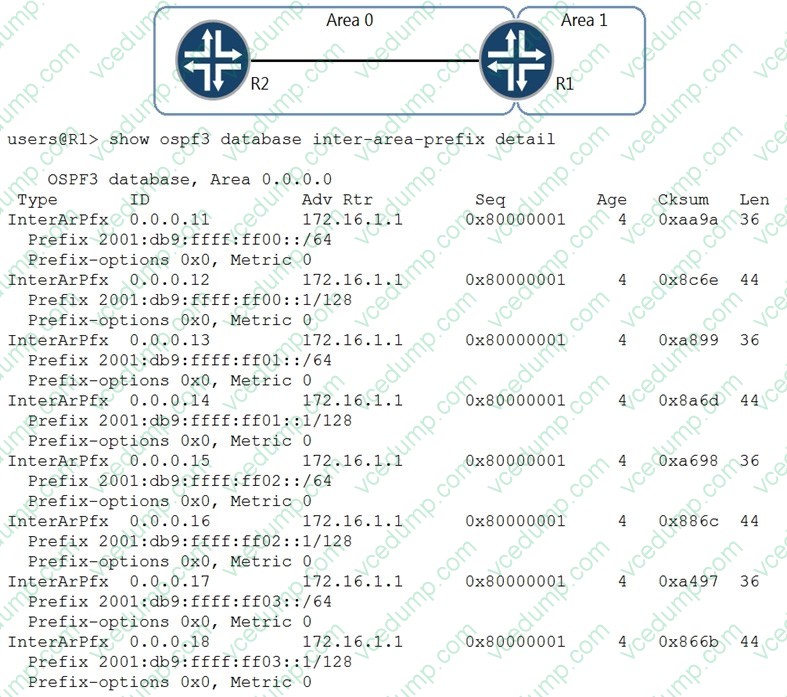
Referring to the exhibit, which command would reduce the size of the OSPF database and corresponding routes?
A. Option A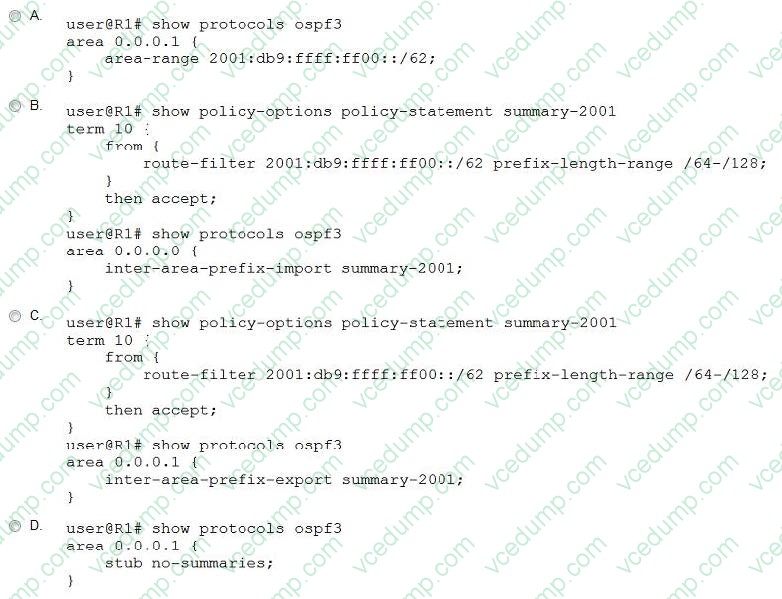
B. Option B
C. Option C
D. Option D -
Question 20:
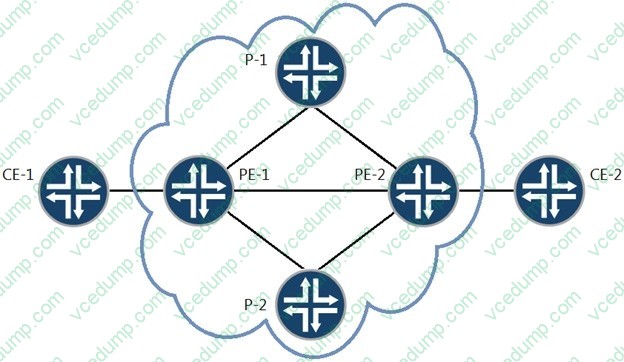
A Layer 3 VPN exists in the provider network and the CE devices are connecting to the PE devices using BGP. The PE devices are receiving BGP routes from the CE devices and the PE devices have the CE BGP routes in their respective routing tables. However, the remote CE devices are not receiving the BGP routes.
Referring to the exhibit, what is the problem?
A. A route distinguisher mismatch exists.
B. The PE devices are detecting an AS loop.
C. The CE devices are detecting an AS loop.
D. A VRF target community mismatch exists.
Related Exams:
-
JN0-102
Internet Associate, Junos(JNCIA-Junos) -
JN0-104
Junos, Associate (JNCIA-Junos) -
JN0-105
Junos, Associate (JNCIA-Junos) -
JN0-106
Junos - Associate (JNCIA-Junos) Junos OS 21.2 -
JN0-1101
Juniper Networks Certified Design Associate (JNCDA) -
JN0-1103
Design, Associate (JNCIA-Design) -
JN0-130
Juniper networks Certified internet specialist.e(jncis-e) -
JN0-1301
Data Center Design, Specialist (JNCDS-DC) -
JN0-1302
Data Center Design Specialist (JNCDS-DC) -
JN0-1331
Security Design, Specialist (JNCDS-SEC)
Tips on How to Prepare for the Exams
Nowadays, the certification exams become more and more important and required by more and more enterprises when applying for a job. But how to prepare for the exam effectively? How to prepare for the exam in a short time with less efforts? How to get a ideal result and how to find the most reliable resources? Here on Vcedump.com, you will find all the answers. Vcedump.com provide not only Juniper exam questions, answers and explanations but also complete assistance on your exam preparation and certification application. If you are confused on your JN0-663 exam preparations and Juniper certification application, do not hesitate to visit our Vcedump.com to find your solutions here.