JN0-663 Exam Details
-
Exam Code
:JN0-663 -
Exam Name
:Service Provider Routing and Switching, Professional (JNCIP-SP) -
Certification
:Juniper Certifications -
Vendor
:Juniper -
Total Questions
:96 Q&As -
Last Updated
:Jul 12, 2026
Juniper JN0-663 Online Questions & Answers
-
Question 1:
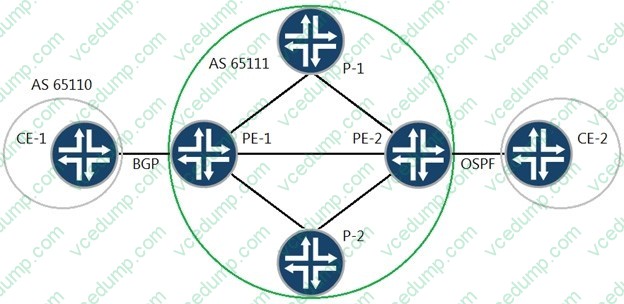
You have a Layer 3 VPN established between PE-1 and PE-2 to allow communication between CE-1 and CE-2. Referring to the exhibit, which statement is correct?
A. You will need an OSPF import policy on PE-1 to receive the BGP routes, learned from PE-2, through the Layer 3 VPN.
B. You will need a BGP export policy on PE-1 to redistribute the routes, learned from CE-1, through the Layer 3 VPN.
C. You will need a VRF import policy on PE-1 to advertise the BGP routes, learned from CE-1, through the Layer 3 VPN.
D. You will need an OSPF export policy on PE-2 to redistribute the BGP routes, learned from PE-1, through the Layer 3 VPN. -
Question 2:
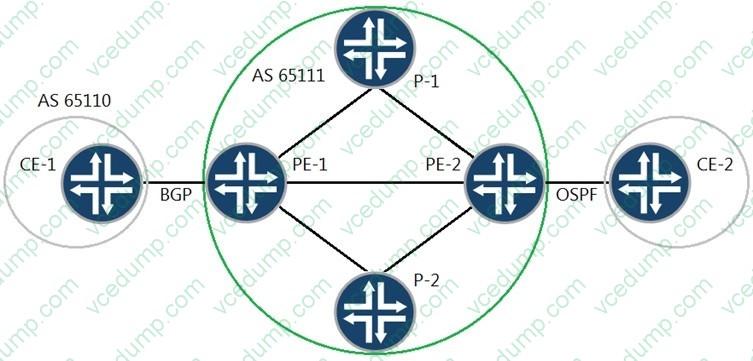
You have a Layer 3 VPN established between PE-1 and PE-2 to allow communication between CE-1 and CE-2. You want to establish communication between CE-1 and CE-2. Referring to the exhibit, which statement is correct?
A. You will need a BGP export policy on PE-1 to redistribute the OSPF routes, learned from PE-2, to the CE1 BGP neighbor.
B. You will need a VRF import policy on PE-2 to advertise the OSPF routes, learned from CE-2, through the Layer 3 VPN.
C. You will need a VRF export policy on PE-2 to redistribute the OSPF routes, learned from CE-2, through the Layer 3 VPN.
D. You will need a VRF import policy on PE-1 to receive the OSPF routes, learned from PE-2, through the Layer 3 VPN. -
Question 3:
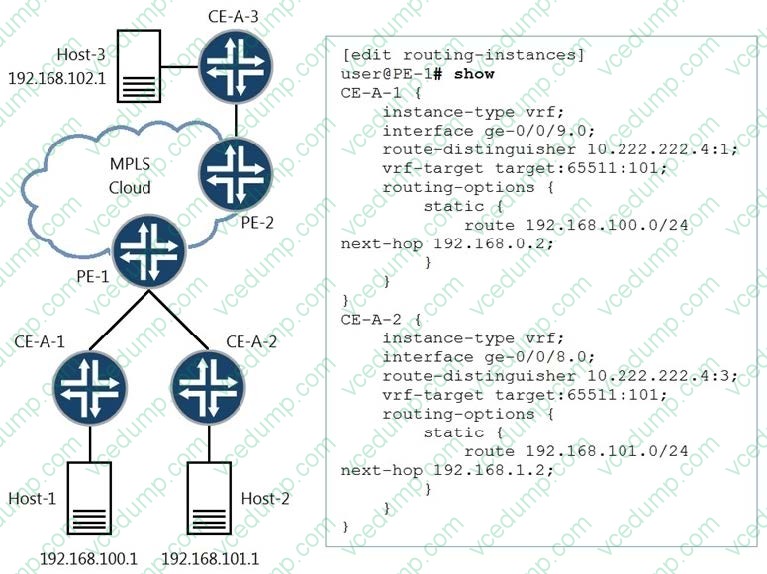
Referring to the exhibit, there is a Layer 3 VPN setup that connects sites CE-A-1, CE-A-2, and CE-A-3 together. Host-1 can communicate with Host-3, but Host-1 cannot communicate with Host-2. What must you do to solve the problem?
A. Change the route distinguisher in both routing instances to the same value.
B. Use the next-table configuration statement for static routes in the corresponding routing instances.
C. Use BGP instead of static routing between the CE and PE devices.
D. Use the auto-export command in both routing instances. -
Question 4:
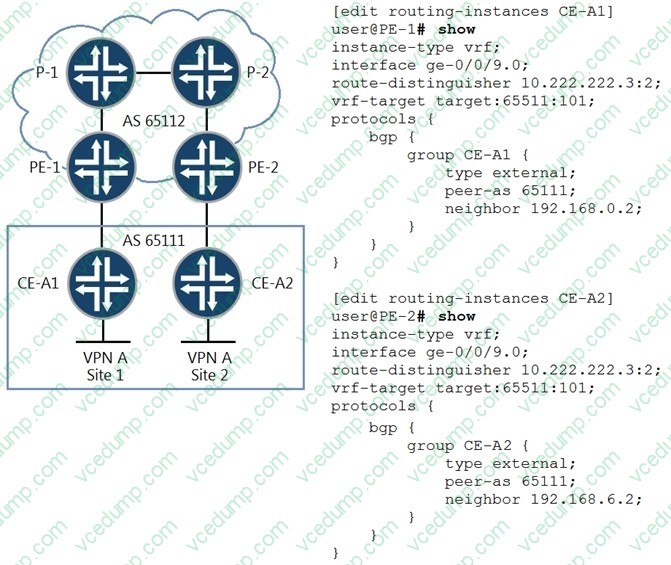
Referring to the exhibit, hosts in Site 1 and Site 2 are unable to communicate with each other through the Layer 3 VPN. What is the problem?
A. The two sites are in the same AS.
B. The two sites are using the same instance type.
C. The two sites are using the same route target.
D. The two sites are using the same route distinguisher. -
Question 5:
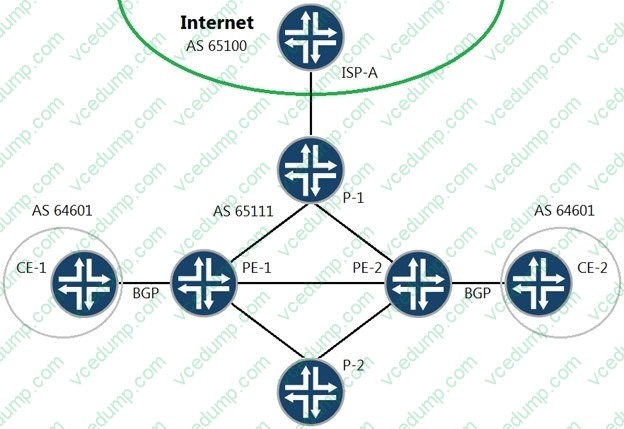
Referring to the exhibit, you have recently established a Layer 3 VPN between PE-1 and PE-2, connecting the two CE sites. Routing information is being shared between sites and the customer has two-way communication. After adding this VPN to your core network, PE-1 and PE-2 are no longer able to forward traffic to the Internet.
In this scenario, what is the problem?
A. You must configure the inet-vpn NLRI for the BGP sessions on both your PE devices.
B. You must configure a multihop external BGP session between your PE devices and the Internet provider's ISP-A device
C. You must configure the inet unicast NLRI for the BGP session on both your PE devices.
D. You must configure a separate internal BGP group on both your PE devices specifically for Internet connectivity. -
Question 6:
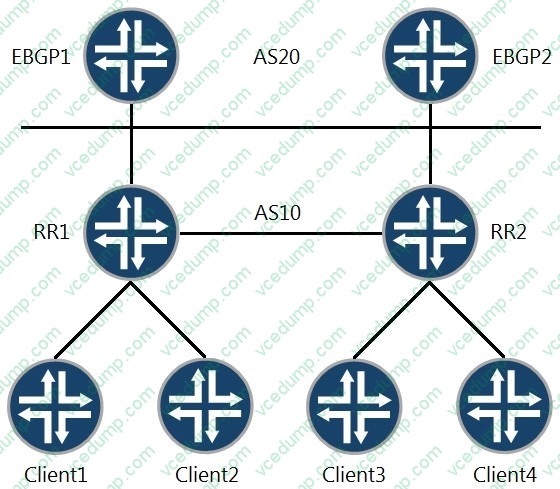
Referring to the exhibit, which two statements about route reflectors are correct? (Choose two.)
A. RR1 advertises routes learned from Client1 to RR2 with itself as the next hop.
B. RR2 advertises routes learned from Client3 to EBGP2 with itself as the next hop.
C. RR1 and RR2 need the same cluster ID to exchange routes learned from their clients.
D. RR2 adds its cluster ID when advertising routes from Client4 to Client3. -
Question 7:
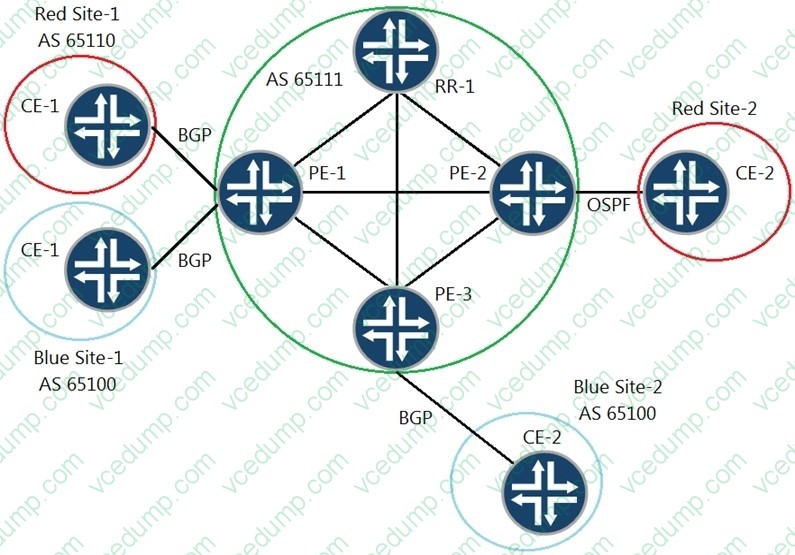
You have a Layer 3 VPN established between PE-1 and PE-2 as well as between PE-1 and PE-3. You are using a route reflector (RR-1) to distribute VPN routes to your IBGP peers. You are asked to ensure that only relevant routes are sent from RR-1 to each of the PE routers.
Referring to the exhibit, which statement is correct?
A. You should use VRF export policies on RR-1 to control which routes are sent to each PE router.
B. You should use route target filtering only on RR-1 to control which routes are sent to each PE router.
C. You should use firewall filtering on RR-1 and all the PE devices to control which routes are sent to each PE router.
D. You should use route target filtering on RR-1 and all the PE devices to control which routes are sent to each PE router. -
Question 8:
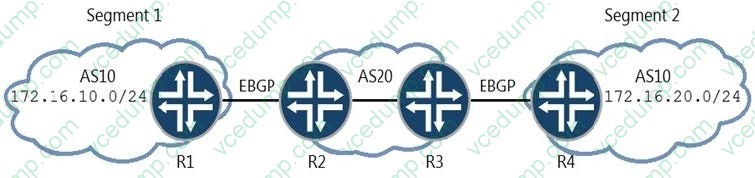
Your network connects two segments of your customer's network as shown in the exhibit. They need to exchange routes between Segment 1 and Segment 2 but both segments use the same AS number. Which two steps will accomplish this task? (Choose two.)
A. Configure the routing-options autonomous-system loops 1 parameter on routers R1 and R4.
B. Configure the BGP group with the advertise-peer-as parameter on routers R2 and R3.
C. Configure the routing-options autonomous-system loops 1 parameter on routers R2 and R3.
D. Configure the BGP group with the as-override parameter on routers R1 and R4. -
Question 9:
You recently deployed CoS-based forwarding in your network, which uses OSPF as its IGP. You notice that the forwarding of traffic has not changed and is not following the path indicated within your configuration. In this scenario, which statement explains this behavior?
A. The defined policy references IP addresses as the next-hops instead of interface names.
B. Load balancing has not been enabled under [edit forwarding-options].
C. The defined policy references interface names as the next-hops instead of IP addresses.
D. The defined policy has not been applied under [edit class-of-service forwarding-policy]. -
Question 10:
Why do interprovider option B VPNs scale better than interprovider option A VPNs?
A. The ASBRs in interprovider option B VPNs do not need per-VPN VRF tables.
B. The ASBRs in interprovider option A VPNs do not need per-VPN VRF tables.
C. The ASBRs in interprovider option A VPNs only carry internal routes.
D. The ASBRs in interprovider option B VPNs only carry internal routes.
Related Exams:
-
JN0-102
Internet Associate, Junos(JNCIA-Junos) -
JN0-104
Junos, Associate (JNCIA-Junos) -
JN0-105
Junos, Associate (JNCIA-Junos) -
JN0-106
Junos - Associate (JNCIA-Junos) Junos OS 21.2 -
JN0-1101
Juniper Networks Certified Design Associate (JNCDA) -
JN0-1103
Design, Associate (JNCIA-Design) -
JN0-130
Juniper networks Certified internet specialist.e(jncis-e) -
JN0-1301
Data Center Design, Specialist (JNCDS-DC) -
JN0-1302
Data Center Design Specialist (JNCDS-DC) -
JN0-1331
Security Design, Specialist (JNCDS-SEC)
Tips on How to Prepare for the Exams
Nowadays, the certification exams become more and more important and required by more and more enterprises when applying for a job. But how to prepare for the exam effectively? How to prepare for the exam in a short time with less efforts? How to get a ideal result and how to find the most reliable resources? Here on Vcedump.com, you will find all the answers. Vcedump.com provide not only Juniper exam questions, answers and explanations but also complete assistance on your exam preparation and certification application. If you are confused on your JN0-663 exam preparations and Juniper certification application, do not hesitate to visit our Vcedump.com to find your solutions here.