JN0-663 Exam Details
-
Exam Code
:JN0-663 -
Exam Name
:Service Provider Routing and Switching, Professional (JNCIP-SP) -
Certification
:Juniper Certifications -
Vendor
:Juniper -
Total Questions
:96 Q&As -
Last Updated
:Jul 12, 2026
Juniper JN0-663 Online Questions & Answers
-
Question 21:
You are responsible for configuring CoS for your network Your network includes a video application with strict latency requirements, so that any packets delayed by more than 75 ms are effectively useless. You want to ensure that you do not waste buffer space.
When configuring the scheduler for this application, which feature would you use?
A. remainder
B. exact
C. temporal
D. rate limit -
Question 22:
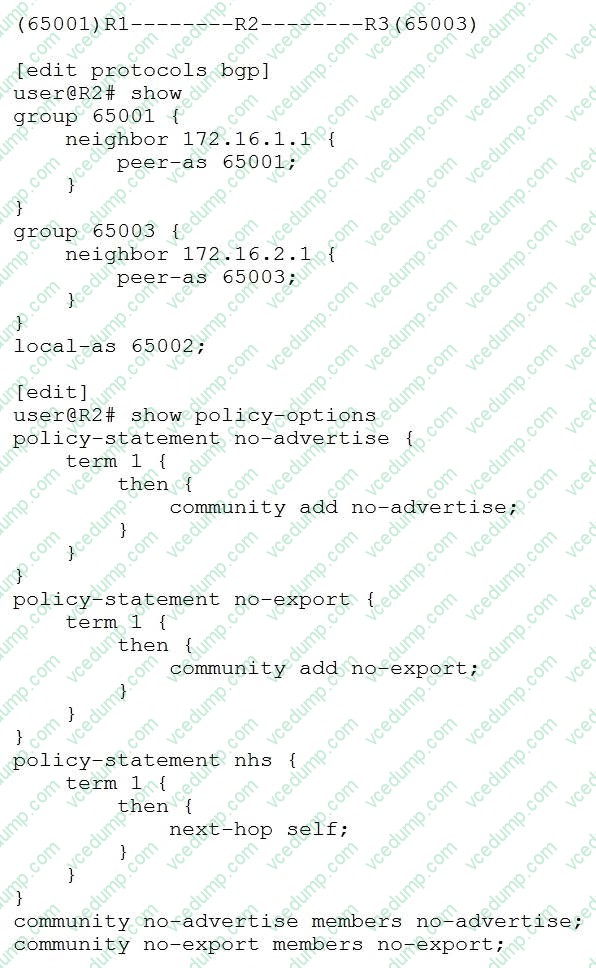
R2 is receiving a route from R1 and you must ensure that the route is not advertised to R3. Referring to the exhibit, which two configuration changes on R2 will solve the issue? (Choose two.)
A. Apply the no-export policy as an import policy under group 65001.
B. Apply the no-advertise policy as an export policy under group 65003.
C. Apply the no-export policy as an export policy under group 65003.
D. Apply the no-advertise policy as an import policy under group 65001. -
Question 23:
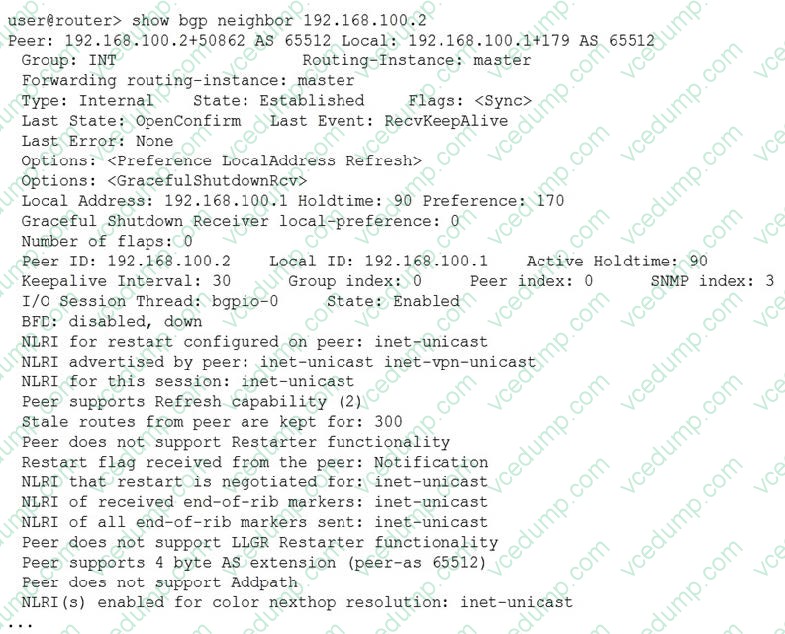
Referring to the exhibit, the local BGP router is receiving IPv4 routes from the BGP neighbor, but it is not receiving L3 VPN routes from the BGP neighbor. Which two actions should you take to solve this problem? (Choose two.)
A. Configure the family inet-vpn unicast statement on the BGP neighbor.
B. Configure the family inet unicast statement on the local BGP router.
C. Configure the family inet-vpn unicast statement on the local BGP router.
D. Configure the family inet unicast statement on the BGP neighbor. -
Question 24:
You must deploy an interprovider VPN option that ensures that the ASBRs do not need to store any VPN routes. In this scenario, which interprovider VPN option should you choose?
A. option A
B. option B
C. option D
D. option C -
Question 25:
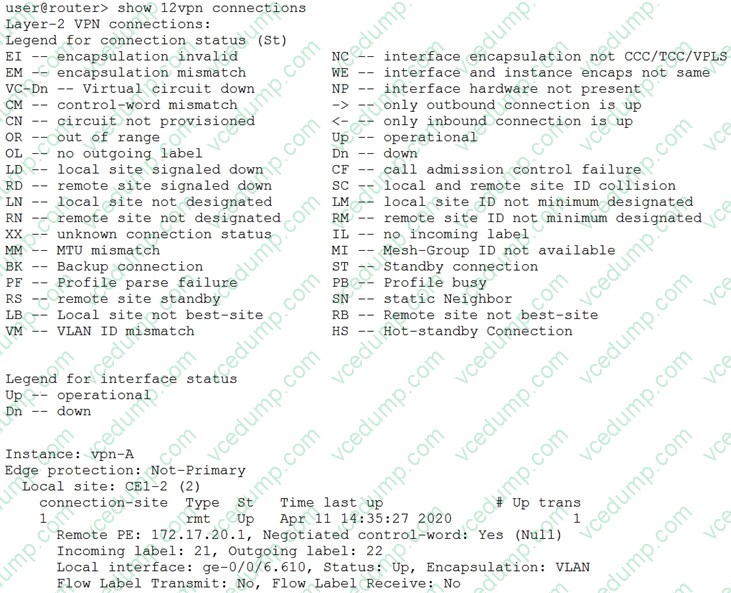
Which two statements regarding the output shown in the exhibit are correct? (Choose two.)
A. The type of connection is remote.
B. The type of connection is local.
C. The PEs have matching control word values.
D. The label associated with this virtual circuit is out of range. -
Question 26:
You are establishing a Layer 3 VPN between two PE devices. Currently you have a single internal IPv4 BGP peering between the PE devices. You must ensure that the IPv4 and IPv6 routes from both CE devices are exchanged between these sites.
Which two statements are correct in this scenario? (Choose two.)
A. You must enable IPv6 tunneling on the LSPs between the PE devices.
B. You must establish an IPv6 BGP peering between the two PEs.
C. You must enable the inet6-vpn NLRI on both PE devices.
D. You must enable the inet-vpn NLRI on both PE devices. -
Question 27:
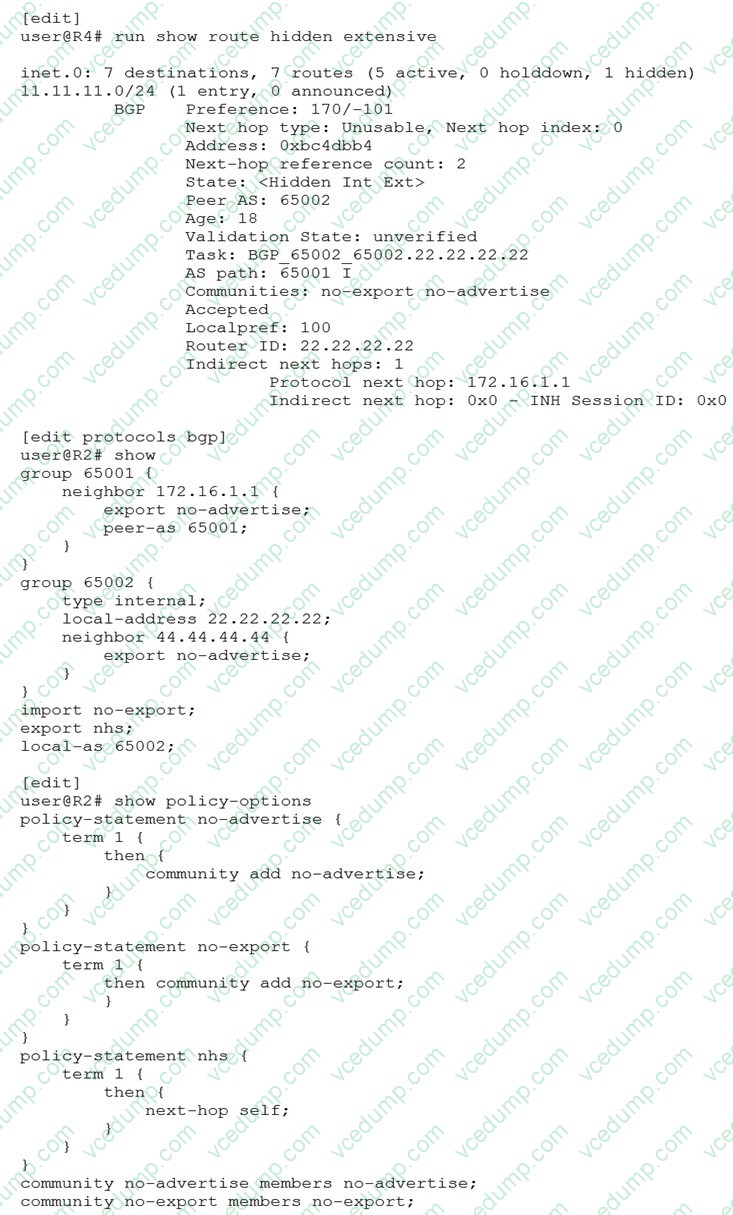
R2 is receiving a route from an EBGP neighbor and is advertising the route to R4. Referring to the exhibit, which configuration on R2 will solve the issue with the route on R4?
A. Move the no-advertise export policy from group 65002 to a global BGP policy.
B. Move the nhs policy from a global BGP export policy to an export policy under group 65002.
C. Move the no-export policy from a global BGP import policy to an import policy under group 65001.
D. Move the no-advertise export policy from group 65001 to a global BGP policy. -
Question 28:
What is the purpose of the cluster-list attribute within a BGP route reflector group?
A. to disable internal cluster re-advertisements
B. to facilitate loop detection within the route reflector network
C. to define the router that first advertised the route to the route reflector
D. to override the router ID value within the cluster -
Question 29:
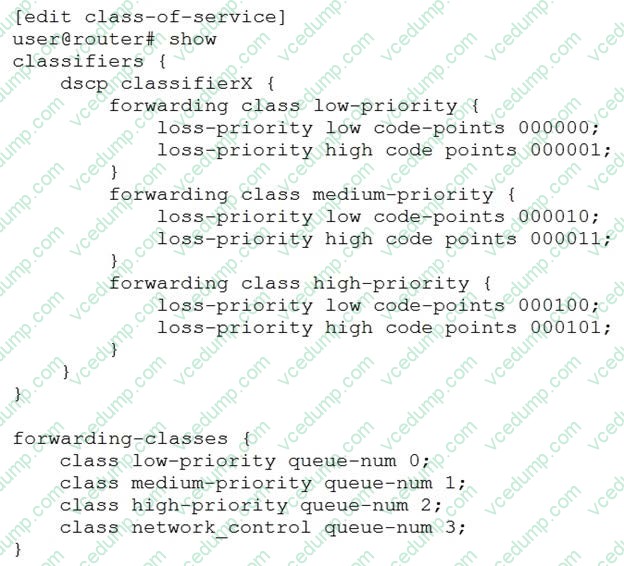
You manage an MX Series device which includes the configuration shown in the exhibit. Traffic marked with DSCP 000011 is entering the ge-1/0/4 interface at 102 Mbps. The traffic exits the device on the ge-1/0/5 interface. No other traffic is transiting the router.
In this scenario, what happens to traffic exceeding 100 Mbps?
A. Traffic exceeding 100 Mbps is redirected to a rate limiter.
B. Traffic exceeding 100 Mbps is buffered.
C. Traffic exceeding 100 Mbps is dropped.
D. Traffic exceeding 100 Mbps is forwarded. -
Question 30:
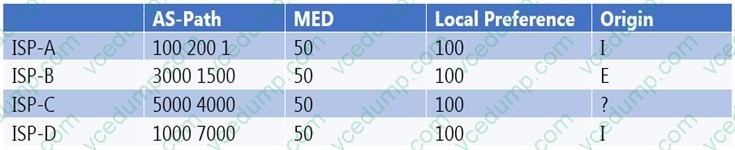
You are receiving the same 200.0.0.0/24 BGP route from four different ISPs. Referring to the exhibit, which ISP's route would be selected as active?
A. ISP-B
B. ISP-A
C. ISP-C
D. ISP-D
Related Exams:
-
JN0-102
Internet Associate, Junos(JNCIA-Junos) -
JN0-104
Junos, Associate (JNCIA-Junos) -
JN0-105
Junos, Associate (JNCIA-Junos) -
JN0-106
Junos - Associate (JNCIA-Junos) Junos OS 21.2 -
JN0-1101
Juniper Networks Certified Design Associate (JNCDA) -
JN0-1103
Design, Associate (JNCIA-Design) -
JN0-130
Juniper networks Certified internet specialist.e(jncis-e) -
JN0-1301
Data Center Design, Specialist (JNCDS-DC) -
JN0-1302
Data Center Design Specialist (JNCDS-DC) -
JN0-1331
Security Design, Specialist (JNCDS-SEC)
Tips on How to Prepare for the Exams
Nowadays, the certification exams become more and more important and required by more and more enterprises when applying for a job. But how to prepare for the exam effectively? How to prepare for the exam in a short time with less efforts? How to get a ideal result and how to find the most reliable resources? Here on Vcedump.com, you will find all the answers. Vcedump.com provide not only Juniper exam questions, answers and explanations but also complete assistance on your exam preparation and certification application. If you are confused on your JN0-663 exam preparations and Juniper certification application, do not hesitate to visit our Vcedump.com to find your solutions here.