ISTQB-CTAL-TM Exam Details
-
Exam Code
:ISTQB-CTAL-TM -
Exam Name
:ISTQB Certified Tester Advanced Level - Test Management (CTAL-TM) v3.0 -
Certification
:ISTQB Certifications -
Vendor
:ISTQB -
Total Questions
:228 Q&As -
Last Updated
:May 30, 2026
ISTQB ISTQB-CTAL-TM Online Questions & Answers
-
Question 141:
Which ONE of the following is considered to be the LEAST independent form of testing for anorganisation? SELECT ONE OPTION
A. Testing is performed by a tester who is part of an independent test team.
B. Testing is performed by an organisation external to the company that has developed the code.
C. Testing is performed by a tester who is part of the development team.
D. Testing is performed by specialists from the business organisation. -
Question 142:
Your manager has decided that your team of manual testers should all become test automation engineers.
Your team is much stronger in analysis than In technical testing so you are concerned about their ability to adapt.
What tool capabilities could help with this transition?
A. Low license costs
B. Remote storage of the test automation scripts
C. High usability with Al-assisted object capture
D. Good reporting -
Question 143:
What is the primary use for the traceability information regarding the relationship between test results and test conditions during test execution? [2]
A. The Test Manager uses this information to control the test execution effort.
B. The development manager uses this information to determine how many developer resources to allocate to defect repair.
C. The project manager uses this information to determine if the project is on schedule.
D. The tester uses this information to determine which test should be run next. -
Question 144:
Week 4 of test execution has been completed and the following test report has been produced
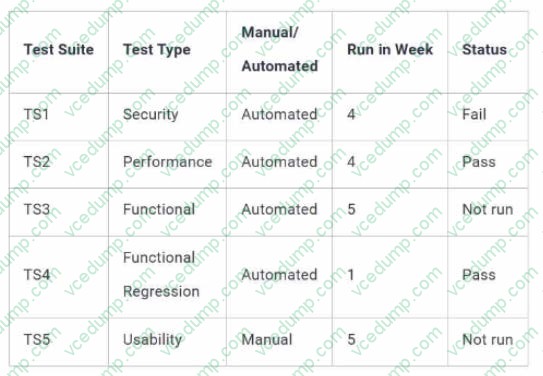
Review this report against the organisational Test Strategy, what is the status of the Test Strategy objectives? SELECT ONE OPTION
A. Test strategy objective 1. 2 and 3 have been met
B. Test strategy objective 2 and 3 have been met. Test strategy objective 1 has NOT been met.
C. Test strategy objective 1 and 2 have been met. Test strategy objective 3 has NOT been met.
D. Test strategy objective 1 and 3 have been met. Test strategy objective 2 has NOT been met. -
Question 145:
You are the Test Manager for a software house (SoftTech), who provide a core banking product to retail banks around the world to enable their customers to process payments via the Internet and telephone banking.
Your current project is to integrate SoftTech's core banking product with Welsh Bank's existing bank systems. However, Welsh Bank's systems are maintained by experienced developers and are poorly documented.
Welsh Bank has stated that this project must comply with Financial Conduct Authority (FCA) regulatory banking standards.
A specification for the 10 interfaces to Welsh Bank's existing systems has been produced by SoftTech's development team.
You have been asked to plan and conduct reviews for the system integration and support documentation of all the systems. Which of the following is the BEST approach for this project? SELECT ONE OPTION
A. Conduct Inspections to verify that all documentation conforms to a set standard.
B. Conduct a management review to assess progress of the integration features.
C. Conduct an audit to verify that all test deliverables have been produced and signed off.
D. Conduct an informal review of the integration documentation before the systems are integrated. -
Question 146:
Your test team is in the process of completing final regression testing one week before the release date. One of your staff has just uncovered a critical defect that causes data corruption. What should you do? [2]
A. Update the risks in your test plan to cover data corruption issues and update your test cases to be sure you test for this in the future
B. Write a high priority defect and follow the escalation communication plan as defined in your test plan
C. Write a high priority defect and call the business stakeholders to warn them about it
D. Update the weekly status charts and change the project status to red -
Question 147:
Which of statement about defect management is TRUE?
A. A good defect management committee reduces the importance of a defect management tool
B. A defect management committee should consider the benefits, risks and costs associated with fixing a defect
C. All projects should have a full-time defect manager to follow up decisions made about defects
D. Cross-functional defect management is important, but only for defects at the higher severity levels -
Question 148:
You have been promoted to Test Manager within your company. Your new manager states that your test team utilized a risk-based test approach for the last release but in production, a number of serious failures in lightly tested areas have
occurred.
What would be your first action prior to the start of the next test phase for the next release? [3]
A. Ensure you have the correct stakeholders' participation during the risk assessment process
B. Review the test cases executed from the previous release.
C. Request functional requirements be prioritized in order of importance to the stakeholder.
D. Review the production defects and determine if they are valid. -
Question 149:
You have replaced informal code reviews with technical reviews for the most complex and critical components, in an attempt to reduce the high number of defects being found during component and integration test levels. The project manager is concerned about the costs of implementing formal reviews and has asked you to measure whether they actually provide a return on investment. Which three of the following metrics would be MOST effective in helping you to achieve this? a- Identification of defect clusters across components b- Number of lines of code reviewed c- Number of defects found during reviews d- Root cause for each defect detected e- Post-review cost of detection and internal failure per defect f- Type of review g- Effort to conduct the review including rework
A. c.e and g.
B. a.f and g.
C. b.d and e.
D. a, c and d. -
Question 150:
You plan to introduce a new tester to your Agile team who has expertise in test automation, a necessary skill lacking in current team members. The individual has a high degree of technical competence but has only ever worked alone and
admits to finding face-to-face communication difficult.
What would be the BEST course of action?
A. Provide them with details of an online self-study program covering communication skills
B. Send them on an external training course covering communications skills and connect them with an experienced mentor
C. Peer learning and sharing occurs naturally in Agile teams, so there is no need for any training
D. Do not use this person. Face-to-face communication is essential in Agile and they will only prove disruptive
Related Exams:
-
ISTQB-AGILE-PUBLIC
ISTQB Agile Public Sector -
ISTQB-ATM
Advanced Test Management Exam v 3.0 – ISTQB -
ISTQB-CT-AI
ISTQB Certified Tester AI Testing -
ISTQB-CT-TAE
ISTQB Certified Tester Test Automation Engineer -
ISTQB-CT-UT
ISTQB Certified Tester Usability Tester -
ISTQB-CTAL-TA
ISTQB Certified Tester Advanced Level - Test Analyst (CTAL-TACore)v3.1.2 -
ISTQB-CTAL-TM
ISTQB Certified Tester Advanced Level - Test Management (CTAL-TM) v3.0 -
ISTQB-CTAL-TTA
ISTQB Certified Tester Advanced Level - Technical Test Analyst -
ISTQB-CTFL
ISTQB Certified Tester Foundation Level (CTFL v4.0)
Tips on How to Prepare for the Exams
Nowadays, the certification exams become more and more important and required by more and more enterprises when applying for a job. But how to prepare for the exam effectively? How to prepare for the exam in a short time with less efforts? How to get a ideal result and how to find the most reliable resources? Here on Vcedump.com, you will find all the answers. Vcedump.com provide not only ISTQB exam questions, answers and explanations but also complete assistance on your exam preparation and certification application. If you are confused on your ISTQB-CTAL-TM exam preparations and ISTQB certification application, do not hesitate to visit our Vcedump.com to find your solutions here.