ISTQB-CTAL-TM Exam Details
-
Exam Code
:ISTQB-CTAL-TM -
Exam Name
:ISTQB Certified Tester Advanced Level - Test Management (CTAL-TM) v3.0 -
Certification
:ISTQB Certifications -
Vendor
:ISTQB -
Total Questions
:228 Q&As -
Last Updated
:May 30, 2026
ISTQB ISTQB-CTAL-TM Online Questions & Answers
-
Question 111:
You are Test Manager on a major project that is of strategic importance to your company. Your team has access to a suite of testing tools that provide support across the development life cycle and thissuite of tools has been in place for the last two projects. You are concerned that the suite does not have an integrated defect management tool and have negotiated a small budget to find and implement such a tool. Your first choice is an open source tool that has been available for just over a year and appears to be popular with its users, who have found it easy to learn. The main disadvantage of the tool would be that current manual defect management processes would need to be modified to embrace use of the tool. Which of the following would be the MAIN risk to consider in deciding whether or not to acquire the defect management tool? SELECT ONE OPTION
A. The risk of additional time and effort required to prepare and roll out a revised defect management process.
B. The risk of not being able to integrate the tool within the existing tool suite to ensure effective interoperability across the whole suite.
C. The risk of not achieving a positive Return on Investment for the tool in the short term.
D. The risk of not being able to achieve effective training for users of the tool to ensure they can use it effectively. -
Question 112:
You are Test Manager of a project delivering a workflow system for complex business processes It has been decided a tool is required to increase the efficiency of test execution. What would be a valid issue to consider when deciding whether to build a custom made tool? SELECT ONE OPTION
A. The tool may only be useable for this project and have no long term benefits
B. The tool may be dependent on the person creating the tool if it is not adequately documented.
C. It may not be possible to integrate the tool with existing tools used in the organisation.
D. The tool may not meet the specific requirements for testing this project. -
Question 113:
SoftTech provides a core banking product to retail banks to enable their customers to process payments via the Internet and telephone banking and. as SoftTech's Test Manager, you are responsible for system testing and system integration testing of all SoftTech's products. Your current project is to integrate SoftTech's core banking product with an existing bank's systems, which are maintained by experienced developers but poorly documented. A specification for the 10 interfaces to the bank's existing systems has been produced by SoftTech's development team. There is an estimating matrix for system integration testing that allows 2 man days per interface for preparation, plus 2 man days per interface for test execution. The exit criteria for the completion of system integration testing has been agreed as: 1- No open Severity 1 defects 2- No more than 10 open severity 2 and/or 3 defects 3- All interfaces tested 4- Cost estimate must not be exceeded System integration test execution is scheduled to last 5 weeks, with week 5 reserved for regression and bug fixing only. At the end of week 3 the following test report has been produced (figures on a week by week basis, not cumulative):
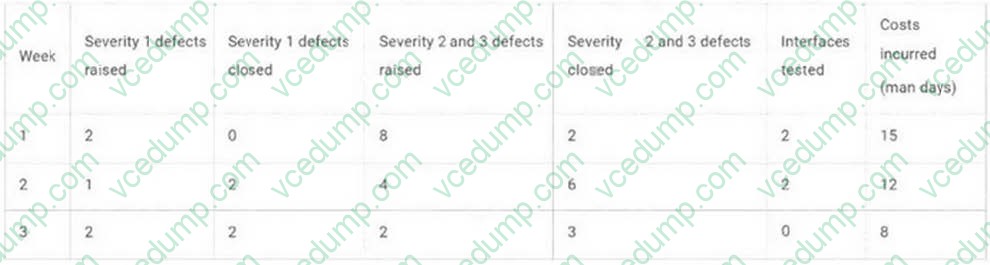
a- System integration b- Open severity 2 and 3 defects c- Interface testing progress d- Development resource for debugging e- Available budget SELECT ONE OPTION
A. c and d.
B. d and e.
C. b and c.
D. c and e -
Question 114:
You are testing a new product that will turn on the windshield wipers of a car when the sensors detect there is moisture on the windshield. Depending on the information returned from the sensors, the wipers will be turned on at one of the
following speeds: slow intermittent, medium intermittent, fast intermittent, slow constant, medium constant, fast constant. Your team has identified the following test condition:
Test Condition 1.1.1 - Verify that the windshield wipers can go from slow constant to fast constant speed when the amount of moisture increases appropriately.
Your team has defined the following steps for a test case for this test condition:
1.Set the moisture sensor to request slow constant
2.Increase the moisture to set the sensor to request fast constant
3.Verify that the wipers respond with fast constant speed
Given this information, which of the following statements is correct? [2]
A. This test case is traceable to the test condition and provides 100% requirements coverage of the defined test condition.
B. There is not enough information in the test condition to define a test case.
C. This test case is not traceable to the test condition.
D. The test case is traceable to the test condition and provides 100% statement coverage of the defined test condition. -
Question 115:
You are monitoring the test results for the first week of system test execution to ensure they conform to the test plan objectives. You are guided by the list of test conditions and traceability matrix produced following test design. Test Plan objectives:
Approach - Risk-based and depth first Status reporting - Execution statuses must be either "Passed*, "Failed", "Blocked" or "Not Run" Traceability - Test execution results must be traceable back to the test conditions
Test Conditions
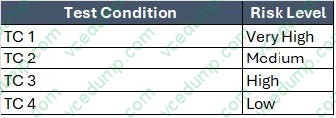
Traceability matrix
Which one of the following is a correct statement regarding the current status of test plan objectives? SELECT ONE OPTION
A. All the Traceability objective has been met.
B. All objectives have been met.
C. None of the objectives have been met.
D. Only Approach and Traceability objectives have been met. -
Question 116:
You are a Test Manager and have started a program of test process improvement. You are following the IDEAL model and have completed the first three phases, now you are ready to go further. Which TWO of the following activities will enable you to complete the remaining phases of the IDEAL model?
A. Trial a low-priority improvement in order to assess the difficulty of changing the organisation's processes
B. Re-prioritise the possible improvements according to their expected return on Investment
C. Trial one or more of the highest-priority improvements in a pilot project
D. Decide whether to take a model based or an analytical based process improvement approach
E. Check to see which benefits have, or have not, been achieved from the improvement made -
Question 117:
You are a test team lead working on a large project and have been subject to considerable stress due to exceptional workload. Your manager has suggested that you need to delegate more work to your team members to both reduce the pressure on yourself and allow team members to take on more responsibility which would, in turn, benefit their growth. Which phase of the Tuckman model would this situational skill represent?
A. Norming
B. Forming
C. Performing
D. Storming -
Question 118:
You have recently implemented a new defect management process which now includes a defect triage committee whose job is to review all new defects. The process is shown in the following diagram:
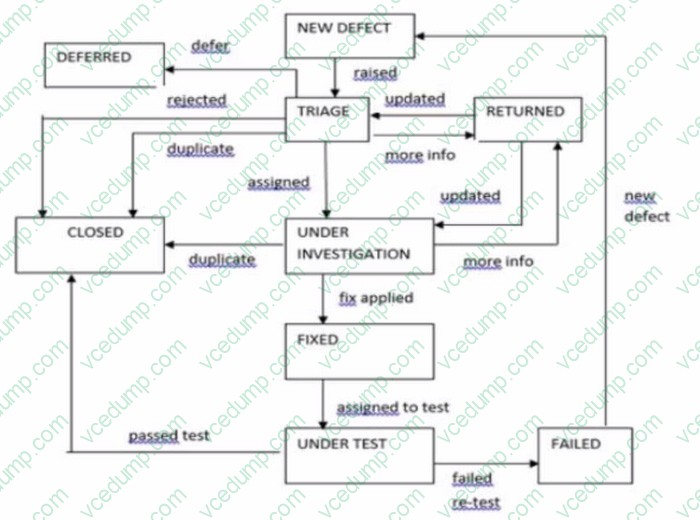
a- The total number of defects rejected, deferred, or assigned by the defect triage committee. b- The total number of defects rejected as not a problem following investigation by the product author c- The number of defects returned to the defect author, expressed as a percentage of all defects raised d- The total number of defects that failed re-test more than once e- The total number of defects closed by the defect triage committee
A. a and e.
B. a and b.
C. c and d.
D. b and d. -
Question 119:
There is a debate in your organization about who can close a defect report The developers think they should be able to reject and close defects without any further steps.
The testers are not happy with this approach as they are afraid the rejections may go undetected and the developers may close something without understanding the real problem。
How can this problem be rectified7
A. Only testers should be allowed to close defect reports
B. Only management should be allowed to close defect reports
C. No one should close a defect report until the release is completed and the product is successfully deployed to production
D. Closure should only occur when a defect is fixed and tested -
Question 120:
Test Analysts are doing test design for a change request to an insurance comparison system. The system provides car insurance quotations, using data input by the user.
The change request states:-Drivers must be aged between 17 to 85 years inclusive to qualify for insurance comparison.
The following Test Conditions have been identified:
1- Driver's age is less than the minimum
2- Driver's age is within the valid range
3- Driver's age is more than the maximum
The Test Strategy states the test techniques to be used include Equivalence Partitioning and Boundary Value Analysis.
Using the Test Conditions and techniques stated in the Test Strategy, the following Test Cases have been created.
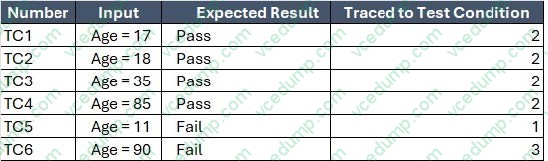
As the Test Manager you are reviewing these Test Cases for traceability to the Test Conditions and to ensure that the change request will be adequately tested in accordance with the Test Strategy. Which of the following statements is FALSE? SELECT ONE OPTION
A. The Test Cases fully test the Test Conditions in relation to the Test Strategy.
B. The traceability of the Test Cases to Test Conditions is clear.
C. The change request requirements have been clearly stated.
D. The Test Conditions have fully covered the change request.
Related Exams:
-
ISTQB-AGILE-PUBLIC
ISTQB Agile Public Sector -
ISTQB-ATM
Advanced Test Management Exam v 3.0 – ISTQB -
ISTQB-CT-AI
ISTQB Certified Tester AI Testing -
ISTQB-CT-TAE
ISTQB Certified Tester Test Automation Engineer -
ISTQB-CT-UT
ISTQB Certified Tester Usability Tester -
ISTQB-CTAL-TA
ISTQB Certified Tester Advanced Level - Test Analyst (CTAL-TACore)v3.1.2 -
ISTQB-CTAL-TM
ISTQB Certified Tester Advanced Level - Test Management (CTAL-TM) v3.0 -
ISTQB-CTAL-TTA
ISTQB Certified Tester Advanced Level - Technical Test Analyst -
ISTQB-CTFL
ISTQB Certified Tester Foundation Level (CTFL v4.0)
Tips on How to Prepare for the Exams
Nowadays, the certification exams become more and more important and required by more and more enterprises when applying for a job. But how to prepare for the exam effectively? How to prepare for the exam in a short time with less efforts? How to get a ideal result and how to find the most reliable resources? Here on Vcedump.com, you will find all the answers. Vcedump.com provide not only ISTQB exam questions, answers and explanations but also complete assistance on your exam preparation and certification application. If you are confused on your ISTQB-CTAL-TM exam preparations and ISTQB certification application, do not hesitate to visit our Vcedump.com to find your solutions here.