H31-161 Exam Details
-
Exam Code
:H31-161 -
Exam Name
:HCIE-Carrier IP (Written) V2.0 -
Certification
:Huawei Certifications -
Vendor
:Huawei -
Total Questions
:180 Q&As -
Last Updated
:Jan 17, 2024
Huawei H31-161 Online Questions & Answers
-
Question 51:
Which of the following statements about inter-AS VPN Option A are true? (ACE)
A. More logical links must be configured between ASBR-PEs when more VPNs are deployed.
B. Option A provides excellent scalability and supports a great number of VPNs.
C. The VPN instances on an ASBR-PE can be bound to both physical interfaces and logical interfaces.
D. ASBR-PEs communicate with each other only through EBGP.
E. ASBR-PEs communicate with each other through any multi-instance (PE-CE) capable routing protocol. -
Question 52:
In MPLS QoS, traffic policies are developed based on simple traffic classification and complex traffic classification. In traffic policies based on simple traffic classification, the service class, color, and drop priority of packets are reset based on the tags in packets. In traffic policies based on complex traffic classification, measures such as traffic policing, priority re-marking, packet filtering, policybased routing, and traffic sampling are implemented based on the traffic type. Generally, simple traffic classification is applied on border routers in DiffServ domains, and complex traffic classification core routers. QoS traffic policies are configured by performing the following operations:
1.
Defines DiffServ domains and configuring a traffic policy.
2.
Classifies traffic.
3.
Defines traffic behaviors and configures characteristics of behaviors.
4.
Defines a traffic policy and specifies actions for traffic categories.
5.
Applies the traffic policy.
6.
Configures L-LSP.
7.
Configures reverse address check.
8.
Adds interfaces to the DiffServ domains.
Which of the preceding operations are required when you configure simple traffic classification?
A. 1 6 8
B. 2 4 5 7
C. 1 5 6
D. 2 3 4 8 -
Question 53:
display igmp group IGMP interface group report information of VPN-Instance: public net Ethernet6/1/1(40.1.1.1): Total 1 IGMP Group reported Group: 232.0.0.1 Uptime: 00:00:22 Expires: off Last reporter: 40.1.1.3 Last-member-query-counter: 0 Last-member-query-timer-expiry: off Group mode: include Version1-host-present-timer-expiry: off Version2-host-present-timer-expiry: off Source list: Source: 20.1.1.56 Uptime: 00:00:22 Expires: 00:05:08 Last-member-query-counter: 3 Last-member-query-timer-expiry: 00:00:01 Source: 20.1.1.57 Uptime: 00:00:22 Expires: 00:00:17 Last-member-query-counter: 3 Last-member-query-timer-expiry: 00:00:01 The preceding information shows the entry states in the IGMP interface table on Ethernet 6/1/1. Which statement is true when IGMP sends source/group query messages?
A. IGMP sends two messages. In one message, the multicast source is 20.1.1.56 and the S flag is not configured. In the other message, the multicast source is 20.1.1.57 and the S flag is set to 1
B. IGMP sends two messages. In one message, the multicast source is 20.1.1.56 and the S flag is set to 1. In the other message, the multicast source is 20.1.1.57 and the S flag is not configured.
C. IGMP sends one message in which the multicast sources are 20.1.1.56 and 20.1.1.57 and the S flag is set to 1.
D. IGMP sends one message in which the multicast sources are 20.1.1.56 and 20.1.1.57 and the S flag is not configured. -
Question 54:
Exhibit.
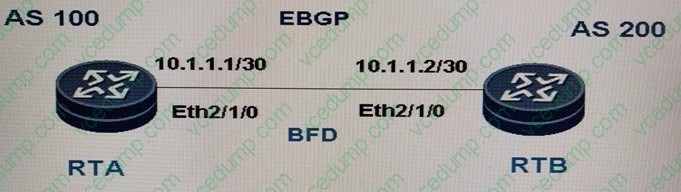
As shown in the figure, RTA and have one BGP session. To detect fault fast, the BFD for BGP feature needs to be configured on RTA and RTB. BGP-related configurations are as follows:
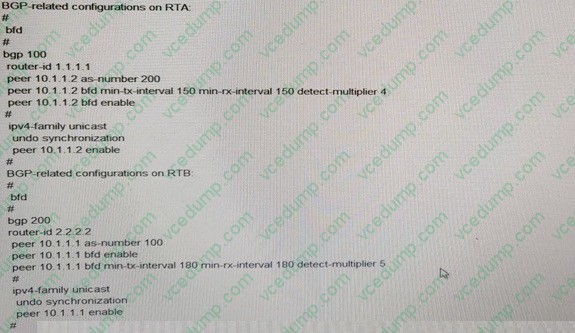
The only Ethernet link between RTA and RTB becomes faulty when the BGP neighbor session is in ESTABLISHED state and the BFD session is in the UP state. Which statements is true? (Note: BFD works in asynchronous mode)
A. RTA detect the fault faster than RTB.
B. The BGP session between RTA and RTB is interrupted when the BGP hold time (time duration is 180s by default) express.
C. RTB detect the fault faster than RTA.
D. RTA and RTB detect the fault simultaneously. -
Question 55:
Refer to the exhibit.
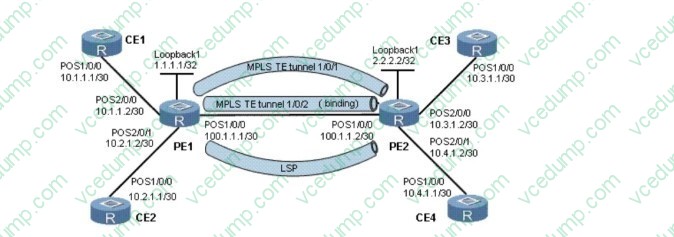
This figure shows the MPLS L3VPN networking. CE 1 and CE 3 belong to VPN A. CE 2 and CE 4 belong to VPN B. Two MPLS TE tunnels (5 Mbit/s and 10 Mbit/s) and an LSP tunnel are set up between PE 1 and PE 2.It is expected that a tunnel policy is configured on PE 1 to distribute traffic in the three tunnels and MPLS TE tunnels are preferred. Configurations on PE
1: Configuration of PE 1 # sysname PE1 # ip vpn-instance vpna route-distinguisher 100:1 tnl-policy policy1 vpn-target 111:1 export-extcommunity vpn-target 111:1 import-extcommunity # ip vpn-instance vpnb route-distinguisher 100:2 tnl-policy policy2 vpn-target 222:2 export-extcommunity vpn-target 222:2 import-extcommunity # mpls lsr-id 1.1.1.1 mplsmpls te mpls rsvp-te mpls te cspf # mpls ldp
#
interface Pos1/0/0
link-protocol ppp
ip address 100.1.1.1 255.255.255.252
mpls
mpls te
mpls te max-link-bandwidth 20000
mpls te max-reservable-bandwidth 15000
mpls rsvp-te
mpls ldp
#
interface Pos2/0/0
link-protocol ppp
ip binding vpn-instance vpna
ip address 10.1.1.2 255.255.255.252
#
interface Pos2/0/1
link-protocol ppp
ip binding vpn-instance vpnb
ip address 10.2.1.2 255.255.255.252
#
interface LoopBack1
ip address 1.1.1.1 255.255.255.255
#
interface Tunnel1/0/1
ip address unnumbered interface LoopBack1
tunnel-protocol mpls te
destination 2.2.2.2
mpls te tunnel-id 11 mpls te bandwidth bc0 5000 mpls te commit # interface Tunnel1/0/2 ip address unnumbered interface LoopBack1 tunnel-protocol mpls te destination 2.2.2.2mpls te tunnel-id 22 mpls te bandwidth bc0 10000 mpls te reserved-for-binding mpls te commit # bgp 100 peer 2.2.2.2 as-number 100 peer 2.2.2.2 connect-interface LoopBack1 # ipv4-family unicast undo synchronization peer 2.2.2.2 enable # ipv4-family vpnv policy vpn-target peer 2.2.2.2 enable # ipv4-family vpn-instance vpna import-route direct
# ipv4-family vpn-instance vpnb import-route direct # ospf 1 opaque-capability enable area 0.0.0.0 network 100.1.1.0 0.0.0.3 network 1.1.1.1 0.0.0.0 mpls-te enable # tunnel-policy policy1 tunnel binding destination 2.2.2.2 te Tunnel1/0/2 # tunnel-policy policy2 tunnel select-seq cr-lsp lsp load-balance-number 3 #
returnUnder the preceding configurations, traffic cannot be distributed to the three tunnels. To implement load balancing, which of the following modifications are correct?
A. Delete policy 1 from PE 1.
B. Delete policy 1 in the vpna instance view.
C. Create a TE tunnel to 2.2.2.2 on PE 1.
D. Create a GRE tunnel to 2.2.2.2 on PE 1. -
Question 56:
When the multicast source starts to send multicast data and no receiver joins in the RP in PIM-SM, which of the following statements are true?
A. The RP receives a registration message from the source DR, creates a multicast routing entry (S, G), and sends a register stop message to the source DR.
B. After the source DR unicasts registration information to the RP, the multicast routing entries (S, G) of all source groups are generated in the RP but the outbound interface is null.
C. After receiving a registration message, the RP creates the multicast routing entries (*, G) of all source groups and sends a register stop message to the source DR.
D. After all sources unicast registration information to the RP, no multicast route entries related to source groups are generated due to receiver absence. -
Question 57:
On the OSPF network, which of the following statements about the authentication function of the OSPF protocol are true?
A. The OSPF protocol supports area authentication and interface authentication.
B. The interface authentication mode must be consistent with the area authentication mode . For Example, interface and area are authentication in simple or MDS mode or are not authenticated.
C. The interface authentication mode can be different from the area authentication mode.
D. The authentication function of the OSPF is implemented by parameter settings in hello packets. -
Question 58:
Which of the following statements about the Martini VPLS are true?
A. When LDP is used to transmit signaling, LDP TLVs carry the VPLS information.
B. Labels are allocated for PWs in DU mode when they are established.
C. Labels are allocated for PWs in DoD mode when they are established.
D. Labels are retained using the liberal label retention method.
E. A VC must be established using remote LDP. -
Question 59:
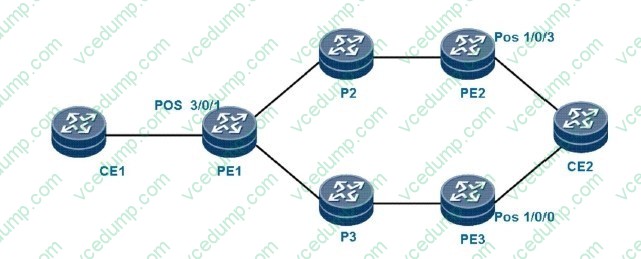
As shown in the figure, the asymmetric VLL FRR networking is used. AC interfaces on PE 1, PE 2, and PE 3 are configured as follows:
Configuration of the AC interface on PE 1:
interface Pos3/0/1link-protocol ppp
undo shutdown
oam detect lcp-terminal notify lcp-terminal ip address 208.1.1.1 255.255.255.0 ip address 208.2.2.1 255.255.255.0 sub mpls l2vc pw-template pw1 13579 ip-interworking mpls l2vc pw-template pw2 24680 ip-interworking secondary mpls l2vpn oam-mapping mpls l2vpn reroute immediately resume 0 Configuration of the AC interface on PE 2: interface Pos1/0/3 link-protocol ppp undo shutdown ip address 208.1.1.2 255.255.255.0 mpls l2vc pw-template pw1 13579 ip-interworking mpls l2vpn oam-mapping Configuration of the AC interface on PE 3: interface Pos1/0/0 link-protocol hdlc undo shutdown oam detect hello-stop notify hello-stop ip address 208.2.2.2 255.255.255.0 mpls l2vc pw-template pw1 24680 ip-interworking mpls l2vpn oam-mapping Which of the following statements are true on the condition that IGP and MPLS are configured correctly on the public network?
A. The PW between PE 1 and PE 2 is the primary PW.
B. If a forwarding fault is detected on the PW between PE 1 and PE 2, traffic can be switched to the backup PW on PE 1.
C. If a forwarding fault is detected on the PW between PE 1 and PE 2, traffic from CE 1 to CE 2 can be switched to the PW between PE 1 and PE 3.
D. If a forwarding fault is detected on the public network side of the PW between PE 1 and PE 2, traffic from CE 2 to CE 1 can be switched to the PW between PE 1 and PE 3. -
Question 60:
When configure IPSec VPN Which kind of encryption algorithms is more excellent in security
A. AES
B. 3DES
C. SHA
D. MD5(128-bit)
Related Exams:
-
H11-821
HCNP-UC-HIPT (Implementing Huawei IP Telephony Solutions) -
H11-828
HCNP-UC(Fast Track)(Unified Communication (Fast Track)) -
H11-851
HCIA-Video Conference V3.0 -
H11-861
HCIP-Video Conference V2.0 -
H11-868
HCNP- VC(Fast Track)-(Video Conference (Fast Track)) -
H12-111
HCIA-IoT V3.0 -
H12-224
HCIP-Routing & Switching (Fast Track) V2.0 -
H12-311
HCIA-WLAN V3.0 -
H12-351
HCIE-WLAN (Written) V1.0 -
H12-411
HCIA-Data Center Facility V2.0
Tips on How to Prepare for the Exams
Nowadays, the certification exams become more and more important and required by more and more enterprises when applying for a job. But how to prepare for the exam effectively? How to prepare for the exam in a short time with less efforts? How to get a ideal result and how to find the most reliable resources? Here on Vcedump.com, you will find all the answers. Vcedump.com provide not only Huawei exam questions, answers and explanations but also complete assistance on your exam preparation and certification application. If you are confused on your H31-161 exam preparations and Huawei certification application, do not hesitate to visit our Vcedump.com to find your solutions here.