FCP_FGT_AD-7.4 Exam Details
-
Exam Code
:FCP_FGT_AD-7.4 -
Exam Name
:FCP - FortiGate 7.4 Administrator -
Certification
:Fortinet Certifications -
Vendor
:Fortinet -
Total Questions
:89 Q&As -
Last Updated
:Jul 12, 2026
Fortinet FCP_FGT_AD-7.4 Online Questions & Answers
-
Question 51:
What are two features of the NGFW profile-based mode? (Choose two.)
A. NGFW profile-based mode can only be applied globally and not on individual VDOMs.
B. NGFW profile-based mode must require the use of central source NAT policy
C. NGFW profile-based mode policies support both flow inspection and proxy inspection.
D. NGFW profile-based mode supports applying applications and web filtering profiles in a firewall policy. -
Question 52:
Refer to the exhibit.
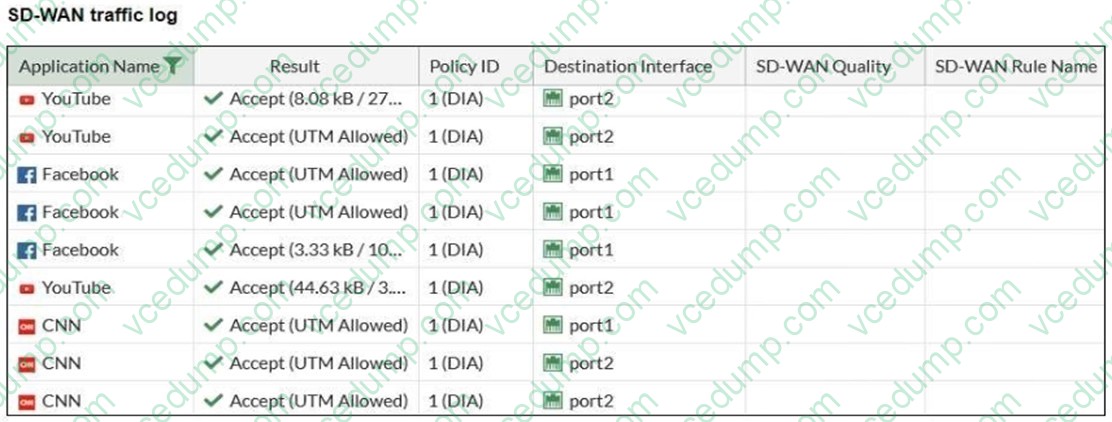
The administrator configured SD-WAN rules and set the FortiGate traffic log page to display SD-WAN-specific columns: SD-WAN Quality and SD-WAN Rule Name.
FortiGate allows the traffic according to policy ID 1. This is the policy that allows SD-WAN traffic.
Despite these settings the traffic logs do not show the name of the SD-WAN rule used to steer those traffic flows.
What can be the reason?
A. FortiGate load balanced the traffic according to the implicit SD-WAN rule.
B. There is no application control profile applied to the firewall policy.
C. Destination in the SD-WAN rules are configured per application but the feature visibility is not enabled.
D. SD-WAN rule names do not appear immediately. The administrator needs to refresh the page. -
Question 53:
Refer to the exhibit.
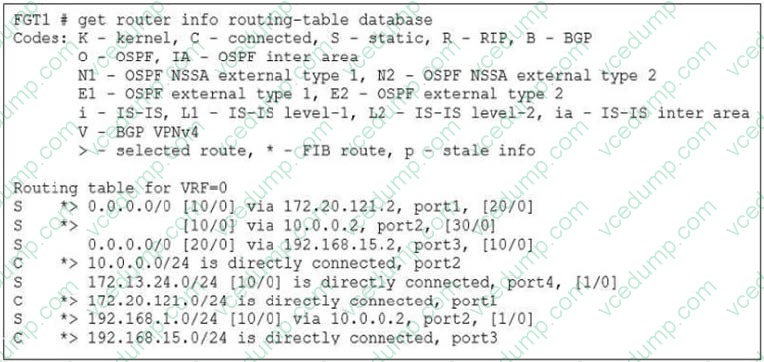
Based on the routing database shown in the exhibit which two conclusions can you make about the routes? (Choose two.)
A. There will be eight routes active in the routing table
B. The port1 and port2 default routes are active in the routing table
C. The port3 default route has the highest distance
D. The port3 default route has the lowest metric -
Question 54:
Refer to the exhibit.
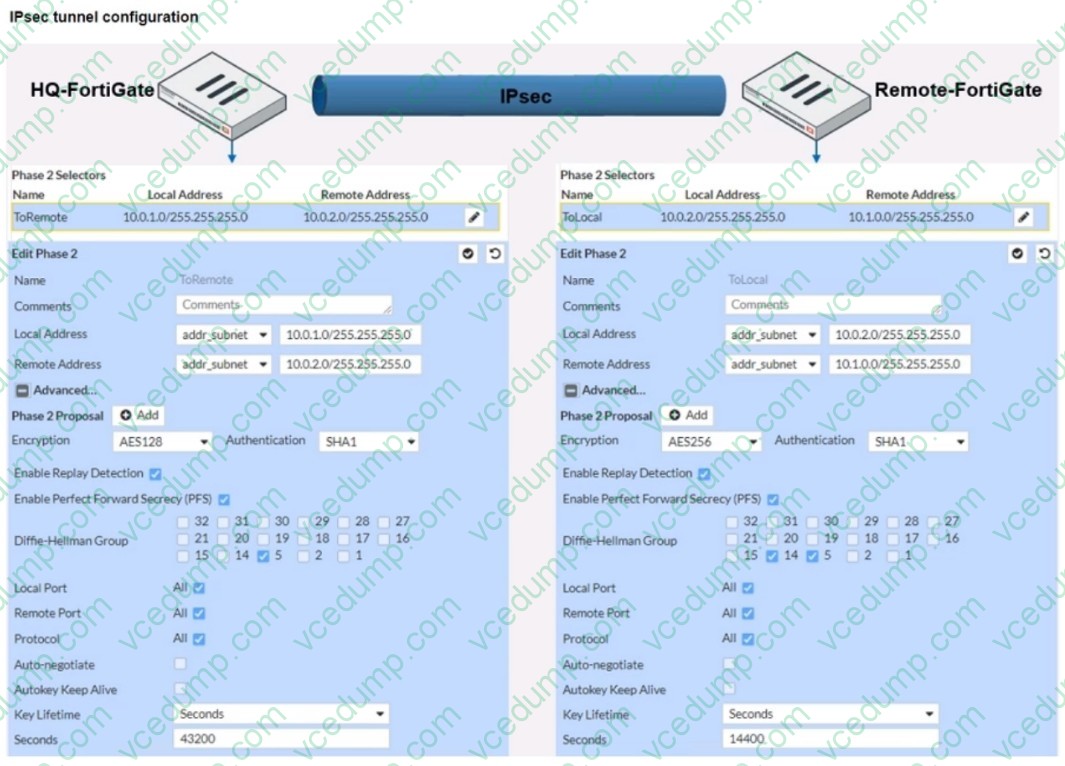
A network administrator is troubleshooting an IPsec tunnel between two FortiGate devices. The administrator has determined that phase 1 status is up, but phase 2 fails to come up. Based on the phase 2 configuration shown in the exhibit, which two configuration changes will bring phase 2 up? (Choose two.)
A. On Remote-FortiGate, set Seconds to 43200.
B. On HQ-FortiGate, enable Diffie-Hellman Group 2.
C. On HQ-FortiGate, set Encryption to AES256.
D. On Remote-FortiGate, set Remote Address to 10.0.1.0/255.255.255.0. -
Question 55:
Refer to the exhibits.
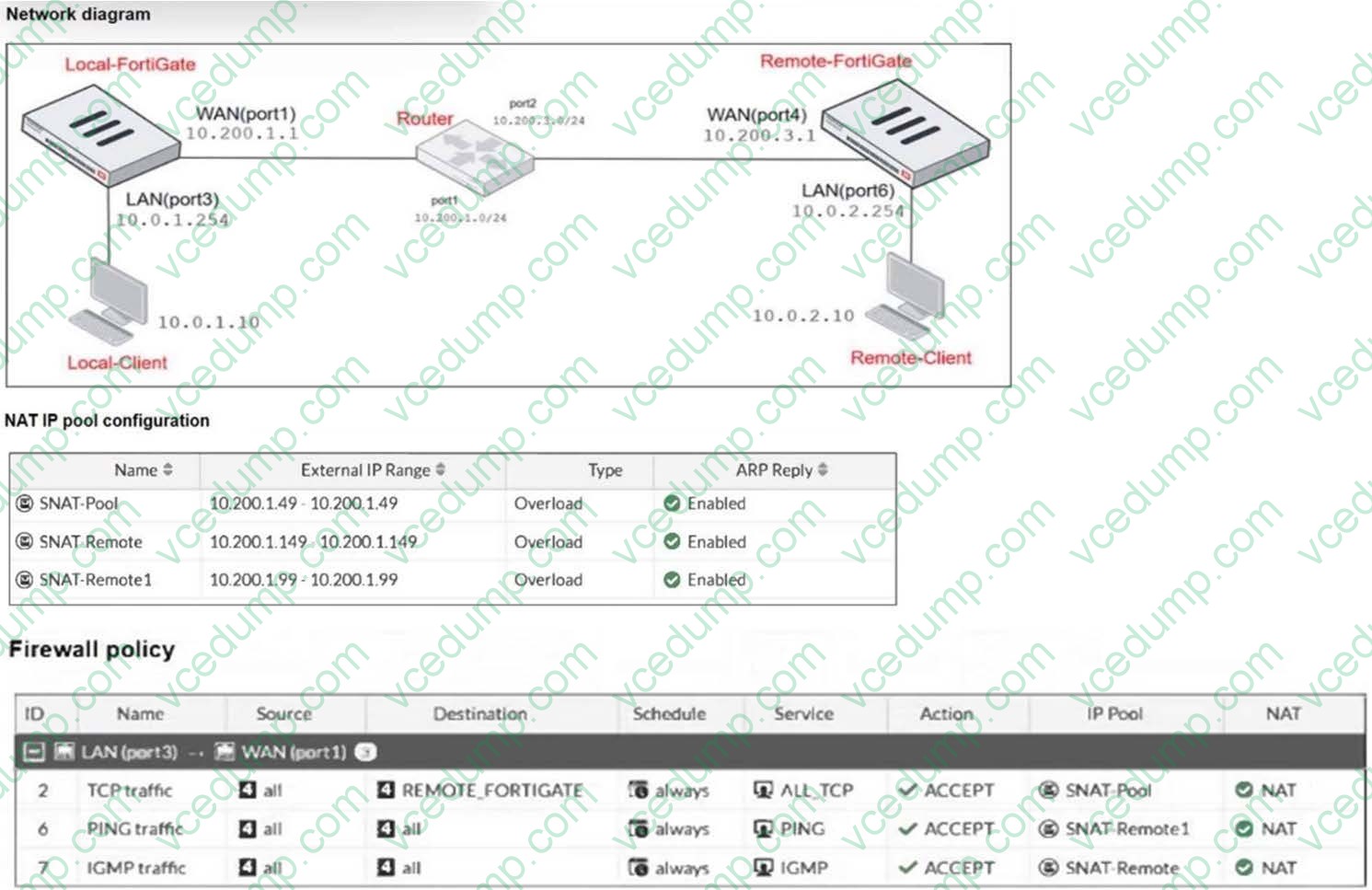
The exhibits show a diagram of a FortiGate device connected to the network, as well as the IP pool configuration and firewall policy objects.
The WAN (port1) interface has the IP address10.200.1.1/24. The LAN (port3) interface has the IPaddress10.0.1.254/24.
Which IP address will be used to source NAT (SNAT) the traffic, if the user on Local-Client (10.0.1.10) pings the IP address of Remote-FortiGate (10.200.3.1)?
A. 10.200.1.1
B. 10.200.1.149
C. 10.200.1.99
D. 10.200.1.49 -
Question 56:
Which two attributes are required on a certificate so it can be used as a CA certificate on SSL inspection? (Choose two.)
A. The issuer must be a public CA
B. The CA extension must be set to TRUE
C. The Authority Key Identifier must be of type SSL
D. The keyUsage extension must be set tokeyCertSign -
Question 57:
A FortiGate administrator is required to reduce the attack surface on the SSL VPN portal. Which SSL timer can you use to mitigate a denial of service (DoS) attack?
A. SSL VPN dcls-hello-timeout
B. SSL VPN http-request-header-timeout
C. SSL VPN login-timeout
D. SSL VPN idle-timeout -
Question 58:
Which three methods are used by the collector agent for AD polling? (Choose three.)
A. WinSecLog
B. WMI
C. NetAPI
D. FSSO REST API
E. FortiGate polling -
Question 59:
FortiGate is operating in NAT mode and has two physical interfaces connected to the LAN and DMZ networks respectively. Which two statements are true about the requirements of connected physical interfaces on FortiGate? (Choose two.)
A. Both interfaces must have the interface role assigned
B. Both interfaces must have directly connected routes on the routing table
C. Both interfaces must have DHCP enabled
D. Both interfaces must have IP addresses assigned -
Question 60:
A FortiGate firewall policy is configured with active authentication however, the user cannot authenticate when accessing a website. Which protocol must FortiGate allow even though the user cannot authenticate?
A. ICMP
B. DNS
C. DHCP
D. LDAP
Related Exams:
-
EMEA-ADVANCED-SUPPORT
Fortinet EMEA Advanced Support -
FCP_FAC_AD-6.5
FCP - FortiAuthenticator 6.5 Administrator -
FCP_FAZ_AD-7.4
FCP - FortiAnalyzer 7.4 Administrator -
FCP_FAZ_AN-7.4
FCP - FortiAnalyzer 7.4 Analyst -
FCP_FAZ_AN-7.6
Fortinet NSE 5 - FortiAnalyzer 7.6 Analyst -
FCP_FCT_AD-7.2
FCP - Forti Client EMS 7.2 Administrator -
FCP_FCT_AD-7.4
Fortinet NSE 6 - FortiClient EMS 7.4 Administrator -
FCP_FGT_AD-7.4
FCP - FortiGate 7.4 Administrator -
FCP_FGT_AD-7.6
FortiGate 7.6 Administrator FCP_FGT_AD-7.6 -
FCP_FMG_AD-7.4
FCP - FortiManager 7.4 Administrator
Tips on How to Prepare for the Exams
Nowadays, the certification exams become more and more important and required by more and more enterprises when applying for a job. But how to prepare for the exam effectively? How to prepare for the exam in a short time with less efforts? How to get a ideal result and how to find the most reliable resources? Here on Vcedump.com, you will find all the answers. Vcedump.com provide not only Fortinet exam questions, answers and explanations but also complete assistance on your exam preparation and certification application. If you are confused on your FCP_FGT_AD-7.4 exam preparations and Fortinet certification application, do not hesitate to visit our Vcedump.com to find your solutions here.