AICPA CPA-TEST Online Practice
Questions and Exam Preparation
CPA-TEST Exam Details
Exam Code
:CPA-TEST
Exam Name
:Certified Public Accountant Test: Auditing and Attestation, Business Environment and Concepts, Financial Accounting and Reporting, Regulation
Certification
:AICPA Certifications
Vendor
:AICPA
Total Questions
:1241 Q&As
Last Updated
:Jun 03, 2026
AICPA CPA-TEST Online Questions &
Answers
Question 541:
Smith was an officer of CCC Corp. As an officer, the business judgment rule applies to Smith in which of the following ways?
A. Because Smith is not a director, the rule does not apply. B. If Smith makes, in good faith, a serious but honest mistake in judgment, Smith is generally not liable to CCC for damages caused. C. If Smith makes, in good faith, a serious but honest mistake in judgment, Smith is generally liable to CCC for damages caused, but CCC may elect to reimburse Smith for any damages Smith paid. D. If Smith makes, in good faith, a serious but honest mistake in judgment, Smith is generally liable to CCC for damages caused, and CCC is prohibited from reimbursing Smith for any damages Smith paid.
B. If Smith makes, in good faith, a serious but honest mistake in judgment, Smith is generally not liable to CCC for damages caused. Choice "b" is correct. The business judgment rule applies to officers as well as directors, who in their capacity, act in a manner the officer believes to be in the best interest of the corporation, and with the care an ordinarily prudent person in a like position would exercise. If the standards of the business judgment rule are met, the officer is not liable to the company for resulting damages. Choices "a", "c", and "d" are incorrect, per the above rule.
Question 542:
The GAO standards of reporting for governmental financial audits incorporate the AICPA standards of reporting and prescribe supplemental standards to satisfy the unique needs of governmental audits. Which of the following is a supplemental reporting standard for governmental financial audits?
A. Auditors should report the scope of their testing of compliance with laws and regulations and of internal controls. B. Material indications of illegal acts should be reported in a document distributed only to the entity's senior officials. C. All changes in the audit program from the prior year should be reported to the entity's audit committee. D. Any privileged or confidential information discovered should be reported to the organization that arranged for the audit.
A. Auditors should report the scope of their testing of compliance with laws and regulations and of internal controls. Choice "a" is correct. The auditor's report on compliance and on internal control over financial recording (based on an audit) must include the scope of testing of compliance and internal control. Choice "b" is incorrect. Material indications of illegal acts are not only reported to the members of the governing body of the audited entity and their senior staff officials but, in some circumstances, auditors should report illegal acts directly to external parties (such as the grantor agency). Choice "c" is incorrect. Although GAO standards require that the auditor communicate information regarding the nature, timing and extent of planned testing to officials of the audited entity and to individuals contracting for the audit, reporting of all changes is not required. (For example, immaterial changes to the audit program need not be reported.) Choice "d" is incorrect. Certain privileged or confidential information may be prohibited from general disclosure and should not be included in the audit report. The report should, however, disclose the nature of the information omitted and the requirement that makes an opinion necessary.
Question 543:
An engagement to express an opinion on the internal control of a nonissuer will generally:
A. Require procedures that duplicate those already applied in assessing control risk during a financial statement audit. B. Increase the reliability of the financial statements that have already been audited. C. Be more extensive in scope than the assessment of control risk made during a financial statement audit. D. Be more limited in scope than the assessment of control risk made during a financial statement audit.
C. Be more extensive in scope than the assessment of control risk made during a financial statement audit. Choice "c" is correct. An engagement to express an opinion on internal control will generally be more extensive in scope than the assessment of control risk made during a financial statement audit of a nonissuer. This occurs because assessing control risk is the primary purpose of an engagement to express an opinion on internal control, whereas it is an incidental result of an audit of a nonissuer. Choice "a" is incorrect. Since the results of the audit may be considered in performing the engagement to express an opinion on internal control, it is unlikely that the auditor would duplicate those procedures already applied. Choice "b" is incorrect. It is unlikely that the reliability of the financial statements that have already been audited would be increased if an engagement to express an opinion on internal control is performed. Choice "d" is incorrect. An engagement to express an opinion on internal control is more extensive in scope than the control risk assessment performed during an audit of a nonissuer.
Question 544:
Tom and Joan Moore, both CPAs, filed a joint 1994 federal income tax return showing $70,000 in taxable income. During 1994, Tom's daughter Laura, age 16, resided with Tom. Laura had no income of her own and was Tom's dependent.
Determine the amount of income or loss, if any that should be included on page one of the Moores' 1994 Form 1040.
In 1992, Joan received an acre of land as an inter-vivos gift from her grandfather. At the time of the gift, the land had a fair market value of $50,000. The grandfather's adjusted basis was $60,000. Joan sold the land in 1994 to an unrelated
third party for $56,000.
A. $0 B. $500 C. $900 D. $1,000 E. $1,250 F. $1,300 G. $1,500 H. $2,000 I. $2,500 J. $3,000 K. $10,000 L. $25,000 M. $50,000 N. $55,000 O. $75,000
A. $0 "A" is correct. $0. Property received by gift has two bases: one for computing gain and another for computing loss. Joan's basis for gain is the grandfather's adjusted basis ($60,000). Using this basis for gain, Joan has a loss of: $56,000 $60,000 = ($4,000 loss). Joan's basis for loss is the fair market value of the property on the date of the gift ($50,000). Using this basis for loss, Joan has a gain of: $56,000 - $50,000 = $6,000 gain. In this unusual situation, Joan has neither a gain nor a loss, although the transaction must be reported.
Question 545:
Which of the following statements is true regarding the risk assessment component of internal control?
A. An auditor evaluates an entity's risk assessment because it is a component of overall audit risk in a financial statement audit. B. An auditor's evaluation of an entity's risk assessment may not be applicable to the audit of every entity. C. An auditor evaluates an entity's risk assessment to understand how management addresses risks relevant to financial reporting. D. An auditor need not consider an entity's risk assessment because he or she is primarily concerned with audit risk in a financial statement audit.
C. An auditor evaluates an entity's risk assessment to understand how management addresses risks relevant to financial reporting. Choice "c" is correct. The auditor needs to understand how management addresses risks relevant to financial reporting in order to properly plan the audit. Choice "a" is incorrect. An entity's risk assessment differs from an auditor's assessment of audit risk. The entity is concerned with managing risks that affect entity objectives (financial reporting, operations, and compliance) whereas the auditor is concerned with the risk that material misstatements could occur in the financial statements. Choice "b" is incorrect. The five components of internal control are applicable to the audit of every entity. Choice "d" is incorrect. The auditor needs to understand how management addresses risks relevant to financial reporting in order to properly plan the audit.
Question 546:
While preparing its 1991 financial statements, ABC Corp. discovered computational errors in its 1990 and 1989 depreciation expense. These errors resulted in overstatement of each year's income by $25,000, net of income taxes. The following amounts were reported in the previously issued financial statements:

ABC's 1991 net income is correctly reported at $180,000. Which of the following amounts should be reported as prior period adjustments and net income in ABC's 1991 and 1990 comparative financial statements?
A. Option A B. Option B C. Option C D. Option D
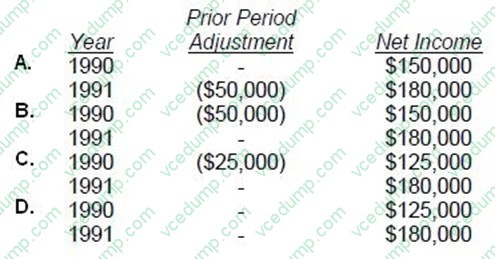
C. Option C Choice "c" is correct. 1990 ($25,000) $125,000 1991 -- 180,000 Because these are comparative financial statements, prior period adjustments require retroactive treatment for the years presented. Because 1989 is not presented, the 1989 correction is shown as a prior period adjustment of $25,000 to retained earnings statement of 1990.
Question 547:
The element of the audit planning process most likely to be agreed upon with the client before implementation of the audit strategy is the determination of the:
A. Evidence to be gathered to provide a sufficient basis for the auditor's opinion. B. Procedures to be undertaken to discover litigation, claims, and assessments. C. Pending legal matters to be included in the inquiry of the client's attorney. D. Timing of inventory observation procedures to be performed.
D. Timing of inventory observation procedures to be performed. Choice "d" is correct. In order to observe the physical inventory count, the auditor would have to coordinate schedules with the client. This timing is usually agreed upon before implementation of the audit strategy. Choice "a" is incorrect. It would not be appropriate for the client to be involved in determining the amount of evidence necessary to provide a basis for an opinion. Choice "b" is incorrect. It would not be appropriate for the client to be involved in determining the procedures necessary to obtain evidence about litigation, claims and assessments. Choice "c" is incorrect. Determination of the pending legal matters to be included in a letter to the client's attorney would not generally be made during the planning stage of the audit.
Question 548:
In considering materiality for planning purposes, an auditor believes that misstatements aggregating $10,000 would have a material effect on an entity's income statement, but that misstatements would have to aggregate $20,000 to materially affect the balance sheet. Ordinarily, it would be appropriate to design auditing procedures that would be expected to detect misstatements that aggregate:
A. $10,000 B. $15,000 C. $20,000 D. $30,000
A. $10,000 Choice "a" is correct. Because the statements are interrelated, the auditor ordinarily considers materiality for planning purposes in terms of the smallest aggregate level of misstatement that could be considered material to any one of the financial statements. Choices "b", "c", and "d" are incorrect, based on the above explanation.
Question 549:
An auditor's communication of internal control related matters noted in an audit usually should be addressed to:
A. Management and those charged with governance. B. The director of internal auditing. C. The chief financial officer. D. The chief accounting officer.
A. Management and those charged with governance. Choice "a" is correct. An auditor's communication of internal control related matters noted in an audit usually should be addressed to management and those charged with governance. Choices "b", "c", and "d" are incorrect. The director of internal auditing, the chief financial officer, and the chief accounting officer all would have access to the letter; however, it would not be addressed to them since they do not have the same level of authority and responsibility to the shareholders as management and those charged with governance.
Question 550:
In planning an audit of a new client, an auditor most likely would consider the methods used to process accounting information because such methods:
A. Influence the design of internal control. B. Affect the auditor's preliminary judgment about materiality levels. C. Assist in evaluating the planned audit objectives. D. Determine the auditor's acceptable level of audit risk.
A. Influence the design of internal control. Choice "a" is correct. The auditor would consider the methods used to process accounting information in planning an audit of a new client, because such methods influence the design of internal control. The auditor is required to obtain an understanding of the design of internal control in order to plan the audit and determine the nature, timing, and extent of tests to be performed. Choice "b" is incorrect. The auditor's judgment about materiality levels is based upon the auditor's perception of the needs of a reasonable person who will rely on the financial statements, not on the methods used to process accounting information. Choice "c" is incorrect. The planned audit objectives are based upon the auditor's desire to render an opinion on the fairness of the financial statements. This end goal is not influenced by the methods used by the client to process accounting information. Choice "d" is incorrect. Audit risk is the risk that the auditor may unknowingly fail to appropriately modify his or her opinion on financial statements that are materially misstated. The auditor's only acceptable level of audit risk is low, and this is not affected by the client's methods used to process accounting information.
Nowadays, the certification exams become more and more important and required by more and more
enterprises when applying for a job. But how to prepare for the exam effectively? How to prepare
for the exam in a short time with less efforts? How to get a ideal result and how to find the
most reliable resources? Here on Vcedump.com, you will find all the answers.
Vcedump.com provide not only AICPA exam questions,
answers and explanations but also complete assistance on your exam preparation and certification
application. If you are confused on your CPA-TEST exam preparations
and AICPA certification application, do not hesitate to visit our
Vcedump.com to find your solutions here.