BUSINESS-ENVIRONMENT-AND-CONCEPTS Exam Details
-
Exam Code
:BUSINESS-ENVIRONMENT-AND-CONCEPTS -
Exam Name
:Certified Public Accountant (Business Environment amd Concepts) -
Certification
:Test Prep Certifications -
Vendor
:Test Prep -
Total Questions
:530 Q&As -
Last Updated
:May 31, 2026
Test Prep BUSINESS-ENVIRONMENT-AND-CONCEPTS Online Questions & Answers
-
Question 381:
Berry, Drake, and Flanigan are partners in a general partnership. The partners made capital contributions as follows: Berry, $150,000; Drake, $100,000; and Flanigan, $50,000. Drake made a loan of $50,000 to the partnership. The partnership agreement specifies that Flanigan will receive a 50% share of profits, and Drake and Berry each will receive a 25% share of profits. Under the Revised Uniform Partnership Act and in the absence of any partnership agreement to the contrary, which of the following statements is correct regarding the sharing of losses?
A. The partners will share equally in any partnership losses.
B. The partners will share in losses on a pro rata basis according to the capital contributions.
C. The partners will share in losses on a pro rata basis according to the capital contributions and loans made to the partnership.
D. The partners will share in losses according to the allocation of profits specified in the partnership agreement. -
Question 382:
Why would a firm generally choose to finance temporary assets with short-term debt?
A. Matching the maturities of assets and liabilities reduces risk.
B. Short-term interest rates have traditionally been more stable than long-term interest rates.
C. A firm that borrows heavily long term is more apt to be unable to repay the debt than a firm that borrows heavily short term.
D. Financing requirements remain constant. -
Question 383:
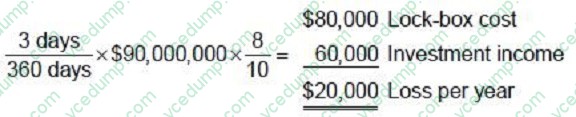
Foster Inc. is considering implementing a lock-box collection system at a cost of $80,000 per year. Annual sales are $90 million, and the lock-box system will reduce collection time by 3 days. If Foster can invest funds at 8 percent, should it use the lock-box system? Assume a 360-day year.
A. Yes, producing savings of $60,000 per year.
B. No, producing a loss of $20,000 per year.
C. No, producing a loss of $60,000 per year.
D. No, producing a loss of $140,000 per year. -
Question 384:
If an investor's certainty equivalent is greater than the expected value of an investment alternative, the investor is said to be:
A. Risk indifferent.
B. Risk averse.
C. Risk seeking.
D. Cautious. -
Question 385:
When markets are perfectly competitive, consumers:
A. Have goods and services produced at the lowest cost in the long run.
B. Must choose the brands they buy solely on the basis of informational advertising.
C. Do not receive any consumer surplus unless producers choose to overproduce.
D. Must search for the lowest price for the products they buy. -
Question 386:
An increase in the money supply leads to:
A. A decline in interest rates, an increase in investment and an increase in aggregate demand.
B. A decline in interest rates, a decrease in investment and an increase in aggregate demand.
C. An increase in interest rates, a decrease in investment and a decrease in aggregate demand.
D. An increase in the money supply has no effect on interest rates or investment. -
Question 387:
All of the following actions are valid tools that the Federal Reserve Bank uses to control the supply of money, except:
A. Selling government securities.
B. Changing the reserve ratio.
C. Raising or lowering the discount rate.
D. Printing money when the money supply appears low. -
Question 388:
An increase in the minimum wage will benefit specific economic wage groups as outlined below:
I. Employees at the minimum wage rate who remain employed will benefit, since they will receive more money.
II.
Many of the unskilled could lose their jobs. There would be fewer jobs for the currently unemployed such as less educated and untrained personnel (e.g., teenagers) who will have more difficulty finding work as firms reduce their labor force and pursue more efficiency.
A. Only I.
B. Only II.
C. Both I and II.
D. Neither I nor II.
I. Employees at the minimum wage rate who remain employed will benefit, since they will receive more money. II. Many of the unskilled could lose their jobs. There would be fewer jobs for the currently unemployed such as less educated and untrained personnel (e.g., teenagers) who will have more difficulty finding work as firms reduce their labor force and pursue more efficiency. -
Question 389:
Which of the following would lead to a reduction in inflation?
A. Increasing aggregate demand and increasing aggregate supply.
B. Decreasing aggregate demand and increasing aggregate supply.
C. Decreasing aggregate demand and decreasing aggregate supply.
D. Increasing aggregate demand and decreasing aggregate supply. -
Question 390:
Downs, Frey, and Vick formed the DFV general partnership to act as manufacturers' representatives. The partners agreed Downs would receive 40% of any partnership profits and Frey and Vick would each receive 30% of such profits. It was
also agreed that the partnership would not terminate for five years.
After the fourth year, the partners agreed to terminate the partnership. At that time, the partners' capital accounts were as follows: Downs, $20,000; Frey, $15,000; and Vick, $10,000. There also were undistributed losses of $30,000.
Which of the following statements about the form of the DFV partnership agreement is correct?
A. It must be in writing because the partnership was to last for longer than one year.
B. It must be in writing because partnership profits would not be equally divided.
C. It could be oral because the partners had explicitly agreed to do business together.
D. It could be oral because the partnership did not deal in real estate.
Related Exams:
-
AACD
American Academy of Cosmetic Dentistry -
ACLS
Advanced Cardiac Life Support -
ASSET
ASSET Short Placement Tests Developed by ACT -
ASSET-TEST
ASSET Short Placement Tests Developed by ACT -
BUSINESS-ENVIRONMENT-AND-CONCEPTS
Certified Public Accountant (Business Environment amd Concepts) -
CBEST-SECTION-1
California Basic Educational Skills Test - Math -
CBEST-SECTION-2
California Basic Educational Skills Test - Reading -
CCE-CCC
Certified Cost Consultant / Cost Engineer (AACE International) -
CGFNS
Commission on Graduates of Foreign Nursing Schools -
CLEP-BUSINESS
CLEP Business: Financial Accounting, Business Law, Information Systems & Computer Applications, Management, Marketing
Tips on How to Prepare for the Exams
Nowadays, the certification exams become more and more important and required by more and more enterprises when applying for a job. But how to prepare for the exam effectively? How to prepare for the exam in a short time with less efforts? How to get a ideal result and how to find the most reliable resources? Here on Vcedump.com, you will find all the answers. Vcedump.com provide not only Test Prep exam questions, answers and explanations but also complete assistance on your exam preparation and certification application. If you are confused on your BUSINESS-ENVIRONMENT-AND-CONCEPTS exam preparations and Test Prep certification application, do not hesitate to visit our Vcedump.com to find your solutions here.