BUSINESS-ENVIRONMENT-AND-CONCEPTS Exam Details
-
Exam Code
:BUSINESS-ENVIRONMENT-AND-CONCEPTS -
Exam Name
:Certified Public Accountant (Business Environment amd Concepts) -
Certification
:Test Prep Certifications -
Vendor
:Test Prep -
Total Questions
:530 Q&As -
Last Updated
:May 31, 2026
Test Prep BUSINESS-ENVIRONMENT-AND-CONCEPTS Online Questions & Answers
-
Question 401:
Absent a specific provision in its articles of incorporation, a corporation's board of directors has the unilateral power to do all of the following, except:
A. Repeal the bylaws.
B. Declare dividends.
C. Fix compensation of directors.
D. Amend the articles of incorporation. -
Question 402:
If a group of consumers decide to boycott a particular product, the expected result would be:
A. An increase in the product price to make up lost revenue.
B. A decrease in the demand for the product.
C. An increase in product supply because of increased availability.
D. That companies in the industry would experience higher economic profits. -
Question 403:
If no provisions are made in an agreement, a general partnership allocates profits and losses based on the: A. Value of actual contributions made by each partner.
B. Number of partners.
C. Number of hours each partner worked in the partnership during the year.
D. Number of years each partner belonged to the partnership. -
Question 404:
Which of the following statements is correct concerning liability when a partner in a general partnership commits a tort while engaged in partnership business?
A. The partner committing the tort is the only party liable.
B. The partnership is the only party liable.
C. Each partner is jointly and severally liable.
D. Each partner is liable to pay an equal share of any judgment. -
Question 405:
In general, which of the following statements is correct with respect to a limited partnership?
A. A limited partner has the right to obtain from the general partner(s) financial information and tax returns of the limited partnership.
B. A limited partnership can be formed with limited liability for all partners.
C. A limited partner may not also be a general partner at the same time.
D. A limited partner may hire employees on behalf of the partnership. -
Question 406:
At the peak of a business cycle:
A. Output (real GDP) tends to be below the potential level of output.
B. There is likely to be an excess supply of labor and business inventories are likely to be high.
C. The overall price level is likely to be falling.
D. Capacity constraints and labor shortages are likely to put upward pressure on the overall price level. -
Question 407:
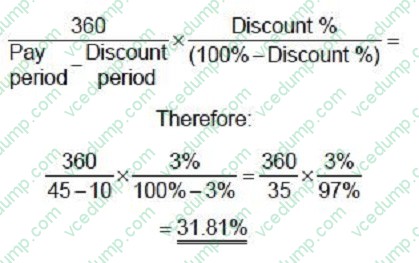
Using a 360-day year, what is the opportunity cost to a buyer of not accepting terms 3/10, net 45?
A. 55.67 percent.
B. 31.81 percent.
C. 15.43 percent.
D. 24.00 percent. -
Question 408:
Which one of the following statements about trade credit is correct? Trade credit is:
A. Not an important source of financing for small firms.
B. A source of long-term financing to the seller.
C. Subject to risk of buyer default.
D. Usually an inexpensive source of external financing. -
Question 409:
The measure most often used to compare standards of living across countries or across time is:
A. Government spending.
B. Real GDP.
C. Real consumption expenditures.
D. Real GDP per capita. -
Question 410:
Management accountants are frequently asked to analyze various decision situations including the following.
I. The cost of a special device that is necessary if a special order is accepted.
II. The cost proposed annually for the plant service for the grounds at corporate headquarters.
III. Joint production costs incurred, to be considered in a sell-at-split versus a process-further decision.
IV.
The costs associated with alternative uses of plant space, to be considered in a make/buy decision.
V.
The cost of obsolete inventory acquired several years ago, to be considered in a keep-versus disposal decision.
The cost described in situation II above is a:
A. Prime cost.
B. Sunk cost.
C. Discretionary cost.
D. Relevant cost.
I. The cost of a special device that is necessary if a special order is accepted. II. The cost proposed annually for the plant service for the grounds at corporate headquarters. III. Joint production costs incurred, to be considered in a sell-at-split versus a process-further decision. IV. The costs associated with alternative uses of plant space, to be considered in a make/buy decision.
Related Exams:
-
AACD
American Academy of Cosmetic Dentistry -
ACLS
Advanced Cardiac Life Support -
ASSET
ASSET Short Placement Tests Developed by ACT -
ASSET-TEST
ASSET Short Placement Tests Developed by ACT -
BUSINESS-ENVIRONMENT-AND-CONCEPTS
Certified Public Accountant (Business Environment amd Concepts) -
CBEST-SECTION-1
California Basic Educational Skills Test - Math -
CBEST-SECTION-2
California Basic Educational Skills Test - Reading -
CCE-CCC
Certified Cost Consultant / Cost Engineer (AACE International) -
CGFNS
Commission on Graduates of Foreign Nursing Schools -
CLEP-BUSINESS
CLEP Business: Financial Accounting, Business Law, Information Systems & Computer Applications, Management, Marketing
Tips on How to Prepare for the Exams
Nowadays, the certification exams become more and more important and required by more and more enterprises when applying for a job. But how to prepare for the exam effectively? How to prepare for the exam in a short time with less efforts? How to get a ideal result and how to find the most reliable resources? Here on Vcedump.com, you will find all the answers. Vcedump.com provide not only Test Prep exam questions, answers and explanations but also complete assistance on your exam preparation and certification application. If you are confused on your BUSINESS-ENVIRONMENT-AND-CONCEPTS exam preparations and Test Prep certification application, do not hesitate to visit our Vcedump.com to find your solutions here.