BUSINESS-ENVIRONMENT-AND-CONCEPTS Exam Details
-
Exam Code
:BUSINESS-ENVIRONMENT-AND-CONCEPTS -
Exam Name
:Certified Public Accountant (Business Environment amd Concepts) -
Certification
:Test Prep Certifications -
Vendor
:Test Prep -
Total Questions
:530 Q&As -
Last Updated
:May 31, 2026
Test Prep BUSINESS-ENVIRONMENT-AND-CONCEPTS Online Questions & Answers
-
Question 141:
In 1990, Amber Corp., a closely held corporation, was formed by Adams, Frank, and Berg as incorporators and stockholders. Adams, Frank, and Berg executed a written voting agreement which provided that they would vote for each other as
directors and officers. In 1994, stock in the corporation was offered to the public. This resulted in an additional 300 stockholders. After the offering, Adams holds 25%, Frank holds 15%, and Berg holds 15% of all issued and outstanding stock.
Adams, Frank, and Berg have been directors and officers of the corporation since the corporation was formed. Regular meetings of the board of directors and annual stockholders meetings have been held.
For this question refer to the formation of Amber Corp. and the rights and duties of its stockholders, directors, and officers.
A. Amber Corp. must be formed under a state's general corporation statute.
B. Amber Corp.'s articles of incorporation must include the names of all stockholders.
C. Amber Corp. must include its corporate bylaws in the incorporation documents filed with the state. -
Question 142:
Which of the following statements describes the same characteristic for both an S corporation and a C corporation?
A. Both corporations can have more than 100 shareholders.
B. Both corporations have the disadvantage of double taxation.
C. Shareholders can contribute property into a corporation without being taxed.
D. Shareholders can be either citizens of the United States or foreign countries. -
Question 143:
When determining net present value in an inflationary environment, adjustments should be made to:
A. Increase the discount rate, only.
B. Increase the estimated cash inflows and increase the discount rate.
C. Increase the estimated cash inflows but not the discount rate.
D. Decrease the estimated cash inflows and increase the discount rate. -
Question 144:
To address the problem of a recession, the Federal Reserve Bank most likely would take which of the following actions?
A. Lower the discount rate it charges to banks for loans.
B. Sell U.S. government bonds in open-market transactions.
C. Increase the federal funds rate charged by banks when they borrow from one another.
D. Increase the level of funds a bank is legally required to hold in reserve. -
Question 145:
Which one of the following represents methods for converting accounts receivable to cash?
A. Trade discounts, collection agencies, and credit approval.
B. Factoring, pledging, and electronic funds transfers.
C. Cash discounts, collection agencies, and electronic funds transfers.
D. Trade discounts, cash discounts, and electronic funds transfers. -
Question 146:
Which of the following statements is true regarding the payback method?
A. It does not consider the time value of money.
B. It is the time required to recover the investment and earn a profit.
C. It is a measure of how profitable one investment project is compared to another.
D. The salvage value of old equipment is ignored in the event of equipment replacement. -
Question 147:
When parties intend to create a partnership that will be recognized under the Revised Uniform Partnership Act, they must agree to:
A. Option A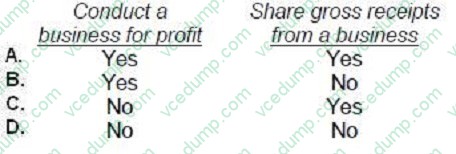
B. Option B
C. Option C
D. Option D -
Question 148:
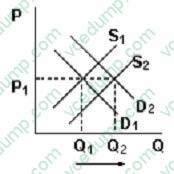
In any competitive market, an equal increase in both demand and supply can be expected to always:
A. Increase both price and market-clearing quantity.
B. Increase market-clearing quantity.
C. Increase price.
D. Decrease price. -
Question 149:
In 1992, Anchor, Chain, and Hook created ACH Associates, a general partnership. The partners orally agreed that they would work full time for the partnership and would distribute profits based on their capital contributions. Anchor
contributed $5,000; Chain $10,000; and Hook $15,000.
For the year ended December 31, 1993, ACH Associates had profits of $60,000 that were distributed to the partners. During 1994, ACH Associates was operating at a loss. In September 1994, the partnership dissolved.
In October 1994, Hook contracted in writing with Ace Automobile Co. to purchase a car for the
partnership. Hook had previously purchased cars from Ace Automobile Co. for use by ACH Associates partners. ACH Associates did not honor the contract with Ace Automobile Co. and Ace Automobile Co. sued the partnership and the
individual partners.
A. Anchor's capital account would be reduced by 1/3 of any 1994 losses.
B. Hook's capital account would be reduced by 1/2 of any 1994 losses. -
Question 150:
The basic objective of the residual income approach of performance measurement and evaluation is to have a division maximize its:
A. Return on investment rate.
B. Imputed interest rate charge.
C. Cash flows in excess of a desired minimum amount.
D. Income in excess of a desired minimum amount.
Related Exams:
-
AACD
American Academy of Cosmetic Dentistry -
ACLS
Advanced Cardiac Life Support -
ASSET
ASSET Short Placement Tests Developed by ACT -
ASSET-TEST
ASSET Short Placement Tests Developed by ACT -
BUSINESS-ENVIRONMENT-AND-CONCEPTS
Certified Public Accountant (Business Environment amd Concepts) -
CBEST-SECTION-1
California Basic Educational Skills Test - Math -
CBEST-SECTION-2
California Basic Educational Skills Test - Reading -
CCE-CCC
Certified Cost Consultant / Cost Engineer (AACE International) -
CGFNS
Commission on Graduates of Foreign Nursing Schools -
CLEP-BUSINESS
CLEP Business: Financial Accounting, Business Law, Information Systems & Computer Applications, Management, Marketing
Tips on How to Prepare for the Exams
Nowadays, the certification exams become more and more important and required by more and more enterprises when applying for a job. But how to prepare for the exam effectively? How to prepare for the exam in a short time with less efforts? How to get a ideal result and how to find the most reliable resources? Here on Vcedump.com, you will find all the answers. Vcedump.com provide not only Test Prep exam questions, answers and explanations but also complete assistance on your exam preparation and certification application. If you are confused on your BUSINESS-ENVIRONMENT-AND-CONCEPTS exam preparations and Test Prep certification application, do not hesitate to visit our Vcedump.com to find your solutions here.