BUSINESS-ENVIRONMENT-AND-CONCEPTS Exam Details
-
Exam Code
:BUSINESS-ENVIRONMENT-AND-CONCEPTS -
Exam Name
:Certified Public Accountant (Business Environment amd Concepts) -
Certification
:Test Prep Certifications -
Vendor
:Test Prep -
Total Questions
:530 Q&As -
Last Updated
:May 31, 2026
Test Prep BUSINESS-ENVIRONMENT-AND-CONCEPTS Online Questions & Answers
-
Question 131:
All of the following are complementary goods, except:
A. Margarine and butter.
B. Gas and motor oil.
C. Cameras and rolls of film.
D. VCRs and video cassettes. -
Question 132:
Stagflation refers to:
A. A combination of rising unemployment and rising real GDP.
B. A combination of rising unemployment and a rising price level.
C. High inflation rates.
D. High unemployment rates. -
Question 133:
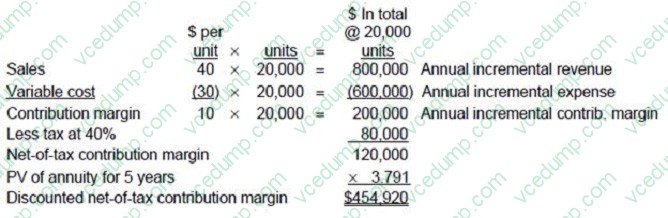
In order to increase production capacity, Gunning Industries is considering replacing an existing production machine with a new technologically improved machine effective January 1, 1997. The following information is being considered by Gunning Industries.
A. $242,624
B. $303,280
C. $363,936
D. $454,920 -
Question 134:
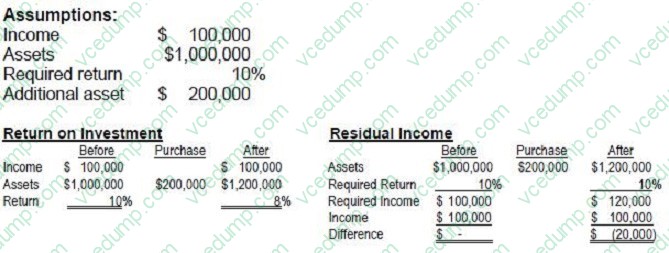
Minon, Inc. purchased a long-term asset on the last day of the current year. What are the effects of this purchase on return on investment and residual income?
A. Option A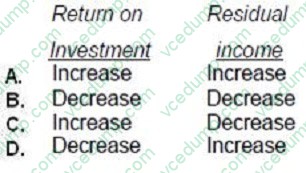
B. Option B
C. Option C
D. Option D -
Question 135:
Food Corp. owned a restaurant called The Ambers. The corporation president, T.J. Jones, hired a contractor to make repairs at the restaurant, signing the contract, "T.J. Jones for The Ambers." Two invoices for restaurant repairs were paid by Food Corp. with corporate checks. Upon presenting the final invoice, the contractor was told that it would not be paiD. The contractor sued Food Corp. Which of the following statements is correct regarding the liability of Food Corp.?
A. It is not liable because Jones is liable.
B. It is not liable because the corporation was an undisclosed principal.
C. It is liable because Jones is not liable.
D. It is liable because Jones had authority to make the contract. -
Question 136:
Which of the following is not considered a factor that increases the bargaining power of the customer?
A. Much information is available to the customer to compare and contrast features of all products on the market.
B. One group of customers makes up a large volume of the firm's business.
C. Buyers have low switching costs of changing products.
D. The firm is unable to change suppliers easily. -
Question 137:
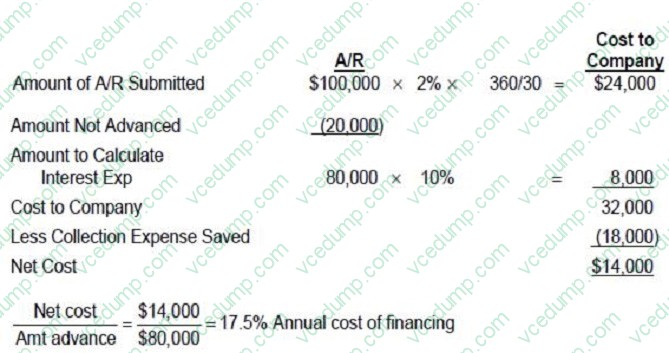
A company enters into an agreement with a firm who will factor the company's accounts receivable. The factor agrees to buy the company's receivables, which average $100,000 per month and have an average collection period of 30 days.
The factor will advance up to 80 percent of the face value of receivables at an annual rate of 10 percent and charge a fee of 2 percent on all receivables purchased. The controller of the company estimates that the company would save
$18,000 in collection expenses over the year.
Fees and interest are not deducted in advance. Assuming a 360-day year, what is the annual cost of financing?
A. 12.0 percent.
B. 14.0 percent.
C. 16.0 percent.
D. 17.5 percent. -
Question 138:
One approach to measuring divisional performance is return on investment. Return on investment is expressed as operating income:
A. Divided by the current year's capital expenditures plus cost of capital.
B. Divided by fixed assets.
C. Divided by current assets.
D. Divided by total assets. -
Question 139:
The working capital financing policy that subjects the firm to the greatest risk of being unable to meet the firm's maturing obligations is the policy that finances: A. Fluctuating current assets with long-term debt.
B. Permanent current assets with long-term debt.
C. Permanent current assets with short-term debt.
D. Fluctuating current assets with short-term debt. -
Question 140:
A firm with a higher degree of operating leverage when compared to the industry average implies that the:
A. Firm has higher variable costs.
B. Firm's profits are more sensitive to changes in sales volume.
C. Firm is more profitable.
D. Firm uses a significant amount of debt financing.
Related Exams:
-
AACD
American Academy of Cosmetic Dentistry -
ACLS
Advanced Cardiac Life Support -
ASSET
ASSET Short Placement Tests Developed by ACT -
ASSET-TEST
ASSET Short Placement Tests Developed by ACT -
BUSINESS-ENVIRONMENT-AND-CONCEPTS
Certified Public Accountant (Business Environment amd Concepts) -
CBEST-SECTION-1
California Basic Educational Skills Test - Math -
CBEST-SECTION-2
California Basic Educational Skills Test - Reading -
CCE-CCC
Certified Cost Consultant / Cost Engineer (AACE International) -
CGFNS
Commission on Graduates of Foreign Nursing Schools -
CLEP-BUSINESS
CLEP Business: Financial Accounting, Business Law, Information Systems & Computer Applications, Management, Marketing
Tips on How to Prepare for the Exams
Nowadays, the certification exams become more and more important and required by more and more enterprises when applying for a job. But how to prepare for the exam effectively? How to prepare for the exam in a short time with less efforts? How to get a ideal result and how to find the most reliable resources? Here on Vcedump.com, you will find all the answers. Vcedump.com provide not only Test Prep exam questions, answers and explanations but also complete assistance on your exam preparation and certification application. If you are confused on your BUSINESS-ENVIRONMENT-AND-CONCEPTS exam preparations and Test Prep certification application, do not hesitate to visit our Vcedump.com to find your solutions here.