B2C-COMMERCE-DEVELOPER Exam Details
-
Exam Code
:B2C-COMMERCE-DEVELOPER -
Exam Name
:Salesforce Certified B2C Commerce Cloud Developer (Comm-Dev-101) -
Certification
:Salesforce Certifications -
Vendor
:Salesforce -
Total Questions
:207 Q&As -
Last Updated
:Jul 08, 2026
Salesforce B2C-COMMERCE-DEVELOPER Online Questions & Answers
-
Question 51:
A developer set up a newsite with Taxation: Net. However, the business requirements changed and the site now needs to be Taxation:Gross. The Business Manager interface does not give this option.
Which sequence of steps is necessary to change the site to gross taxation?
A. Make sure that the developer has "Administrator" Access, then change the Taxationsetting to Gross
B. Unlock the site preferences and then change the Taxation setting to Gross
C. Change the global setting,"Enable Taxation Methods" to true, then change the Taxationsetting to Gross
D. Create a new site with Taxation set to Gross, then delete the old site. -
Question 52:
The following sample code is NOT providing the desired results. The Digital Developer needs to add an entry to the logs to debug the problem.
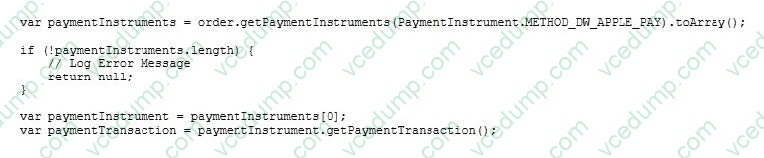
Which statement correctly adds a log entry?
A. Logger.exception(`Unable to find Apple Paypayment instrument for order.`+paymentInstruments);
B. Logger.getErrorLog().log(`Unable to find Apple Pay payment instrument for order.`+paymentInstruments);
C. Logger.fault(`Unable to find Apple Pay payment instrument for order.`+paymentInstruments);
D. Logger.error(`Unable to find Apple Pay payment instrument for order.`+paymentInstruments); -
Question 53:
A Digital Developer wants to selectivelyretrieve products and process them from an iPhone.
Which action should the Developer take, given that JavaScript controllers CANNOT be used?
A. Use import/export in Business Manager.
B. Create a webservice to retrieve products.
C. Use OCAPI and invoke it in native language.
D. Use WebDAV Client to retrieve products. -
Question 54:
A developer is asked to periodically create a CSB file in a WebDAV folder to hold the orders information of the last 30 days.
What are the appropriate actions to implement such a requirement?
A. Develop and configure a steptype and corresponding CommonJ5 job step script.
B. Implement and configure a recurring task using the cron commandin Business Manager.
C. Configure a new custom OCAPI endpoint and use the Customers resource type. -
Question 55:
Given the file structure below, which ISML method call renders the customLandingPage template?
A. ISML.renderTamplate(`cartridge/templates/default/content/custom/customLandingPage');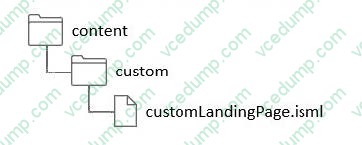
B. ISML(`content/custom/customLandingPage');
C. ISML.render(`content/custom/customLandingPage');
D. ISML.renderTemplate(`content/custom/customLandingPage'); -
Question 56:
Which two items are appropriate content of custom logs implemented atcheckout? Choose 2 answers:
A. Customer's password at post-checkout sign up
B. Order failure information
C. Transaction's credit card information
D. Payment gateway service response code -
Question 57:
A Digital Developer is implementing an Open Commerce API call to add products to a basket. Given the following resource configuration:
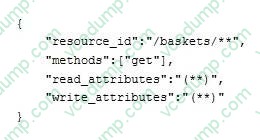
Which modification allows the requests to successfully execute?
A. Change the "resource_id" value to: "/baskets/*/items".
B. Change the "write_attributes" value to: "(+items)".
C. Change the "read_attributes" value to: "(items)".
D. Change the "methods" value to: ["get", "post"]. -
Question 58:
Server.get(`Show', consentTracking.consent, cache.applyDefaultCache, function (req,res,next){
Var Site = require(`dw/system/Syte");
Var pageMetaHelpter = require(`*/cartridge/scripts/helpers/pageMetaHelper');
pageMetaHelpter.setPageMetaTags(req.pageMetaData, Site.current);
res.render(`/home/homePage');
Missing code here
}, pageMetadata.computedPageMetadata);
The controller endpoint code snippet above does not work.
Which line of code should the developer use to replace line 6 and correct the problem?
A. next();
B. return res;
C. res.next();
D. req.next(); -
Question 59:
There is a business requirement thata custom controller in app_custom_my_cartridge invokes the calculateTax(basket) function of the dw, order calculateTex hook that is defined in app_storefront_base. How can the developer implement this call?
A. Use dw.system.HookMgr.callHook('dw.order.calculateTax', 'calculateTax', {basket: currentBasket});
B. Add the location of the dw.order.calculateTax hook to hooks.json, and then use dw.system.HookMgr.callHook('dw.order.calculateTax', 'calculateTax', {basket: currentBasket});
C. Add the location of the dw.order.calculateTax hook to package.json, and then use dw.system.HookMgr.callHook('dw.order.calculateTax', 'calculateTax', {basket: currentBasket}); -
Question 60:
A new product has been added to the Storefront catalog that 15 assigned to a site
Which configuration does a developer need to ensure to have a new product visible in the Storefror
A. The search index is built AND the product is online and searchable.
B. The product has a master product AND the search index is built.
C. The product has a price AND the product rs online and searchable.
Related Exams:
-
201-COMMERCIAL-BANKING-FUNCTIONAL
Salesforce enCino 201 Commercial Banking Functional -
ADM-201
Salesforce Certified Platform Administrator (Plat-Admn-201) -
ADM-211
Administration Essentials for Experienced Admin (ADM-211) -
ADM-261
Service Cloud Administration (SU24) -
ADVANCED-ADMINISTRATOR
Salesforce Certified Advanced Administrator -
ADVANCED-CROSS-CHANNEL
Marketing Cloud Advanced Cross Channel Accredited Professional -
ADX-201
Administrative Essentials for New Admins in Lightning Experience -
ADX-271
Salesforce Certified Community Cloud Consultant (ADX-271) -
AGENTFORCE-SPECIALIST
Salesforce Certified Agentforce Specialist (AI-201) -
ALS-CON-201
Salesforce Certified Agentforce Life Sciences Consultant
Tips on How to Prepare for the Exams
Nowadays, the certification exams become more and more important and required by more and more enterprises when applying for a job. But how to prepare for the exam effectively? How to prepare for the exam in a short time with less efforts? How to get a ideal result and how to find the most reliable resources? Here on Vcedump.com, you will find all the answers. Vcedump.com provide not only Salesforce exam questions, answers and explanations but also complete assistance on your exam preparation and certification application. If you are confused on your B2C-COMMERCE-DEVELOPER exam preparations and Salesforce certification application, do not hesitate to visit our Vcedump.com to find your solutions here.