A retailer notices that the Account Addresses page is showing the wrong shopper's address.
Which toolshould the developer start with to identify the issue?
A. Storefront Toolkit B. Reports and Dashboards module C. Pipeline Profiler
C. Pipeline Profiler To identify the issue of an Account Addresses page showing the wrong shopper's address, the developer should start with the Storefront Toolkit (Option A). This tool provides access to real-time diagnostics and debugging capabilities directly on the storefront, allowing developers to inspect controller calls, caching behaviors, and other session-specific data that could contribute to the problem. The Storefront Toolkit is an effective first step for troubleshooting issues that manifest in the storefront environment, as it allows for immediate visibility into the operations of the site as experienced by end-users.
Question 72:
Business Manager has the configuration:
Active log category is "root"
Log level of INFO
The code below execites:
Var log = Logger.getLogger("products","export");
Log.info ("This is important information");
Using this information, what is the beginning of the filename in which the log will be written?
A. custom-export B. custom-products C. products D. info-export
B. custom-products Given the configuration of the logging system in Salesforce B2C Commerce where the log category is set to "root" and a log level of INFO, and considering the code snippet provided, the beginning of the filename where the log will be written would be determined by the logger instance created with parameters "products" and "export". Here, "products" is the category and "export" is the subcategory. As per the standard logging configuration in B2C Commerce, the log file name typically starts with the category or subcategory name when defined, leading to the filename beginning with "custom-products". This prefix "custom-" indicates custom logging categories beyond the default system log files.
Question 73:
A client that sells sport shows wants to allow its customers to filer products based on the intended activity (such as tennis, jogging, basketball, etc.) but this particular information is not present in the current catalog.
Which two actions does a developer need to perform in a B2C Commerce instance to allow this two happen?
A. Createa new Product custom attribute AND add a new Search Refinement Definition for the desired categories. B. Create a new ProductRefinement custom attribute AND add a new Search Refinement Definition for the desired categories. C. Create a new Product customattribute AND add a new viewtype in the storefront catalog settings
A. Createa new Product custom attribute AND add a new Search Refinement Definition for the desired categories. To allow filtering of products based on the intended activity such as tennis, jogging, or basketball, the developer should perform two actions: create a new product custom attribute and add a new Search Refinement Definition for the desired categories. Option A is correct as it involves creating a new custom attribute, which can be used to store activity- specific information for each product, and configuring a new search refinement definition, which allows this attribute to be used as a criterion in the storefront's search and navigation facilities. This setup is crucial for enhancing the shopping experience by enabling customers to narrow down their search based on specific product attributes relevant to their needs.
Question 74:
What happens if the log file size limit is reached in custom logging?
A. Logging is suspended for the day. B. Logging is suspended for two hours. C. The log file is deleted and recreated from scratch. D. The log file rolls over and the last used log is overwritten.
D. The log file rolls over and the last used log is overwritten. In Salesforce Commerce Cloud, when the size limit of a custom log file is reached, the system automatically rolls over the log file. This means the existing log file is closed and a new log file is started. If the number of log files exceeds the configured limit, the oldest log file is overwritten. This mechanism ensures that logging can continue without interruption and without exceeding storage allocations, thereby maintaining system performance and log file manageability.
Question 75:
Given the following snippet:
Server.append( `Show' , function (req, res, next) )
According to SFRA, which two optionsshows a correct way to complete the code above in order to provide data to the response using a controller? Choose 2 answers
A. res.viewData = {data: myDataObject};res.render(`/content/myPage');next();}); B. res.setViewData ({data: myDataObject});res.render(`/content/myPage');next();}); C. res.render(`/content/myPage',{data: myDataObject});next();}); D. res.render(`/content/myPage');next();}).append{(Data:myDataObject});
B. res.setViewData ({data: myDataObject});res.render(`/content/myPage');next();}); C. res.render(`/content/myPage',{data: myDataObject});next();}); In the Salesforce Commerce Cloud SFRA (Storefront Reference Architecture), the proper way to provide data to the response object in a controller involves using the setViewData method or passing data directly to the render method. Option B: res.setViewData({data: myDataObject}); res.render('/content/myPage'); next(); correctly uses setViewData to prepare data before rendering the page. This method sets the view data for the response which is then used when render is called. Option C: res.render('/content/myPage', {data: myDataObject}); next(); directly passes the data object to the render method, which is also a valid and efficient way to handle data in SFRA controllers. Both options correctly use the methods as per the patterns recommended in SFRA documentation.
Question 76:
A developer is asked to create a new service instance that will call a remote web service.
Which method should the developer use to create the service instance?
A. dw.svc.LocalServiceRegistry.createService() B. dw.svc.LocalServiceInstance.createService() C. dw.svc.LocalServiceRegistry.getDefaultService()
A. dw.svc.LocalServiceRegistry.createService() For creating a new service instance in Salesforce B2C Commerce that calls a remote web service, the correct method to use is dw.svc.LocalServiceRegistry.createService(), as shown in Option A. This method allows developers to define a service configuration that specifies various aspects of the service call, such as the endpoint URL, request method, credentials, and other necessary parameters. By using LocalServiceRegistry.createService(), the developer can leverage the built-in service framework in B2C Commerce, which facilitates the management and execution of external service calls, including error handling and connection pooling.
Question 77:
A developer is asked to implementa simple call to an authentication - protected REST web service. Which configuration is valid?
A. Add the authentication password to the service credentials. B. Configure the authentication username using a site preference. C. Insert the service'sendpoint in a .properties file.
A. Add the authentication password to the service credentials. Explanation Explanation/Reference:The valid configuration to implement a call to an authentication-protected REST web service is to add the authentication password to the service credentials (Option A). This approach ensures that the credentials required for authentication are securely stored and utilized in the service configuration. Typically, credentials for external services should be configured within the service framework in Salesforce B2C Commerce, which allows for secure storage and usage of sensitive information such as passwords, thereby maintaining security best practices.
Question 78:
A client has two B2C Commerce sites in the same instance: one forthe U.S. market, the other for the European market. They offer free gift wrapping on a selection of products. For each order, five products can be wrapped in the U.S., but only three products can be wrapped in the European region.
How should a developer allow the merchant to independently adjust this number?
A. Create a new custom preference by extending the Site Preference object type. B. Select the corresponding option in the system preference for Orders. C. Add a new Campaign using the Online Marketing section of the Business Manager. D. Configure a new localizable content slot with a market-specific value.
A. Create a new custom preference by extending the Site Preference object type. In Salesforce B2C Commerce, site preferences allow customization and configuration of various site-specific settings, which can be managed independently across different regional sites on the same instance. By creating a new custom preference under the Site Preference object type, developers can introduce a setting that specifies the number of products eligible for gift wrapping per order for each specific site. This approach provides the flexibility needed to adjust these numbers independently for the U.S. and European markets as required by the business logic. Such preferences are accessed and modified through the Business Manager, ensuring that business users can easily update them without needing further code deployment. This solution aligns with Salesforce B2C Commerce's best practices for managing site-specific behaviors and configurations without hardcoding values, thereby maintaining scalability and manageability across multiple market-specific sites.
Question 79:
Given a sandbox with an active slot configuration with the following specifications:
1.
Content type set to product
2.
With someproduct configured
3.
With the following rendering template: slots/product/product_1x2 isml
4.
Correctly enabled and scheduled
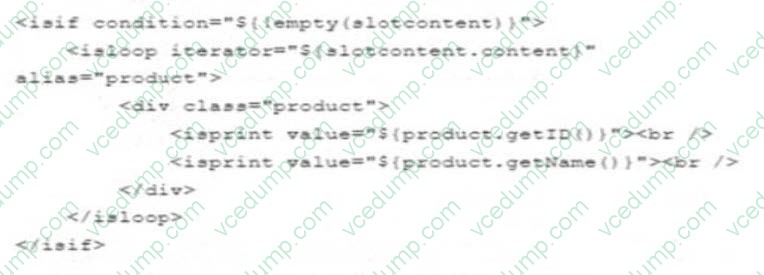
And given the code contained in the selected rendering template: Is an additional action needed for this to work asintended?
A. No - The content slot is rendered correctly. B. Yes - The isloop should be removed because no loops are allowed in a content slot rendering template. C. Yes - The content needs to be configured with a recommender to display products.
A. No - The content slot is rendered correctly. The provided code snippet, which uses an isif and isloop within a template, is perfectly valid within Salesforce B2C Commerce Cloud context, especially when rendering products from a content slot that has been set to a "product" content type. Here's why: Template and Content Slot Configuration: The content slot configuration specifies that the content type is set to "product" and it is associated with a specific template (slots/product/product_1x2 isml). This indicates that the slot is intended to display product information, which matches the data type expected by the template. Use of isloop: The isloop is used to iterate over the content of the slot, which in this case, consists of product data. The iterator $(slotcontent.content) suggests that multiple products can be configured within this slot and the template is set up to handle multiple entries. This is a common practice when a slot is configured to display multiple items, such as products in a promotional section or a product list. Template Syntax: The template uses ISML tags (isif, isloop, isprint) correctly. The isif condition checks if the slot content is not empty, ensuring that the loop only runs when there is content to display. Each product's ID and name are fetched and displayed using isprint, which is appropriate for rendering text data on a page. No Need for Recommender: The suggestion that a recommender is required (Option C) is incorrect in this context because the slot configuration and template logic do not necessitate any specific recommender setup. A recommender would be used if dynamic product recommendations were needed, but this setup appears to be designed to display predefined products configured within the content slot. Loop Usage in Slots: The claim in Option B that loops are not allowed in content slot rendering templates is incorrect. Loops are often used in templates to iterate over collections of items, such as products in a slot, particularly when the content slot is intended to handle multiple elements. In summary, no additional action is required for the slot and template to work as intended, based on the information provided and standard practices within Salesforce B2C Commerce Cloud. The setup using isloop within a product content slot is standard and intended to display multiple products. Hence, the answer is A - The content slot is rendered correctly.
Question 80:
Multiple shoppers report slow performance on the Product Details Page.
Which tool can a developer use to view average response times for the Product-Detail controller route?
A. Pipeline Profiler B. Request Logs C. URL Request Analyzer
C. URL Request Analyzer Explanation Explanation/Reference:To analyze the performance issues on the Product Details Page, particularly the response times for specific controller routes like 'Product-Detail', the URL Request Analyzer tool in Salesforce B2C Commerce is most appropriate. This tool provides detailed insights into the performance of individual URLs, including the breakdown of time spent in various areas such as scripting, pipeline execution, and service calls. By using the URL Request Analyzer, developers can pinpoint bottlenecks and inefficiencies in the Product Details Page and take necessary actions to optimize performance.
Nowadays, the certification exams become more and more important and required by more and more
enterprises when applying for a job. But how to prepare for the exam effectively? How to prepare
for the exam in a short time with less efforts? How to get a ideal result and how to find the
most reliable resources? Here on Vcedump.com, you will find all the answers.
Vcedump.com provide not only Salesforce exam questions,
answers and explanations but also complete assistance on your exam preparation and certification
application. If you are confused on your B2C-COMMERCE-DEVELOPER exam preparations
and Salesforce certification application, do not hesitate to visit our
Vcedump.com to find your solutions here.