A Digital Developer needs to add logging to the following code: Which statement logs the HTTP status code to a debug-level custom log file?
A. logger.getLogger(`profile').debug("Error retrieving profile email, Status Code: ", http.statusCode); B. logger.debug("Error retrieving profile email, Status Code: {0} was returned.", http.statusCode); C. Logger.getLogger().debug("Error retrieving profile email, Status Code: {0} was returned.", http.statusCode); D. Logger.getLogger(`profile').debug("Error retrieving profile email, Status Code: {0} was returned.", http.statusCode);
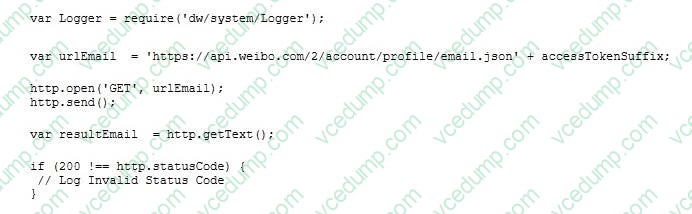
D. Logger.getLogger(`profile').debug("Error retrieving profile email, Status Code: {0} was returned.", http.statusCode); In Salesforce B2C Commerce, logging is implemented via the Logger class available through the dw.system.Logger module. The correct way to log messages is to use the getLogger() method to retrieve an instance of a logger configured for a specific category, followed by one of the log level methods such as debug(). The logging statement must correctly format the message and include dynamic data like the HTTP status code. In the options given: Option A incorrectly uses logger.getLogger() and the debug method does not properly format the message with the status code. Option B uses logger.debug() without obtaining a logger instance specific to a category which does not match the given syntax of dw.system.Logger. Option C lacks the specific category 'profile' needed for getLogger() method. Option D is correct because it uses Logger.getLogger('profile').debug(), which correctly references a specific logger category and uses the placeholder {0} for the status code. This matches the Salesforce Commerce Cloud's way of handling log messages with parameterized data.
Question 12:
Which line of code creates a content slot that can be included on homepage.isml to display on the home page?
B To create a content slot that is included on the homepage and displayed correctly, the code should specify the context appropriate to the homepage. The correct line of code, , indicates that the slot is a global type and the context is set to "homepage". This means the content slot 'my_banner' is designed to be used across various pages of the site but specifically renders in the homepage context, aligning with common ISML template practices.
Question 13:
A developer has a sandbox with code to log a message during execution, and the following code:

After the codeexecutes, the developer does not see any log file with the message in the WebDAV folder. Which two tasks does the developer need to perform to correct this issue? Choose 2 answers
A. Request that the developer's account be given permission to the Log Center of the current realm. B. Set the root log level to debug. C. Check the box for Info under Log Files. D. Set the logging global preference to true.
A. Request that the developer's account be given permission to the Log Center of the current realm. C. Check the box for Info under Log Files. Explanation Explanation/Reference:When logs do not appear as expected in the WebDAV folder, common issues include lack of appropriate permissions and incorrect log file settings. For Salesforce B2C Commerce: A: Developers must have the appropriate permissions to access and view logs in the Log Center of the Business Manager. Without these permissions, even if logs are generated, the developer may not be able to view them. C: Ensuring that the appropriate log level (Info in this case, based on the code) is selected under Log Files in the Business Manager settings is crucial. If this setting is not enabled, logs of this level will not be written or displayed.
Question 14:
A developer is asked to improve the maintainability of a page by reducing its code repetition.
What are two techniques the developer should implement to achieve this? Choose 2 answers.
A. Require and render templates with tags B. Uselocal template includes C. Implement template decorators paired with replace tags D. Embed partial files using ISML expressions
B. Uselocal template includes C. Implement template decorators paired with replace tags To improve the maintainability of a page by reducing code repetition, the developer should: B. Use local template includes - This technique involves creating smaller, reusable templates for common parts of the page, which can then be included as needed across different templates. This reduces redundancy and makes the codebase easier to manage. C. Implement template decorators paired with replace tags - Template decorators allow developers to define common layout or structural elements that can be reused across different parts of the application. Replace tags can be used within these decorators to specify where unique content should be inserted, further reducing the need to duplicate structural code.
Question 15:
A merchant wants customers to be able to order gift vouchers via their site. Since they can issue an unlimited number of these digital vouchers, this item should be available to sell at all items.
How can a developer use Business Manager to ensure that the gift vouchers are always available?
A. Check the perpetual flag in the product inventory record B. Check the Available to Sell (ATS) flag dor the producto set C. Set StockLevel = maxAllocation for the producto. D. Manually set the inventory to a high number.
A. Check the perpetual flag in the product inventory record To ensure that gift vouchers are always available for sale regardless of actual inventory, a developer should utilize the "perpetual" flag in the product inventory record. By checking the perpetual flag in Business Manager, the inventory system treats this product as always available, effectively ignoring any inventory checks. This is particularly suitable for non- physical or digital items like gift vouchers, where the concept of physical stock does not apply. The perpetual flag setting ensures that the item can be sold without limits, which aligns with the nature of digital vouchers.
Question 16:
A developer is tasked with implementing the necessary code for a new Page Designer component.
What are the two purposes of the JSON metadata definition file that the developer creates? Choose 2 answers
A. Defines regions within the component type. B. Defines the responsive layout of the rendered template. C. Defines the business and rendering logic of the component required by the merchant. D. Defines theattributes that a merchant enters when using the component type.
A. Defines regions within the component type. D. Defines theattributes that a merchant enters when using the component type. In the context of Page Designer in Salesforce Commerce Cloud, the JSON metadata definition file serves critical roles in defining the structure and capabilities of a new component. Firstly, it defines the regions within the component type, which are areas where other components can be nested or placed, essentially outlining the structural layout of the component. Secondly, it specifies the attributes that a merchant can set when configuring the component in the Page Designer tool. These attributes can include various configurable options like colors, sizes, or text, which allow for customization of the component's appearance and behavior without hard coding these properties. This file does not directly define the rendering logic or the responsive layout, which are typically handled by the template and CSS respectively.
Question 17:
A Digital Developer has created a new PaymentForm controller thatrequires communication with the server and must be made using the HTTPS protocol. Which code sample should the Developer use to make sure that HTTPS is used?
A. exports.PaymentForm = guard.ensure([`http', `post', `loggedIn'], handlePaymentForm); B. exports.PaymentForm = guard.expose([`post', `loggedIn'], handlePaymentForm); C. exports.PaymentForm = guard.httpsPost(handlePaymentForm); D. exports.PaymentForm = guard.ensure([`https', `post', `loggedIn'], handlePaymentForm);
D. exports.PaymentForm = guard.ensure([`https', `post', `loggedIn'], handlePaymentForm); Explanation Explanation/Reference:To ensure that a PaymentForm controller uses the HTTPS protocol in Salesforce B2C Commerce, the correct approach is to use the guard.ensure function with the 'https' argument along with 'post' and 'loggedIn'. Option D, exports.PaymentForm = guard.ensure(['https', 'post', 'loggedIn'], handlePaymentForm);, correctly specifies that the PaymentForm handler should be accessible only via HTTPS, ensuring secure communication over the network. The guard.ensure method is a part of the application security framework designed to enforce certain conditions like HTTP methods and secure protocols before a controller action is executed. This is documented in the Salesforce B2C Commerce security best practices, where specifying 'https' ensures that any data transmitted during the payment process is encrypted and secure.
Question 18:
There are three logging categories: category1, category1.eu, and category1.us.
In Business Manager, category1 is enabled for WARN level and no other categories are configured. All custom log targets are enabled.
The code segmentbelow executes.

What is the result'
A. Logs will not be written. B. Logs will be written to the log file with a prefix loggerFile. C. Logs will be written to the log file with a prefix custom-loggerFile. D. Logs will be written to the log file with a prefix customwarn.
A. Logs will not be written. Given that the logging category "category1.eu" is not explicitly configured in Business Manager and "category1" is set to WARN level, logs intended for "category1.eu" with a severity of WARN will not inherit settings automatically from "category1" unless explicitly specified. Therefore, without specific configuration enabling "category1.eu" or adjusting the level to WARN or lower, logs under "category1.eu" with a message level of WARN will not be written. This behavior ensures that logs are controlled and categorized precisely, avoiding unintended logging.
Question 19:
Given the sandbox with:
Service configured and assigned to its profile and credential.
A code version that uses that service
And given the requirement to limit the number of success or error calls the code can perform to a restricted number ofcalls per second.
Which configuration should the developer perform?
A. Set the service as limited and change the services profile site preferences with the required values. B. Set the rate limiter in the service profile and configure its values with the ones required. C. Set a new quota limit for the service profile and assign the service to it.
B. Set the rate limiter in the service profile and configure its values with the ones required. Explanation Explanation/Reference:In Salesforce B2C Commerce, to manage the rate of calls made to external services and to prevent exceeding the limit of allowed calls, developers can configure a rate limiter directly in the service profile. This involves setting up specific thresholds that define the number of calls that can be made per second. This setup ensures that the integration adheres to external service limitations or internal performance considerations by controlling the rate at which requests are sent. The configuration of rate limiting is critical in environments where multiple calls are made to external APIs, which might have their own limitations on how often they can be accessed. This practice not only adheres to the best use of external services but also helps in maintaining the stability and performance of the application.
Question 20:
A developer working on a simple web service integration is asked toadd appropriate logging to allow future troubleshooting.
According to logging best practices, which code should the developer write to log when an operation succeeds, but has an unexpected outcome that may produce side effects?
A. Logger.info(`Unexpected service response') B. Logger.debug(`Unexpected service response') C. Logger.error(`Unexpected service response') D. Logger.warn(`Unexpected service response')
D. Logger.warn(`Unexpected service response') Explanation Explanation/Reference:When logging information about an operation that succeeds but has an unexpected outcome that may produce side effects, the appropriate log level is: D. Logger.warn(`Unexpected service response') - The warn level is used to indicate potentially harmful situations that are not immediate errors but could potentially lead to issues. It's appropriate here because the operation did not fail outright, but the outcome was not as expected, warranting attention but not a full error declaration.
Nowadays, the certification exams become more and more important and required by more and more
enterprises when applying for a job. But how to prepare for the exam effectively? How to prepare
for the exam in a short time with less efforts? How to get a ideal result and how to find the
most reliable resources? Here on Vcedump.com, you will find all the answers.
Vcedump.com provide not only Salesforce exam questions,
answers and explanations but also complete assistance on your exam preparation and certification
application. If you are confused on your B2C-COMMERCE-DEVELOPER exam preparations
and Salesforce certification application, do not hesitate to visit our
Vcedump.com to find your solutions here.