Given the above OCAPI definitions, which permission or permissions apply?
{
"resource_id": "/sites/*/coupons/*",
"methods": [
"put"
],
"read_attributes": "(**)",
"write_attributes": "(**)"
}
A. Allows external applications to create coupons B. Allows external applications to create, update, and delete coupons C. Allow external applications to create, update, and delete both coupons and coupon codes D. Allows external applications to update coupons
D. Allows external applications to update coupons Based on the given OCAPI definitions in the image, the permission specified allows only the "put" method under "methods". This method corresponds to the HTTP PUT request, typically used for updating resources. In the context of the OCAPI setting, this would specifically allow external applications to update existing coupons on the Salesforce B2C Commerce platform. There are no permissions granted for creating or deleting coupons, or for handling coupon codes, as the methods for those actions (POST for creating and DELETE for deleting) are not listed.
Question 192:
Universal Containers is preparing their storefront to use Open Commerce APIs (OCAPI).
To which hook should the Digital Developermove taxation logic to ensure consistent order totals within B2C Commerce?
A. dw.ocapi.shop.order.validateOrder B. dw.ocapi.shop.basket.calculate C. dw.ocapi.shop.basket.afterPostShipment D. dw.ocapi.shop.order.afterPOST
B. dw.ocapi.shop.basket.calculate Explanation Explanation/Reference: The hook dw.ocapi.shop.basket.calculate is ideal for integrating taxation logic when preparing a storefront to use OCAPI in Salesforce B2C Commerce Cloud. This hook allows the system to apply custom business logic, such as tax calculations, each time the basket's totals are calculated. This ensures that the order totals remain consistent and accurate across various customer interactions and API calls. Option B (dw.ocapi.shop.basket.calculate): Correctly applies tax logic during the calculation of basket totals, which is critical for ensuring that all updates to the basket (like adding items, applying discounts, or changing quantities) consider tax implications correctly. This approach aligns with the best practices for extending OCAPI in Commerce Cloud to maintain consistency in order totals, especially when the basket state changes.
Question 193:
A merchant has a content slot on a page that currently displays products based on the top Sellers for the current week.
They wish to change this functionality and, instead, have the slot render a specific content asset so that the content experience is more personalized to the visitors.
Which two actions are necessary to make this change? Choose 2 answers
A. Delete the existing content slot and create a new one. B. Change the rendering template in the slot configuration C. Change the default setting in the slot configuration D. Change the content type for the slot configuration
B. Change the rendering template in the slot configuration D. Change the content type for the slot configuration To change the functionality of a content slot from displaying top sellers to rendering a specific content asset, the necessary actions include: B. Change the rendering template in the slot configuration. This action involves adjusting the template used to render the slot content, ensuring it is appropriate for displaying a content asset instead of a product list. D. Change the content type for the slot configuration. This change specifies what type of content the slot should handle, switching from product-based content to a content asset. This adjustment in the slot configuration is essential for tailoring the content experience to be more personalized, as it defines the type of content that will be rendered in the slot. These changes are sufficient to alter the slot's behavior without needing to delete the existing slot or only adjust default settings without changing the content type.
Question 194:
A developeris importing edits for two different sites into the same sandbox, and is provided with four different files.
Which two XML files should the developer import using the site-specific Merchant Tools import modules, instead of the Administration section import modules? Choose 2 answers.
A. System type extensions (solo en Sites) B. Site Jobs (sites) C. Search Settings En (search y en Sites) D. Promotions ( en sites y en online marketing)
B. Site Jobs (sites) D. Promotions ( en sites y en online marketing) When importing configurations specific to different sites into the same sandbox, the XML files that should be imported using site-specific Merchant Tools rather than through the Administration section are: B. Site Jobs - These files relate to scheduled jobs configured at the site level, containing settings and parameters specific to operations within individual sites. D. Promotions - These involve marketing and promotional settings that are typically specific to individual sites, affecting how discounts and special offers are applied and managed within that site's context. Importing these using the site-specific Merchant Tools ensures that configurations apply correctly and are managed in the context of the intended site, maintaining consistency and specificity in site operations.
Question 195:
Given a job step configured in the steptype.json, a developer needs to add a custom status code
"No_FILES_FOUND".
Which code snippet will complete the requirement?
A. var status = {success: `OK'. Message: `NO_FILES_FOUND'};return status; B. var status = require(`dw/system/status');return new Status(Status.OK, `NO_FILES_FOUND'); C. this.status = `NO_FILES_FOUND'return this; D. return `NO_FILES_FOUND
B. var status = require(`dw/system/status');return new Status(Status.OK, `NO_FILES_FOUND'); In Salesforce B2C Commerce, when you need to return a custom status code from a job step, you should use the dw.system.Status class to create and return a new status object with the appropriate status and custom status message. The correct code snippet is option B: var status = require('dw/system/status'); return new Status(Status.OK, 'NO_FILES_FOUND');. This snippet correctly creates a new status object indicating a successful completion (Status.OK) but also communicates the specific outcome of "NO_FILES_FOUND" by using the second parameter of the Status constructor to set a custom status message, aligning with the API's way of handling custom statuses.
Question 196:
A developer isimplementing new Page Designer content on a merchant's Storefront and adds the line shown below to the setupCsntentSearch function in the searchHelpers.Js file.
What does this achieve?
A. Allows Page Designer pages and components to be searchable B. Prevents Page Designer pages from being searchable C. Allows filtering Page Designer pages by folder
A. Allows Page Designer pages and components to be searchable Adding specific configurations to the setupContentSearch function within the searchHelpers.js file enables Page Designer content, including pages and components, to be included in search results on a merchant's Storefront. This modification to the search setup allows the site's search functionality to index and retrieve content created through Page Designer, thereby enhancing the discoverability of dynamically created content. Enabling searchability for Page Designer content is crucial for sites that heavily utilize dynamic content creation tools to ensure that all relevant content is accessible through the site's search features.
Question 197:
A Digital Developer suspects a logical error in a script.
Which action will help locate the error?
A. Submit a support ticket to B2C Commerce. B. Check request logs for evidence ofthe logical error. C. Put breakpoints in the code, debug, and examine variable values. D. Print all values in the script node called before the current script.
C. Put breakpoints in the code, debug, and examine variable values. To locate a logical error in a script within Salesforce B2C Commerce, the most effective approach is to utilize debugging tools that allow breakpoints and examination of variable values. This method, option C, involves putting breakpoints in the script where the developer suspects the error might be occurring. By stepping through the code and examining the values of variables at these breakpoints, the developer can observe the script's execution flow and pinpoint where things go awry. This hands-on debugging approach provides direct insight into the script's behavior, which is crucial for identifying and resolving logical errors. Details on setting breakpoints and debugging can be found in the "Debugging Scripts" section of the Salesforce Commerce Cloud documentation.
Question 198:
A Digital Developer is working on a projectto convert a pipeline to a JavaScript controller. UX Studio has a functioning pipeline debugger configured for the site. Assume the Developer will add a breakpoint to the controller when it is written.
What must be done in order to use the debugger with the new controller when it is written?
A. Create and use a new script debug configuration. B. Use the existing pipeline debugger. C. Modify the debugger configuration and use the existing pipeline debugger. D. Create and use a new controller debug configuration.
D. Create and use a new controller debug configuration. When converting a pipeline to a JavaScript controller and needing to debug the controller in Salesforce B2C Commerce, you must set up an appropriate debugging environment that supports JavaScript controllers specifically: Option D: Create and use a new controller debug configuration is the correct answer. This is because the debugging tools and configurations for pipelines are different from those used for JavaScript controllers. A controller debug configuration specifically targets the debugging of server-side JavaScript, allowing breakpoints, step-through, and inspection of JavaScript code executed on the server. Option A refers to a generic script debug configuration, which might not be specific enough. Option B and C, related to pipeline debuggers, are not applicable to JavaScript controllers, as they are designed for the older pipeline architecture.
Question 199:
A Digital Developer extends a system object, Product, andadds a Boolean attribute, "sellable," to it.
Assuming "prod" is the variable name handling the product, what code can the Developer use to access it?
A. prod.extended.sellable B. prod.sellable C. prod.persistable.sellable D. prod.custom.sellable
D. prod.custom.sellable When extending a system object in Salesforce B2C Commerce, such as adding a new attribute to the Product object, custom attributes are accessed through the custom namespace. Therefore, if a Boolean attribute named "sellable" is added to the Product object, it should be accessed as prod.custom.sellable. This approach is part of the platform's data customization framework, where custom provides a namespace for all user-defined extensions to system objects, ensuring that they do not conflict with existing system properties. Detailed usage and examples of accessing custom attributes can be found in the Salesforce Commerce Cloud Script API documentation under "System Object Types".
Question 200:
The following code ensures that an address ID CANNOT be used if it is already in use by another address in the customer's address book. There is a problem with the code. The error message for an invalid address ID is never shown to the user on the formfield.
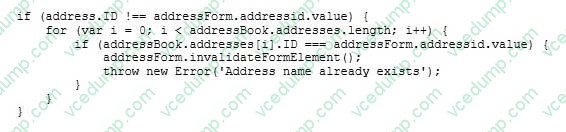
How should the Digital Developer resolve this issue so that the error message is displayed on the address ID form field?
A. addressForm.invalidateFormElement("addressid"); B. addressForm.addresssid.invalidateFormElement = true; C. addressForm.invalidateFormElement(addressForm.addressid); D. addressForm.addresssid.invalidateFormElement();
A. addressForm.invalidateFormElement("addressid"); In the given scenario, the correct way to ensure that an error message is displayed on the address ID form field when an invalid address ID is entered is: A. addressForm.invalidateFormElement("addressid");This method call specifically targets the form element associated with the address ID and marks it as invalid, which triggers the display of the associated error message. This approach is direct and ensures that the user is immediately informed about the invalidity of the entered address ID, enhancing the user experience and form validation process.
Nowadays, the certification exams become more and more important and required by more and more
enterprises when applying for a job. But how to prepare for the exam effectively? How to prepare
for the exam in a short time with less efforts? How to get a ideal result and how to find the
most reliable resources? Here on Vcedump.com, you will find all the answers.
Vcedump.com provide not only Salesforce exam questions,
answers and explanations but also complete assistance on your exam preparation and certification
application. If you are confused on your B2C-COMMERCE-DEVELOPER exam preparations
and Salesforce certification application, do not hesitate to visit our
Vcedump.com to find your solutions here.