B2C-COMMERCE-DEVELOPER Exam Details
-
Exam Code
:B2C-COMMERCE-DEVELOPER -
Exam Name
:Salesforce Certified B2C Commerce Cloud Developer (Comm-Dev-101) -
Certification
:Salesforce Certifications -
Vendor
:Salesforce -
Total Questions
:207 Q&As -
Last Updated
:Jul 16, 2026
Salesforce B2C-COMMERCE-DEVELOPER Online Questions & Answers
-
Question 121:
A developer has a sandbox with code to log a message during execution, and the following code:
After the code executes the developer does not see any log file with the message in the WebDEV folder.
Which two XML filesshould the developer import using the using-specific Merchant Tools import modules?
A. Search settings and Promotion
B. Search settings and Site Jobs
C. Promotions and Site jobs -
Question 122:
A developer wants to configure multiple products that should only be sold as a group. It should not bepossible for buyers to buy these products individually. How should the developer configure the products?
A. Bundle
B. Set
C. Variation Group -
Question 123:
A Digital Developer is working on a multi-site realm. A new site requires a different layout for the account landing page. The business logic and datamodel remain the same. The existing code is in AccountControl.js and accountlanding.isml in the app_storefront cartridge. The app_storefront cartridge contains code for all other business functions. The cartridge path for the new site is currently int_cybersource:int_paypal:app_storefront.
The Developer creates a new cartridge named app_newsite that contains only the accountlanding.isml template for the new site.
Which modification should be made to the new cartridge path?
A. Set the cartridge path sothat app_newsite is before app_storefront.
B. Set the cartridge path so that app_storefront is before int_cybersource.
C. Set the cartridge path to include only app_newsite.
D. Set the cartridge path so that app_newsite is after app_storefront. -
Question 124:
A NewsletterSubscription custom object exists that has a key attribute named email of type String and the following script code.

However, the NewsletterSubscription custom object is not persisted. What is a possible reason?
A. The code shownneed to be wrapped in a transaction.
B. The code shown needs to be wrapped in a try/catch block.
C. The code shown is the wrong syntax. The correct syntax is: -
Question 125:
A Digital Developer wants pass control to an ISML template from a JavaScript Controller and load product on thepipeline dictionary with the name myProduct. Which code sample will achieve this?
A. ISML.renderTemlpate ( "helloworld.isml", { "myProduct": "product" });
B. ISML.renderTemlpate ( "helloworld.isml", { "product": myProduct });
C. ISML.renderTemlpate ( "helloworld.isml", { product: myProduct });
D. ISML.renderTemlpate ( "helloworld.isml", { myProduct: product }); -
Question 126:
A Digital Developer has identified that the code segment below is causing performance problems.
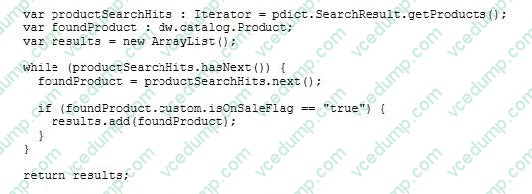
What should theDeveloper do to improve the code?
A. Use a system attribute instead of the isOnSaleFlag custom attribute.
B. Avoid post-processing and use the isOnSaleFlag attribute as a search refinement.
C. Breaks the process into separate loops.
D. Avoid using an Iterator and use a Collection instead. -
Question 127:
Given the following conditions:
Site export file with a copy of the Storefront data for a custom site
Sandbox with the custom site code, but no Storefront data
Requirement for a working copy of SFRA for development reference
A developer is assigned the following Business manager tasks:
A-Import the custom Site using Site Import/Export B-Import the SFRA Demo Sites using Site Import/Export C-Rebuild the custom Site search indexes
In what sequence should the developer perform the tasks, so that the custom Site displays the products as intended?
A. Task A, then C, then B
B. Task B, then C, then A
C. Task A, then B, then C
D. Task B, then A, then C -
Question 128:
An instance has custom logging enabled. The log reaches the file size limit.
What happens in this situation?
A. The log file is deleted and a new log file is created.
B. Logging is suspended for the day
C. The currentlog file is archived and a new log file is created.
D. The log file Rolls over and the oldest log messages are overwritten -
Question 129:
The developer needs to add custom category debug logging into the "contact'' script, to ensure that a third-party service call responds as expected.
Assuming that the logging configurations for the contact category are correctly in place, which line of code should the developer add in the 06 placeholder to meet this requirement?
A. Logger.getLogger('contact').debug('Contact service responded with OK.')
B. Logger.debug('Contact service responded with OK.')
C. Logger.customLogger('contact').debug('Contact service responded with OK.') -
Question 130:
A developer is given the requirement to add a step to the existing business logic of theregistration process. How should the developer modify the route that handles the customer registration?
A. Change the controller route with new functionality.
B. Extend the route with new functionality.
C. Copy the code from the original route to a new controller route, and change it.
D. Override the route with new functionality.
Related Exams:
-
201-COMMERCIAL-BANKING-FUNCTIONAL
Salesforce enCino 201 Commercial Banking Functional -
ADM-201
Salesforce Certified Platform Administrator (Plat-Admn-201) -
ADM-211
Administration Essentials for Experienced Admin (ADM-211) -
ADM-261
Service Cloud Administration (SU24) -
ADVANCED-ADMINISTRATOR
Salesforce Certified Advanced Administrator -
ADVANCED-CROSS-CHANNEL
Marketing Cloud Advanced Cross Channel Accredited Professional -
ADX-201
Administrative Essentials for New Admins in Lightning Experience -
ADX-271
Salesforce Certified Community Cloud Consultant (ADX-271) -
AGENTFORCE-SPECIALIST
Salesforce Certified Agentforce Specialist (AI-201) -
ALS-CON-201
Salesforce Certified Agentforce Life Sciences Consultant
Tips on How to Prepare for the Exams
Nowadays, the certification exams become more and more important and required by more and more enterprises when applying for a job. But how to prepare for the exam effectively? How to prepare for the exam in a short time with less efforts? How to get a ideal result and how to find the most reliable resources? Here on Vcedump.com, you will find all the answers. Vcedump.com provide not only Salesforce exam questions, answers and explanations but also complete assistance on your exam preparation and certification application. If you are confused on your B2C-COMMERCE-DEVELOPER exam preparations and Salesforce certification application, do not hesitate to visit our Vcedump.com to find your solutions here.