A developer has these requirements for out-of-stock products:
1.
Save the SKUs of the out-of-stock products that the customer is interested in
2.
Save the customer email regardless if the customer is a guest or registered
3.
Email the customer whenthe product is back-in-stock
Which step should the developer perform as part of the solution to achieve the requirements?
A. Create a new set-of-string type custom attribute to the system object type Profile to save all the SKUs and use the existing emailfield for the email. B. Create a new system object type that has a set-of-string type custom attribute for the SKUs and a string for the email field. C. Create a new custom object type that has a set-of-string type custom attribute for the SKUs and a string for the email field. D. Create a new set-of-string type custom attribute to the system object type Product to save all the customer email addresses for back-in-stock notification.
C. Create a new custom object type that has a set-of-string type custom attribute for the SKUs and a string for the email field. To fulfill the requirement of saving SKUs of out-of-stock products and customer emails for notification purposes, the most effective solution is to create a new custom object type. This custom object type would include a set-of-string type custom attribute to store the SKUs of products a customer is interested in and a string type custom attribute for storing the email address of the customer. This approach allows for greater flexibility and organization, making it easier to manage and query the data as needed for notifying customers when products are back in stock.
Question 142:
Which three techniques improve client-side performance in production while following documented best practices? (Choose three.)
A. Use one style sheet for each ISML decorator template. B. Place CSS outside of templates. C. Compress CSS. D. Use inline Javascript. E. Combine several images into a single image.
B. Place CSS outside of templates. C. Compress CSS. E. Combine several images into a single image. For improving client-side performance, several techniques are considered best practices: Place CSS outside of templates (B): External CSS files can be cached by the browser, reducing the need to download them for every page load. This also separates content from style, which aids in maintaining cleaner HTML and potentially speeds up page rendering times. Compress CSS (C): Compressing CSS files reduces their size, leading to faster download times. This can be achieved through minification, which removes unnecessary characters from code without changing its functionality. Combine several images into a single image (CSS sprites) (E): Using CSS sprites combines multiple images into one larger image that is downloaded as a single file. This reduces the number of HTTP requests needed for loading multiple images, thereby decreasing load times and improving performance.
Question 143:
Universal Containers requires that a new order comments attribute is added to the existing SiteGenesis checkout flow. This new attribute needs to be included as part of the standard order export.
Aside from updating the HTML markup and form definition, which option contains all necessary steps to achieve this task?
A. Add the new attribute to the";Orde"; system object. Modify th"t;COPIaceOrd"t; controller to add this new attribute to the current session's "Order" object. B. Modify the";COPIaceOrde"; controller to update a CSV file in the IMPEX WebDAV directory with the order ID and comments. Modify the order export process to read information in the CSV file and include it as part of the export. C. Add the new attribute to the";Custome"; system object. Modify th"t;COPIaceOrd"t; controller to add this new attribute to the current session's "Customer" object. D. Create a new custom object type for order comments that contains the attributes: order ID and comments. Modify the";COPIaceOrde"; controller to create a new order comments custom object upon order completion.
A. Add the new attribute to the";Orde"; system object. Modify th"t;COPIaceOrd"t; controller to add this new attribute to the current session's "Order" object. To add a new order comments attribute to the existing SiteGenesis checkout flow and include it as part of the standard order export, the correct steps involve modifying the system objects and controller logic directly associated with order processing: A. Add the new attribute to the "Order" system object. Modify the "COPlaceOrder" controller to add this new attribute to the current session's "Order" object. This approach integrates the new attribute into the existing order data structure, allowing it to be seamlessly included in the standard order export process without the need for additional data handling or storage mechanisms. This method is supported by the Salesforce B2C Commerce documentation on system object extensions and controller modifications for enhancing functionality.
Question 144:
A Digital Developer adds the following line of code to a script.
The code executes without error; however, the log file on disk does NOTcontain the log message.
Which two actions should be completed to write the log message to disk? (Choose two.)
A. Ensure that the debug log level is enabled to write to file in the Custom Log Settings Business Manager module. B. Archive old log files tomake room in the log directory. C. Ensure that the "login" category is added to the Custom Log Filters in the Log Settings Business Manager module. D. Ensure that the debug log level has been added to the custom log level types in the Global Preferences business manager module.
A. Ensure that the debug log level is enabled to write to file in the Custom Log Settings Business Manager module. C. Ensure that the "login" category is added to the Custom Log Filters in the Log Settings Business Manager module. For a log message to be recorded on disk correctly, certain settings must be configured in the Business Manager: Ensure that the debug log level is enabled to write to file in the Custom Log Settings Business Manager module (A): This setting allows messages logged at the debug level to be written to the file system. If it is not enabled, debug-level messages might only be available in the console or not captured at all. Ensure that the "login" category is added to the Custom Log Filters in the Log Settings Business Manager module (C): This ensures that log messages, which belong to specific categories such as "login," are not filtered out and are written to the log files. These actions are critical for ensuring that log messages are not only generated but are also retained as intended in the log files. Options like archiving old log files (B) and adding custom log level types in Global Preferences (D) do not directly impact whether a new log message is written but are more about managing existing log data or global logging settings.
Question 145:
Given the following ISML example, how should a developer reference the product object in the current iteration of thebasket?
…
A. product B. pdict.Basket.products{loopstatus} C. loopstatus.product D. pdict.product
A. product Explanation Explanation/Reference:In the provided ISML example, the correct way to reference the product object in the current iteration of the loop is simply with product. This is because the var attribute in the tag defines product as the variable name that holds the current item in the loop. The variable product directly accesses the properties of the product object being iterated over, without needing to reference the complete path or the loop status. This usage aligns with standard ISML loop conventions documented in Salesforce Commerce Cloud developer guides.
Question 146:
A merchant uploads an image using the ContentImage Upload module of Business Manager.
Which three modules can the merchant or developer use to display the image on the Storefront? Choose 3 answers
A. ISML templates B. Content assets C. Storefront catalogs D. Content slots E. Payment types
A. ISML templates B. Content assets D. Content slots When displaying uploaded images on the Salesforce B2C Commerce Storefront, the following modules can be used: A: ISML templates can be used to embed images directly into the HTML structure of the page, offering a way to directly reference and display images. B: Content assets can include images as part of their composition, allowing for reusable content that includes text, images, and other media types. D: Content slots can be configured to display specific content assets, including those containing images, thereby enabling dynamic content display across different parts of the storefront.
Question 147:
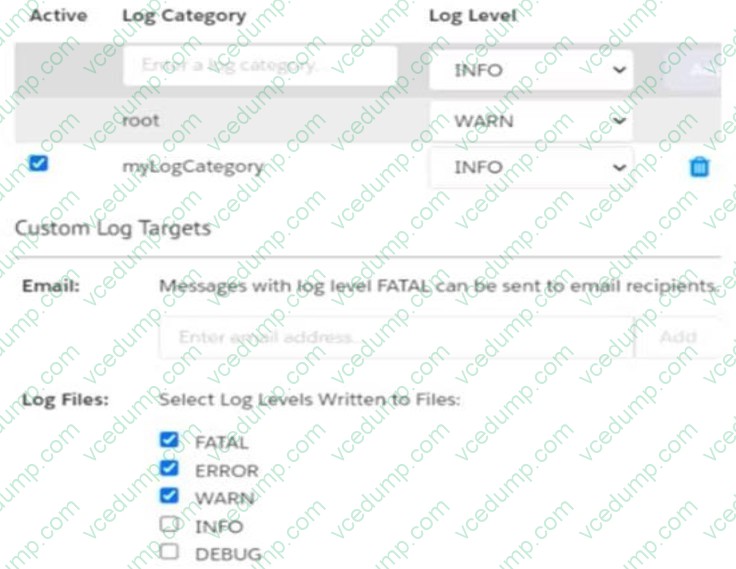
The developer wants to be able to view DEBUG
The developer wants to be able to view DEBUG level messages for myLogCategory in the Request Log tool. Given the custom log configurations in the image above, what does the developer need to do to accomplish this?
A. Change the Log Level for myLogCategory to DEBUG. B. Check the DEBUG box in the Log Files section. C. Change the Log Level for myLogCategory to DEBUG and check the DEBUG box in theLog Files section.
C. Change the Log Level for myLogCategory to DEBUG and check the DEBUG box in theLog Files section. In order to view DEBUG level messages for the myLogCategory in the Request Log tool of Salesforce B2C Commerce, the developer will need to adjust both the log category settings and the log file settings, as detailed in option C. Here's why both adjustments are necessary: Changing the Log Level for myLogCategory to DEBUG: Initially, the log level for myLogCategory is set to INFO as seen in the image. This means that only INFO and higher severity messages (WARN, ERROR, FATAL) will be logged under this category. To capture DEBUG messages, the log level must be explicitly set to DEBUG. This step ensures that DEBUG messages are generated and considered for logging. Checking the DEBUG box in the Log Files section: This section controls which log levels are actually written to the log files. Even if DEBUG messages are generated (after adjusting the log level for myLogCategory), they won't be written to the log files unless DEBUG is specifically selected in the Log Files settings. By default, only FATAL, ERROR, and WARN levels are selected to be written to files, as shown in the image. To include DEBUG messages in the logs, this setting must be adjusted to check the DEBUG box. Both steps are necessary because one dictates the generation of DEBUG level logs ( myLogCategory set to DEBUG), and the other dictates the persistence of these logs in the log files (checking the DEBUG box). If only one of these actions is performed, DEBUG messages for myLogCategory will not be fully enabled and viewable in the Request Log tool. Therefore, the correct and complete action to take is option C: Change the Log Level for myLogCategory to DEBUG and check the DEBUG box in the Log Files section.
Question 148:
A developer must configure permissions for an Open Commerce API resource on a sandbox instance that currently does not have any permissions configured.
Which two configuration properties are required to enable Access to the resource? Choose 2 answers
A. Resource_id B. Read_attributes C. Client_id D. Versi_range
A. Resource_id C. Client_id For configuring permissions for an Open Commerce API resource, the essential properties needed are: A. Resource_id - This property specifies the identifier for the resource you wish to configure, which is crucial for defining the scope and target of the API permissions. C. Client_id - This property identifies the specific client application that the permissions apply to. It is essential for controlling which client applications have access to the specified resource. These properties ensure that permissions are correctly assigned both to the resource and to the client application accessing it, aligning with security and access management practices in Salesforce B2C Commerce.
Question 149:
Which method is efficient and scalable because it uses the product search index rather than searching the database?
A. ProducrlndexModel.getOrderableProductsOnly() B. ProduccAvailabiliryModel.isOrderable() C. ProductSearcbHodel().gerProductSearchHita() D. ProductVanari.cnMcciel.aerVariams ()
C. ProductSearcbHodel().gerProductSearchHita() The method ProductSearchModel().getProductSearchHits() is efficient and scalable because it utilizes the product search index rather than conducting a direct search within the database. This indexing method enables quicker retrieval of product information and is optimized for performance in scenarios where multiple products need to be fetched based on various criteria. Using the product search index means that data retrieval is managed through indexed fields, which is significantly faster than querying a database directly for each request. This approach not only improves performance but also reduces the load on the database, making it a scalable solution for e-commerce environments where high traffic and large product catalogs are common.
Question 150:
A developer uses hooks for an extension point. Which n true for running multiple hooks for an extension point?
A. It is possible to register multiple modules to call for an extension point in a singlehooks.json file B. It is possible to control the order in which registered modules are called. C. If you call multiple modules, only the first hook called returns a value
A. It is possible to register multiple modules to call for an extension point in a singlehooks.json file In Salesforce B2C Commerce, particularly when using the hooks framework, it is possible to register multiple hooks for a single extension point within a single hooks.json file. This feature allows developers to extend or modify the behavior of the base application by specifying different modules that can be called when a particular event or operation occurs. By defining multiple hooks in the hooks.json file, developers can effectively modularize their customizations, making the system more flexible and easier to maintain. Each registered module can be triggered in sequence based on the configuration, providing extensive control over the application's flow and functionalities.
Nowadays, the certification exams become more and more important and required by more and more
enterprises when applying for a job. But how to prepare for the exam effectively? How to prepare
for the exam in a short time with less efforts? How to get a ideal result and how to find the
most reliable resources? Here on Vcedump.com, you will find all the answers.
Vcedump.com provide not only Salesforce exam questions,
answers and explanations but also complete assistance on your exam preparation and certification
application. If you are confused on your B2C-COMMERCE-DEVELOPER exam preparations
and Salesforce certification application, do not hesitate to visit our
Vcedump.com to find your solutions here.