Recent code changes to an existing cartridge do not appear correctly on a Storefront. The developer confirms that the code is uploaded in the IDE and ensures that the cartridge is associated with the sandbox. Which two additional steps should the developer take to troubleshoot this problem? Choose 2 answers
A. Check that the search index was recently rebuilt. B. Check the Business Manager site cartridge path. C. Check the Storefront site cartridge path. D. Check that the correct code version is selected.
B. Check the Business Manager site cartridge path. D. Check that the correct code version is selected. Explanation Explanation/Reference:When changes to a cartridge do not reflect on the storefront, it's important to verify: B: The site cartridge path configured in the Business Manager. This path determines the order and inclusion of cartridges that are executed. If the path is incorrect or the updated cartridge is not included, the changes won't appear on the storefront. D: The code version selected in the Business Manager must be the version where the latest changes were uploaded. If an older version is selected, the recent changes will not be reflected.
Question 112:
In the SFRA Page controller, the following route exists:
What is the correct way to use this controller route in an ISML template?
A. ${Resource.msg('aboutus','content',null)}
B n Salesforce B2C Commerce, the SFRA (Storefront Reference Architecture) utilizes controllers to handle requests and direct traffic within the application. When setting up routes and referencing these routes in ISML templates, it's important to ensure that the methods and syntax used are compatible with how SFCC expects URLs to be constructed and handled. For the specific route in question, where the controller is defined to use a default cache with a middleware, and navigating to the specified address results in an error, we need to consider how the route is being referenced in ISML templates. Option A: html Copy code ${Resource.msg('aboutus', 'content', null)} This uses the URLUtils.url function to create a link, which correctly builds URLs based on named routes in SFRA controllers. However, this approach is more generic and doesn't directly address or adapt to specific caching or middleware needs unless those are configured within the controller itself. Option B: html Copy code This option effectively uses the tag to embed the result of the URL constructed by URLUtils.url. This method is appropriate when you need to include content that is generated by a controller route, especially when that route is intended to render parts of a page or specific components rather than serve standalone pages. Given the use of caching and middleware as specified in the route, this approach can ensure that the content is fetched and displayed correctly with caching behaviors respected. Option C: html Copy code Like , is used for including content, but its usage is slightly different and typically not the right choice for invoking controller routes that are meant to return full page components or segments managed by specific middleware and caching strategies. In conclusion, Option B is the correct and most appropriate way to use this controller route in an ISML template. It leverages the caching and middleware setup defined in the controller and ensures that the included content behaves as expected within the site's architecture and caching strategy.
Question 113:
Universal Containers recently completed updates to their storefront shopping cart page. A problem has been discovered since the update. Users are no longer able to submit coupon codes on this page. Additionally, authenticated userswho try to add a coupon are logged out.
The following processing code is found in the Cart.js controller file:
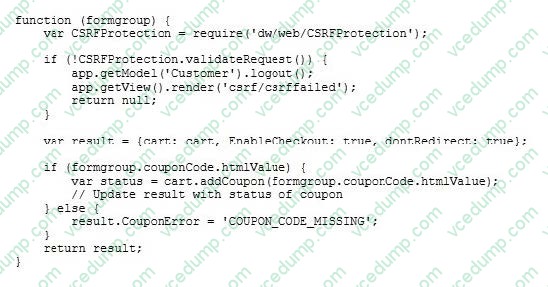
What should the Developer verify to identify the issue?
A. The CSRF cartridge is included in the site's cartridge path. B. The form grouphas the secure attribute set to true. C. The CSRF token is present in the form and is being submitted in the request. D. The CSRF settings in Business Manager are properly configured.
C. The CSRF token is present in the form and is being submitted in the request. The issue described involves problems with submitting coupon codes and users being logged out upon attempting this action, which strongly points to issues related to Cross-Site Request Forgery (CSRF) protection mechanisms in Salesforce B2C Commerce Cloud. Given the described behavior: Option A suggests verifying if the CSRF cartridge is in the cartridge path, which is essential but not directly related to the specific issue of form submission. Option B discusses the 'secure' attribute of the form group, which is important for HTTPS security but does not address the CSRF token issue directly. Option C is the correct answer, as it focuses on verifying if the CSRF token is present in the form and is being submitted with the request. This token is crucial for validating that the form submission is legitimate and not a CSRF attack. The absence or mishandling of this token could lead to the issues described, such as users being logged out when they try to submit a form, as the system might interpret these actions as potential CSRF attacks. Option D suggests checking the CSRF settings in Business Manager, which, while important, is more about configuration rather than troubleshooting specific form submission issues in the code.
Question 114:
Universal Containers calls thefollowing combination of products "The Basics" and sells the combination as a unique product ID:
1.
One Model 103 container
2.
Five Model 611 container
3.
Tree Model 201 container
The Developer created these three products in the catalog.
What is the next stepin Business Manager to create "The Basics" as a combination?
A. In the Product Bundles module, create a bundle named "The Basics". B. In the Products module, create a product named "The Basics" and add the products to the Product Bundles tab. C. In the Products module, create a product named "The Basics" and add the products to the Product Sets tab. D. In the Product Sets module, create a product set named "The Basics".
A. In the Product Bundles module, create a bundle named "The Basics". To create "The Basics" as a combination of different products in Salesforce B2C Commerce, the appropriate step is to use the Product Bundles feature. A. In the Product Bundles module, create a bundle named "The Basics". This option allows the developer to group multiple individual products into a single purchasable item, with its unique ID and inventory tracking as a bundle. Creating a product bundle is suitable for selling combinations of products as a package, which fits the scenario of selling "The Basics" as a combined product. The Product Sets module (Option D) is typically used for grouping products for display purposes rather than selling them as a single SKU, which distinguishes it from the bundles. Detailed instructions and guidelines on creating product bundles are available in the Business Manager documentation under the "Product Bundles" section.
Question 115:
A Digital Developer creates a B2C Commerce server connection in their UX Studio workspace. The Developer adds new cartridges to the workspace, but the cartridges do NOT execute as the Developer expects.
Which three things should the Digital Developer verify to ensure the cartridges are uploaded? (Choose three.)
A. The Auto-Upload setting is enabled for the server connection. B. The Active Server setting is enabled for the server connection. C. The credentials for the server connectionare correctly entered. D. The cartridge is for the current version of B2C Commerce. E. The server is configured to accept incoming connections.
A. The Auto-Upload setting is enabled for the server connection. B. The Active Server setting is enabled for the server connection. C. The credentials for the server connectionare correctly entered. When a Digital Developer notices that newly added cartridges are not executing as expected in Salesforce B2C Commerce, several aspects of the server connection setup in UX Studio should be verified: A. The Auto-Upload setting is enabled for the server connection. This setting automatically uploads code changes to the connected server, ensuring that any updates in the cartridges are reflected on the server without requiring manual uploads. B. The Active Server setting is enabled for the server connection. This ensures that the server connection is active and that the server is set to receive uploads and execute cartridges. C. The credentials for the server connection are correctly entered. Accurate credentials are essential for establishing a stable and authorized connection between UX Studio and the server, allowing for successful uploads and execution of cartridges. These settings ensure that the development environment is properly configured for code deployment and execution, directly impacting how cartridges are handled by the server.
Question 116:
HOTSPOT
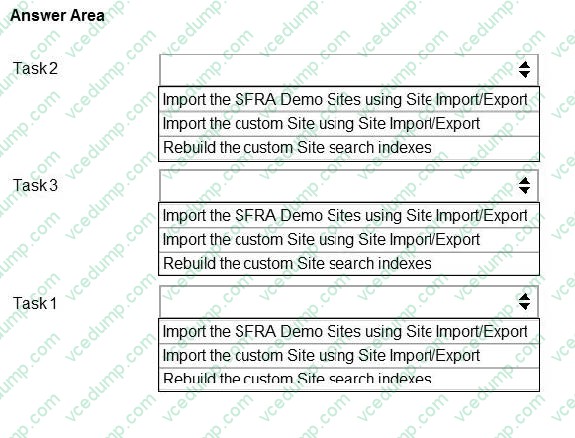
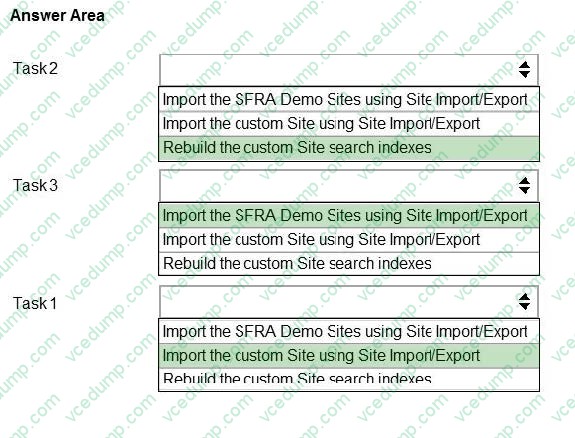
Given the following conditions:
1.
A site export file with a copy of the Storefront data for a custom site
2.
A sandbox with the custom site code, but no Storefront data
3.
A requirement for a working copy of SFRA for development reference
A developer is assigned three tasks to perform in Business Manager. In what sequence should the developer perform the tasks, so that the custom site displays the products as intended?
Hot Area:
Question 117:
A client sells its products in North America, Europe, and Asia, and has a B2C Commerce Site for each of these markets. The client receives three area-specific snippets of analytics code by a third-party provider to insert in the sites.
How should the developer configure an instance to allow the merchant to independently insert and update these snippets?
A. Create a new "HTML" attribute in the SitePreference object type. B. Use ISML conditional tags to add the snippet into the codebase. C. Configure a new Service Profile with the provided snippet of code.
A. Create a new "HTML" attribute in the SitePreference object type. To enable the merchant to independently insert and update area-specific snippets of analytics code for each market (North America, Europe, and Asia), the developer should create a new "HTML" attribute in the SitePreference object type (Option A). This solution allows for different values to be set per site or region, leveraging the flexibility of Site Preferences in Salesforce B2C Commerce. By using Site Preferences to manage these snippets, the merchant can easily update the analytics code via the Business Manager without needing to modify the codebase directly, thus maintaining a separation of concerns and allowing non-developers to manage site-specific configurations.
Question 118:
A merchant wants to obtain an export file that contains all the products .assigned to their Storefront catalog. They do not know how to achieve this easily without manual processing, so asked their developer to help Generate this. The merchant s Instance setup is as follows:
They have one Master catalog and one storefront catalog.
Some, but not all, of the products in the Master catalog are assigned to categories within the Storefront catalog.
Which method allows the developer to generate the export for the merchant?
A. Using the Catalog Import and Export module, export the Master catalog with a category- assignment search to export specific B. Using the Site Import and Export module, export both the Site catalog and the Master catalog in a single archive. C. Using the Site Import and Export module, export the Master catalog filtered by the site catalog categoriesto export specific products.
C. Using the Site Import and Export module, export the Master catalog filtered by the site catalog categoriesto export specific products. The correct approach to generate an export file containing all products assigned to the storefront catalog is to use the Site Import and Export module to export the Master catalog, but filtered by the categories used in the site catalog. This method ensures that only the products that are relevant to the storefront catalog are included in the export, providing a precise and efficient solution for the merchant's requirement. This functionality is specifically designed to handle scenarios where selective data extraction from the catalog is necessary, reflecting a deep integration between catalog management and site-specific configurations within Salesforce B2C Commerce.
Question 119:
Universal Containers wants to change a content slot that is currently configured to display a content asset. Now they want the slot to display the top five selling boxes for the week. Which two changes need to be madefor this to occur? (Choose two.)
A. Change the slot's configuration content type to "products." B. Change the slot's configuration content type to "recommendations." C. Change the slot's configuration template to the appropriate rendering template. D. Delete the existing content asset.
A. Change the slot's configuration content type to "products." C. Change the slot's configuration template to the appropriate rendering template. Explanation Explanation/Reference:To change a content slot from displaying a content asset to displaying the top five selling boxes for the week, the necessary changes are: A. Change the slot's configuration content type to "products." This adjustment aligns the slot's content type with the nature of the items it is meant to display--products, not content assets. C. Change the slot's configuration template to the appropriate rendering template. This ensures that the slot uses a template that is designed to properly display product information, such as listing the top selling products. These changes ensure that the content slot is repurposed effectively to display dynamic product information instead of static content, utilizing the slot's configuration in Business Manager to switch between different types of displayable content as described in the Salesforce B2C Commerce documentation on content slot management.
Question 120:
A developer has aspecification to integrate with a REST API for retrieving traffic conditions. The service expects parameters to be form encoded.
Which service type should the developer register?
A. HTML Form B. SOAP Form C. POST Form D. HTTP Form
C. POST Form For integrating with a REST API where the parameters are expected to be form-encoded, the service type to be registered in Salesforce B2C Commerce Cloud should be a "POST Form." This service type configures the service framework to encode the parameters as application/x-www-form-urlencoded, which is the correct content type for form-encoded data. This setting is crucial for ensuring that the API receives the data in the expected format and can parse it correctly.
Nowadays, the certification exams become more and more important and required by more and more
enterprises when applying for a job. But how to prepare for the exam effectively? How to prepare
for the exam in a short time with less efforts? How to get a ideal result and how to find the
most reliable resources? Here on Vcedump.com, you will find all the answers.
Vcedump.com provide not only Salesforce exam questions,
answers and explanations but also complete assistance on your exam preparation and certification
application. If you are confused on your B2C-COMMERCE-DEVELOPER exam preparations
and Salesforce certification application, do not hesitate to visit our
Vcedump.com to find your solutions here.