The probability of default of a security over a 1 year period is 3%. What is the probability that it would have defaulted within 6 months?
A. 98.49% B. 3.00% C. 1.51% D. 17.32%
C. 1.51%
Explanation
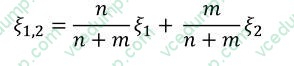
The question is asking for the probability of default over a 6 month period when the probability of annual default is known. If we let the 6 month probability of defaut be 'd', then the probability of survival at the end of 1 year would be (1 - d)^2. This we know is equal to 1 - 3% = 0.97. Therefore we can calculate 'd' to be equal to 1.51%. Choice 'c' is the correct answer, the others are incorrect. Note that an exam question may ask for probability of the security having survived after 6 months, in which case the answer might be 1 - 1.51%. Also note that such questions will always require you to use the probability of survival (1 - probability of default) for doing the calculations. That is because the probabilities of survival can be multiplied over periods of time, but not probabilities of default as the first default in any period is the 'game-over' event after which neither survival nor defaults mean anything. Therefore you generally always have to get the probability of survival till a point in time, and use that for any other calculations.
Question 262:
The 10-day VaR of a diversified portfolio is $100m. What is the 20-day VaR of the same portfolio assuming the market shows a trend and the autocorrelation between consecutive periods is 0.2?
A. 100 B. 200 C. 154.92 D. 141.42
C. 154.92
Explanation
The square root of time rule cannot be applied here because the returns across the periods are not independent. (Recall that the square root of time rule requires returns to be iid, independent and identically distributed.) Here there is a 'autocorrelation' in play, which means one period's returns affect the returns of the other period. VaR is merely a multiple of volatility, or standard deviation, using the factor for the desired confidence level. VaR across time periods can be combined using the square root of time rule, in fact if returns were independent we could have easily calculated the VaR for the 20- day period as equal to $100m*SQRT(20/10) = $141.4m But in this case we need to account for the autocorrelation. We can do this akin to the way we combine the VaR of different assets that have a given correlation. Since we know that: Variance (A + B) = Variance(A) + Variance(B) + 2*Correlation*StdDev(A)*StdDev(B). The standard deviation, which the VaR is a multiple of, can be calculated by taking the square root of the variance. Therefore the combined VaR over the two months will be equal to =SQRT( (100^2) + (100^2) + 2*0.2*100*100 )= $154.92m. All other answers are incorrect.
Question 263:
The sensitivity (delta) of a portfolio to a single point move in the value of the SandP500 is $100. If the current level of the SandP500 is 2000, and has a one day volatility of 1%, what is the value-at-risk for this portfolio at the 99% confidence and a horizon of 10 days? What is this method of calculating VaR called?
A. $14,736, parametric VaR B. $4,660, Monte Carlo simulation VaR C. $14,736, historical simulation VaR D. $4,660, parametric VaR
A. $14,736, parametric VaR
Explanation
If the current level of the SandP 500 is 2000, and a single day volatility is 1%, and the delta (ie change in portfolio value from a one point change) is $100, then the 1 day volatility for the portfolio in dollars is 2000 * 1% * $100 = $2,000. At the 99% confidence level, the value of the inverse cumulative density function for the normal distribution is 2.33 (=NORMSINV(99%), in Excel). Therefore the 1 day VaR will be 2.33 * $2000 = $4,660. Extending it to 10 days using the square root of time rule, we get the 10 day VaR as equal to SQRT(10)*4660 = $14,736. Since this method of calculating VaR relies upon a delta approximation of a risk factor (in this case the SandP500), it is the parametric approach to calculating VaR (the other methods being historical simulation, and Monte Carlo simulation). The 2015 Handbook provides an excellent example of parametric (and other) VaR calculations in Chapter 3 of Volume III of Book 3. The spreadsheet used for the illustration can be downloaded from http://www.prmia.org/prm-exam/handbook-resources.
Question 264:
Calculate the 99% 1-day Value at Risk of a portfolio worth $10m with expected returns of 10% annually and volatility of 20%.
A. 290218 B. 2326000 C. 126491 D. 294218
A. 290218
Explanation
Be wary of questions asking you to calculate VaR where the mean or expected returns are different from zero. The VaR formula of z-value times standard deviation needs to have an adjustment for the expected return [ie use VaR = z-value times standard deviation minus expected return]. In this case, the standard deviation for 1 day for the portfolio is =SQRT(1/250)*20%*$10m = $126,491. The VaR is therefore (2.326 * $126,491) - ($10,000,000 * 10% * 1/250) = $290,218.
Question 265:
A risk analyst uses the GARCH model to forecast volatility, and the parameters he uses are = 0.001%, = 0.05 and = 0.93. Yesterday's daily volatility was calculated to be 1%. What is the long term annual volatility under the analyst's model?
A. 3.54 % B. 0.25 % C. 0.22 % D. 7.94 %
A. 3.54 %
Explanation
The correct answer is choice 'a'
Recall the following summary of the GARCH model. The long term variance in a GARCH model is given by /(1 - - ). In this case, this works out to =SQRT(0.001/(1 - 0.05 - 0.93)) * SQRT(250) = 3.54%. Yesterday's volatility of 1% is irrelevant
to the question.
Question 266:
Which of the following statements are true:
I - Top down approaches help focus management attention on the frequency and severity of loss events, while bottom up approaches do not.
II - Top down approaches rely upon high level data while bottom up approaches need firm specific risk data to estimate risk.
III - Scenario analysis can help capture both qualitative and quantitative dimensions of operational risk.
A. III only B. II and III C. I only D. II only
B. II and III
Explanation
Top down approaches do not consider event frequency and severity, on the other hand they focus on high level available data such as total capital, income volatility, peer group information on risk capital etc. Bottom up approaches focus on severity and frequency distributions for events. Statement I is therefore not correct. Top down approaches do indeed rely upon high level aggregate data and tend to infer operational risk capital requirements from these. Bottom up approaches look at more detailed firm specific information. Statement II is correct. Scenario analysis requires estimating losses from risk scenarios, and allows incorporating the judgment and views of managers in addition to any data that might be available from internal or external loss databases. Statement III is correct. Therefore Choice 'b' is the correct answer.
Question 267:
Which of the following can be used to reduce credit exposures to a counterparty:
I - Netting arrangements II - Collateral requirements III - Offsetting trades with other counterparties IV - Credit default swaps
A. I and II B. I, II, III and IV C. I, II and IV D. III and IV
C. I, II and IV
Explanation
Offsetting trades with other counterparties will not reduce credit exposure to a given counterparty. All other choices represent means of reducing credit risk. Therefore Choice 'c' is the correct answer.
Question 268:
Under the CreditPortfolio View model of credit risk, the conditional probability of default will be:
A. lower than the unconditional probability of default in an economic expansion B. higher than the unconditional probability of default in an economic expansion C. lower than the unconditional probability of default in an economic contraction D. the same as the unconditional probability of default in an economic expansion
A. lower than the unconditional probability of default in an economic expansion
Explanation
When the economy is expanding, firms are less likely to default. Therefore the conditional probability of default, given an economic expansion, is likely to be lower than the unconditional probability of default. Therefore Choice 'a' is the correct answer and the other statements are incorrect.
Question 269:
Which of the following statements are true with respect to stress testing:
I - Stress testing results in a dollar estimate of losses II - The results of stress testing can replace VaR as a measure of risk as they are better grounded in reality III - Stress testing provides an estimate of losses at a desired level of confidence IV - Stress testing based on factor shocks can allow modeling extreme events that have not occurred in the past
A. I and IV B. I, II and IV C. II and III D. II, III and IV
A. I and IV
Explanation
Any stress test is conducted with a view to produce a dollar estimate of losses, therefore statement I is correct. However, these numbers do not come with any probabilities or confidence levels, unlike VaR, and statement III is incorrect. Stress
testing can complement VaR, but not replace it, therefore statement II is not correct. Statement IV is correct as stress tests can be based on both actual historical events, or simulated factor shocks (eg, a factor, such as interest rates, moves
by say 10-z).
Therefore Choice 'a' is correct.
Question 270:
For a hypotherical UoM, the number of losses in two non-overlapping datasets is 24 and 32 respectively. The Pareto tail parameters for the two datasets calculated using the maximum likelihood estimation method are 2 and 3. What is an estimate of the tail parameter of the combined dataset?
A. 2.57 B. 2.23 C. 3 D. Cannot be determined
A. 2.57
Explanation
For a number of processes, including many in finance, while a distribution such as the normal distribution is a good approximation of the distribution near the modal value of the variable, the same normal distribution may not be a good estimate of the tails. For this reason, the Pareto distribution is one of the distributions that is often used to model the tails of another distribution. Generally, if you have a set of observations, and you discard all observations below a threshold, you are left with what are called 'exceedances'. The threshold needs to be reasonably far out in the tail. If from each value of the exceedances you subtract the threshold value, the resulting dataset is estimated by the generalized Pareto distribution.
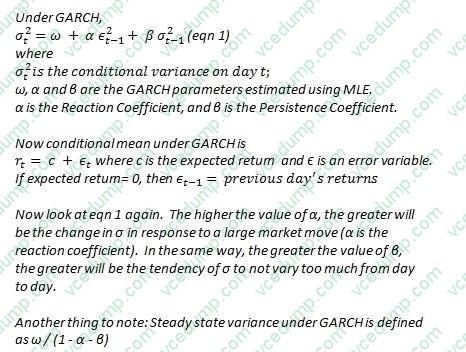
The Pareto distribution has a 'shape parameter'. The average of two Pareto distributions with tail parameters 1 and 2 ( is a Greek character, pronounced as 'sai' (saa-eee)), is the weighted average of 1 and 2 with weights proportional to the number of observations in the datasets underlying the distributions.
Nowadays, the certification exams become more and more important and required by more and more
enterprises when applying for a job. But how to prepare for the exam effectively? How to prepare
for the exam in a short time with less efforts? How to get a ideal result and how to find the
most reliable resources? Here on Vcedump.com, you will find all the answers.
Vcedump.com provide not only PRMIA exam questions,
answers and explanations but also complete assistance on your exam preparation and certification
application. If you are confused on your 8008 exam preparations
and PRMIA certification application, do not hesitate to visit our
Vcedump.com to find your solutions here.