74-409 Exam Details
-
Exam Code
:74-409 -
Exam Name
:Server Virtualization with Windows Server Hyper-V and System Center -
Certification
:Microsoft Certifications -
Vendor
:Microsoft -
Total Questions
:99 Q&As -
Last Updated
:Dec 10, 2021
Microsoft 74-409 Online Questions & Answers
-
Question 21:
You have a Windows Server 2012 R2 Hyper-V environment that includes System Center 2012 R2 Virtual Machine Manager (VMM). The environment includes five physical servers. The servers are configured as follows:

You plan to use VMM to migrate physical machines to virtual machines. You must migrate all servers that support physical to virtual (P2V) migration.
You need to migrate the servers.
Which three servers should you migrate? Each correct answer presents part of the solution.
A. NYC-WEB
B. NYC-PR
C. NYC-DEV
D. NYC-FS
E. NYC-EX -
Question 22:
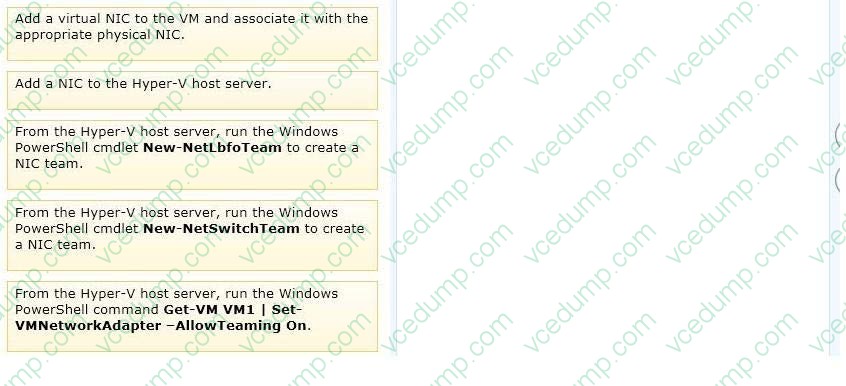
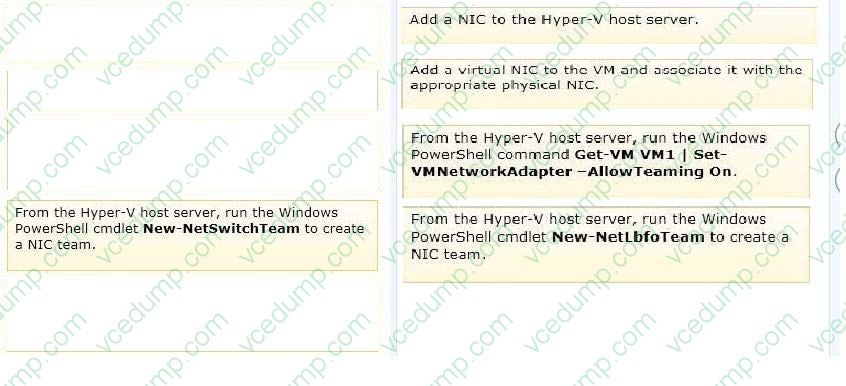
A software company has a Windows Server 2012 R2 server that has the Hyper-V role installed. The server hosts a single virtual machine (VM) named VM1. VM1 has one virtual CPU, one virtual hard disk, and one virtual network interface card (NIC) that is attached to an external network.
The company prepares to test its software in VM1. Before testing begins, VM1 must meet the following requirements:
Availability of network bandwidth must be maximized.
VM network connectivity must be fault tolerant.
You need to configure the environment.
Which four actions should you perform in sequence? To answer, move the appropriate actions from the list of actions to the answer area and arrange them in the correct order.
Select and Place:
-
Question 23:
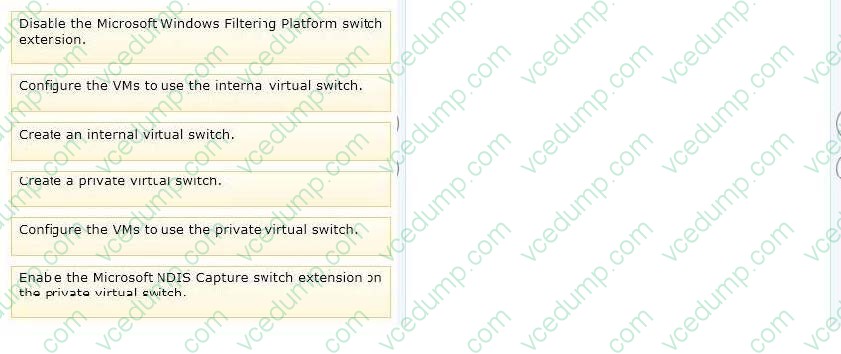
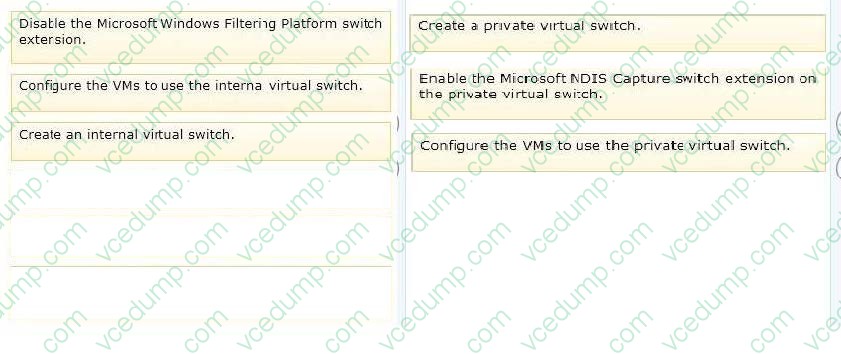
You have a Windows Server 2012 R2 server that has the Hyper-V role installed. The company has the following requirements for the Hyper-V host server:
1. Virtual machines (VMs) must only communicate with other VMs.
2. You must be able to monitor all TCP/IP packets to and from VMs from the moment that VMs are able to communicate.
3. You must support a third-party program that uses the Network Driver Interface Specification (NDIS) API to monitor the TCP/IP packets between VMs.
You need to configure the environment.
Which three actions should you perform in sequence? To answer, move the appropriate actions from the list of actions to the answer area and arrange them in the correct order.
Select and Place:
-
Question 24:
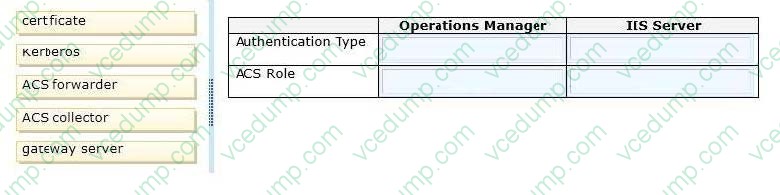
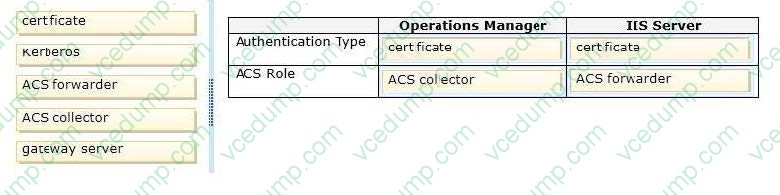
A company has a single-domain Active Directory Domain Services (AD DS) environment. Some servers and all domain controllers are deployed on the internal network. All servers in the perimeter network are joined to a workgroup. The company uses System Center 2012 R2 Operations Manager to monitor the server infrastructure on the internal network.
The company plans to use Audit Collection Services (ACS) for one Internet Information Services (IIS) server that is in the perimeter network.
You need to configure the authentication type and ACS role for Operations Manager and the IIS server.
How should you configure the servers? To answer, drag the appropriate authentication type and ACS role to the location or locations in the answer area. Each authentication type and ACS role may be used once, more than once, or not at all.
You may need to drag the split bar between panes or scroll to view content.
Select and Place:
-
Question 25:
A company has a virtualization infrastructure that consists of two Hyper-V host servers. The host servers and all of the virtual machines (VMs) run Windows Server 2012 R2. The company plans to deploy VMs by using file shares that use the Server Message Block (SMB) protocol. You need to store the maximum amount of VM data on the SMB file shares. Which three file types should you store on the SMB file shares? Each correct answer presents part of the solution.
A. VM logical unit numbers (LUNs)
B. VM configuration files
C. Hyper-V host server logical unit numbers (LUNs)
D. VM snapshots
E. VM virtual hard disks (VHDs) -
Question 26:
A company has servers that run Windows Server 2012 R2. The company has one Active Directory Domain Services (AD DS) domain. A user reports that USB devices are not redirected when he uses the Virtual Machine Connection tool to
connect to a virtual machine. USB device redirection works for other users that connect to this VM.
You need to ensure that USB devices are redirected for all users when they connect to this VM.
What should you do?
A. Add the user as a member of the Administrators group on the VM.
B. Ensure that the Allow enhanced session mode setting is set to Enabled on the VM.
C. Ensure that the Remote Desktop Services service is running on the VM.
D. Add the user as a member of the Administrators group on the AD DS domain. -
Question 27:
A company has offices in Hamburg, New York, and San Francisco. The Hamburg office has one Hyper-V host server named HAM-HOST1. The New York office has two Hyper-V host servers named NYC-HOST1 and NYC-HOST2. The San
Francisco office has one Hyper-V host server named SFC-HOST1. All Hyper-V host servers run Windows Server 2012 R2.
You must deploy an application virtual machine (VM) that will be used by the sales team at the company.
You need to ensure that the VM remains available during unplanned system outages.
Which solution should you implement?
A. a Hyper-V cluster that includes NYC-HOST1 and NYC-HOST2
B. Server Message Block (SMB) 3.0 file shares on NYC-HOST1, NYC-HOST2, SFC-HOST1, and HAM-HOST1
C. a Distributed File System (DFS) replication between NYC-HOST1, SFC-HOST1, and HAM- HOST1
D. dynamic optimization on NYC-HOST1 and NYC-HOST2 -
Question 28:
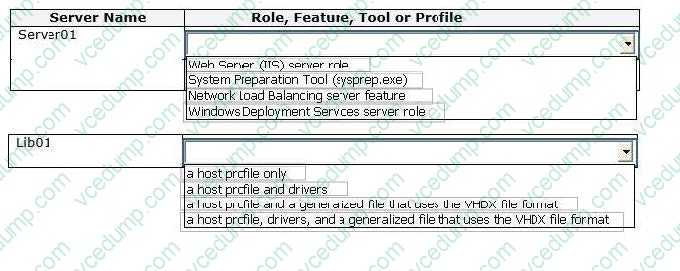
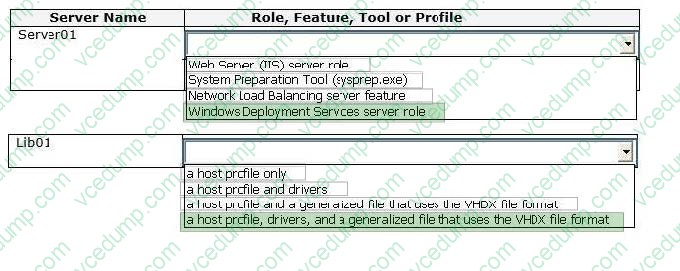
You have an environment that contains the servers as shown in the following table:

You purchase a physical server that supports out-of-band management to deploy as a bare-metal Hyper-V host server.
Administrators must be able to deploy standard Hyper-V host server images to bare-metal computers by using the least amount of administrative effort.
You need to prepare the environment.
What should you use? To answer, select the appropriate option from each drop-down menu in the answer area.
Hot Area:
-
Question 29:
A company has an Active Directory Domain Services (AD DS) environment. All domain controllers run Windows Server 2012 R2. The company also has a virtualization infrastructure that consists of two Hyper-V host servers. The host servers
and all of the virtual machine (VMs) run Windows Server 2012 R2.
The company must deploy VMs by using file shares that use the Server Message Block (SMB) protocol. You create a file share. You must follow the principle of least privilege. You need to implement the NTFS and share permissions required
to use the file share.
Which objects should you grant permissions to?
A. Hyper-V service accounts and the LocalSystem account
B. LocalSystem and all Hyper-V administrators
C. computer objects for the VMs, the SYSTEM account, and all Hyper-V administrators
D. computer objects for the Hyper-V host servers, the SYSTEM account, and all Hyper-V administrators -
Question 30:
A company has one central data center and five branch offices. Each office has three Hyper-V host servers that run Windows Server 2012 R2 Datacenter edition. Each branch office has a system administrator. You plan to deploy virtual
machines (VMs) that run Windows Server 2012 R2 Standard edition to each branch office.
You have the following requirements:
The VMs must be activated at the branch offices, even if the branch office has no Internet connectivity.
Activation keys must NOT be shared with the branch office administrators.
You must be able to track license usage from the central location, even without access rights to the VMs.
You must be able to verify license compliance and perform real time reporting on license usage from a central location.
You need to configure licensing and activation for the VMs.
Which feature or tool should you use?
A. Multiple Activation Key (MAK)
B. Volume Activation Management Tool (VAMT)
C. Key Management Service (KMS)
D. Automatic Virtual Machine Activation (AVMA)
Related Exams:
-
62-193
Technology Literacy for Educators -
70-243
Administering and Deploying System Center 2012 Configuration Manager -
70-355
Universal Windows Platform – App Data, Services, and Coding Patterns -
77-420
Excel 2013 -
77-427
Excel 2013 Expert Part One -
77-725
Word 2016 Core Document Creation, Collaboration and Communication -
77-726
Word 2016 Expert Creating Documents for Effective Communication -
77-727
Excel 2016 Core Data Analysis, Manipulation, and Presentation -
77-728
Excel 2016 Expert: Interpreting Data for Insights -
77-731
Outlook 2016 Core Communication, Collaboration and Email Skills
Tips on How to Prepare for the Exams
Nowadays, the certification exams become more and more important and required by more and more enterprises when applying for a job. But how to prepare for the exam effectively? How to prepare for the exam in a short time with less efforts? How to get a ideal result and how to find the most reliable resources? Here on Vcedump.com, you will find all the answers. Vcedump.com provide not only Microsoft exam questions, answers and explanations but also complete assistance on your exam preparation and certification application. If you are confused on your 74-409 exam preparations and Microsoft certification application, do not hesitate to visit our Vcedump.com to find your solutions here.