72300X Exam Details
-
Exam Code
:72300X -
Exam Name
:Avaya Aura Communication Applications Support -
Certification
:Avaya Certifications -
Vendor
:Avaya -
Total Questions
:93 Q&As -
Last Updated
:Jul 12, 2026
Avaya 72300X Online Questions & Answers
-
Question 71:
Which statement about Network Routing Policies in Avaya Aura® Session Manager (SM) is true?
A. A dial pattern and routing policy are necessary in SM to call from an H323 device to a Basic/Native SIP device (without an Avaya Aura® Communication Manager profile).
B. A dial pattern and routing policy are necessary in SM to call from a Basic/Native SIP device (without a CM profile) to an H323 device on Avaya Aura® Communication Manager (CM).
C. A dial pattern and routing policy are necessary in SM to call from an H323 device to an AST device on the same Avaya Aura® Communication Manager (CM).
D. A dial pattern and routing policy are necessary in SM to call from an AST device to an H323 device on the same Avaya Aura® Communication Manager (CM). -
Question 72:
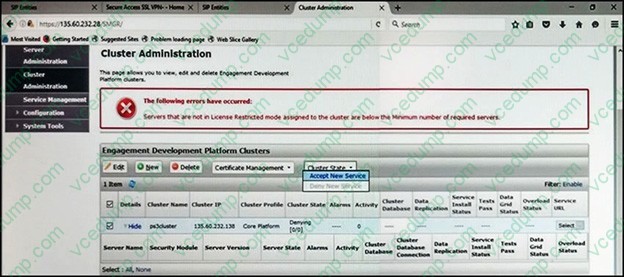
Refer to the exhibit.
In the Cluster Administration screen of a PresenceServices cluster, when you try to change the cluster state to Accept New Service, you receive the error:
Servers that are not in License Restricted mode assigned to the cluster are below the Minimum number of required servers.
You check that a server has been administered under Breeze > Server Administration which shows green check under License Mode, and a System State of Denying.
Which action needs to be taken to solve this problem?
A. Edit the Cluster, access the Servers tab, and assign the server to the cluster; then set the cluster to Accept New Service.
B. Under Avaya Breeze > Server Administration, select the server and change the System State to Accept New Service, then return to the Cluster Administration screen and set the cluster to Accept New Service.
C. Obtain and install an Avaya Breeze™ license on webLM with more instances of Avaya Breeze™ nodes.
D. Edit the cluster to change the cluster profile from Core Platform to General Purpose. -
Question 73:
When a customer calls voicemail to retrieve their messages they hear "Hello, to access your mailbox..." instead of the users named followed by "please enter your password...".
After troubleshooting you discover that the Caller ID is not being sent correctly, therefore Avaya Aura® Messaging (AAM) is not able to identify the correct mailbox associated with the station number calling into AAM.
How can this problem be fixed?
A. Change clid-numbering 0 SAT form to send the correct CLID.
B. Using AAM web GUI access Administration > Messaging > Telephone Integration, write a caller ID modification rule to correct the incoming CLID format.
C. In Session Manager, configure a DigitConversionAdapter with `fromto=true' to update the `Form' header as well as the P-asserted-identity, and link it to the AAM SIP Entity.
D. Having identified the trunk group from Avaya Aura? Communication Manager (CM) to AMM is public, change public-unknown-numbering 0 SAT form, to send the correct CLID. -
Question 74:
Callers hear a fast busy when they dial into Avaya Aura® Messaging (AAM) to retrieve their voicemail messages. After troubleshooting you discover that someone has left trunks in busy-out state on AAM. How would you restore the trunks to in-service status?
A. Using AAM web GUI access Administration > Messaging > Diagnostics > Network Connection, and then click on the Release All Trunks button.
B. SSH to AAM, and execute the release trunks all command.
C. SSH to AAM, and execute the release trunk command.
D. Using AAM web GUI access Administration > Messaging > Telephony Diagnostics > Release, type `all' in the Equipment Number field, and then click on the Release button. -
Question 75:
You are troubleshooting a TLS link down message between Avaya Aura® Session Manager (SM) and Avaya Session Border Controller for Enterprise (SBCE). Tracing on SM and SBCE reveals a Fatal Error Unknown CA message being sent
by SBCE when it receives the Server Identity certificate from SM.
To solve this problem, which two actions need to be completed? (Choose two.)
A. Install the Certificate Authority certificate that signed SBCE identity certificate into SM.
B. Export the SBCE identity certificate, and import it into SM.
C. Install the Certificate Authority certificate that signed SM identity certificate into SBCE.
D. Add Certificate Authority certificate into the TLS profile Peer Verification List. -
Question 76:
traceSBC is a tool that can be used to trace the calls that cross through the Avaya Session Border Controller (SBC), calls to the public network, or calls from the public network. Which two statements describe another function of traceSBC? (Choose two.)
A. traceSBC can only be used to view PPM messages if they are transported using HTTP instead HTTPS
B. traceSBC can trace SIP trunk calls but not Remote Workers calls at the same time
C. traceSBC command can be used from CLI ipsec user
D. traceSBC can be used to view STUN/TURN messages.
E. traceSBC parses Avaya SBCE log files and displays SIP and PPM messages, you can use the tool even in case of TLS and HTTPS -
Question 77:
A technician is trying to access the Avaya Aura ® Media Server (AAMS) after receiving a troubleshooting ticket. After failing to enter the system using different web browsers, the technician realizes the incorrect URL was being used. Which URL must be used to access the AAMS web page?
A. https: AAMS FQDN or IP address:8443/emlogin
B. http: AAMS FQDN or IP address:8443/emlogin
C. https: AAMS FQDN or IP address:443/emlogin
D. https: SMGR FQDN or IP address:8443/emlogin -
Question 78:
Considering the message flow to an Avaya Aura® Contact Centre (AACC) Agent Desktop, which protocol is used to communicate between Avaya Aura® Communication Manager (CM) and Avaya Aura® Application Enablement Services (AES)?
A. WCF
B. ASAI/TSAPI
C. DMCC/TSAPI
D. TR87 -
Question 79:
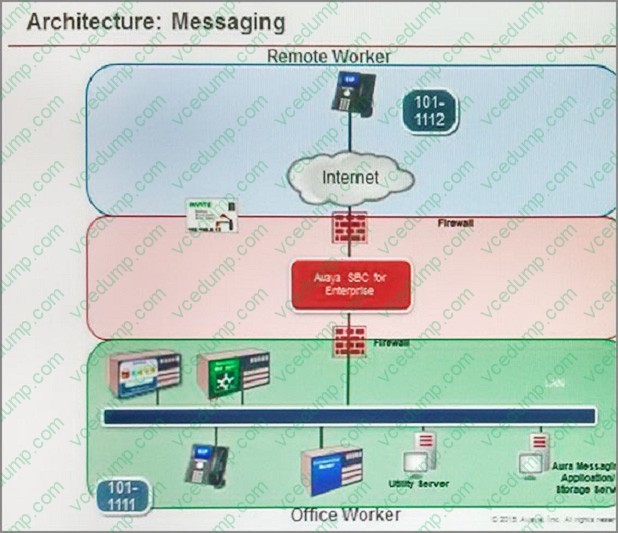
Refer to the exhibit.
After some system maintenance was completed over the weekend, a customer calling from the office states they hear a fast busy when trying to access their voicemail.
Avaya support verifies local network connectivity is up and Avaya Aura® Messaging server is registering no alarms. A SIP trace displays a 404 Not Found error message.
Based on what is already working, to where can the issue potentially be isolated?
A. endpoint routing configuration issue
B. interoperability testing
C. network outage
D. routing configuration issues -
Question 80:
A Maintenance Engineer logs onto the Command Line Interface (CLI) of Avaya Aura® Messaging (AAM) and issues the vmstat command.
What information will the display present?
A. statistical information about voicemail boxes
B. information about the volatile memory
C. status information about the virtual machine
D. count of mailbox password violation attempts
Related Exams:
-
3002
Avaya IP Office™ Platform Configuration and Maintenance Exam -
3100
Avaya Aura Contact Recording and Avaya Aura Quality Monitoring Implementation Exam -
3101
Avaya Aura® Communication Manager and CM Messaging - Embedded Maintenance and Troubleshooting Exam -
3102
Avaya IP Office Implementation -
3104
Avaya one-X UC Soft Clients Implementation and Maintenance -
3107
Avaya Session Border Controller Enterprise Implementation and Maintenance -
3108
Avaya Scopia® Solution Implementation and Maintenance Exam -
31860X
Avaya IX Calling Design -
3202
Avaya Aura® Conferencing (R7.x) Implementation and Maintenance -
3203
Avaya Aura Messaging Implementation and Maintenance Exam
Tips on How to Prepare for the Exams
Nowadays, the certification exams become more and more important and required by more and more enterprises when applying for a job. But how to prepare for the exam effectively? How to prepare for the exam in a short time with less efforts? How to get a ideal result and how to find the most reliable resources? Here on Vcedump.com, you will find all the answers. Vcedump.com provide not only Avaya exam questions, answers and explanations but also complete assistance on your exam preparation and certification application. If you are confused on your 72300X exam preparations and Avaya certification application, do not hesitate to visit our Vcedump.com to find your solutions here.