70-410 Exam Details
-
Exam Code
:70-410 -
Exam Name
:Installing and Configuring Windows Server 2012 -
Certification
:Microsoft Certifications -
Vendor
:Microsoft -
Total Questions
:537 Q&As -
Last Updated
:Feb 03, 2022
Microsoft 70-410 Online Questions & Answers
-
Question 191:
You have a server named Server1 that runs Windows Server 2012 R2.
A network technician installs a new disk on Server1 and creates a new volume. The properties of the new volume are shown in the exhibit. (Click the Exhibit button.)
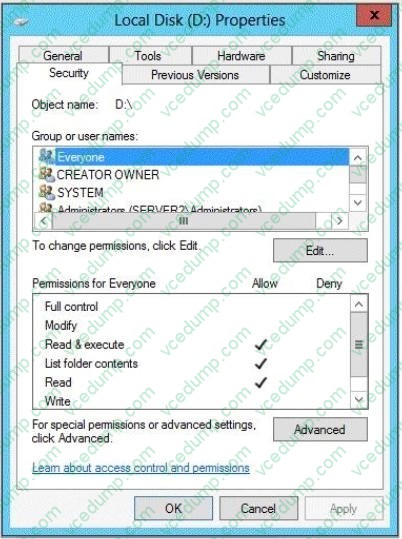
You need to ensure that you can enable NTFS disk quotas for volume D. What should you do first?
A. Install the File Server Resource Manager role service.
B. Format volume D.
C. Run the convert.exe command.
D. Convert the disk to a dynamic disk. -
Question 192:
You have a server named Server2 that runs Windows Server 2012 R2. You open Server Manager on Server2 as shown in the exhibit. (Click the Exhibit button.) The Everyone group has read share permission and read NTFS permission to
Sources.
You need to ensure that when users browse the network, the Sources share is not visible.
What should you do?
A. From the properties of the Sources folder, remove the Sources share, and then share the Sources folder as Sources$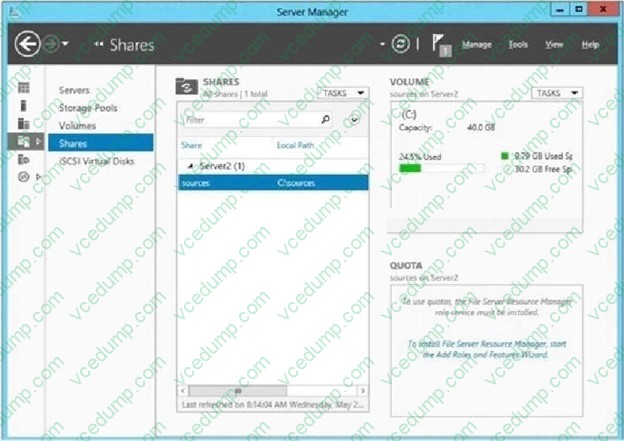
B. From the properties of the Sources folder, deny the List Folder Contents permission for the Everyone group
C. From the properties of the Sources share, configure access-based enumeration
D. From the properties of the Sources folder, configure the hidden attribute -
Question 193:
Your network contains an Active Directory forest. The forest contains two domains named contoso.com and corp.contoso.com. All domain controllers run Windows Server 2012 R2 and are configured as global catalog servers. The
corp.contoso.com domain contains a domain controller named DC1.
You need to disable the global catalog on DC1.
What should you do?
A. From Active Directory Users and Computers, modify the properties of the DC1 computer account.
B. From Active Directory Administrative Center, modify the properties of the DC1 computer account.
C. From Active Directory Sites and Services, modify the NTDS Settings of the DC1 server object.
D. From Active Directory Domains and Trusts, modify the properties of the corp.contoso.com domain. -
Question 194:
Your network contains one Active Directory forest named contoso.com. The forest contains a single domain. All domain controllers run Windows Server 2012 R2.
You need to modify the membership of a group named Group1 to include two users named User1 and User2.
What command should you run? To answer, select the appropriate options in the answer area.
Select three.
A. Use command Add-GroupMember
B. Use command Add-ADGroupMember
C. As first parameter use Group1
D. As first parameter use User1, User2
E. As first parameter use {User1, User2}
F. As second parameter use Group1
G. As second parameter use User1, User2
H. As second parameter use {User1, User2} -
Question 195:
You are configuring the IPv6 network infrastructure for a branch office.
The corporate network administrator allocates the 2001:DB8:0:C000::/58 address space for use in the branch office.
You need to identify the maximum number of IPv6 subnets you can create.
How many IPv6 subnets should you identify?
A. 32
B. 64
C. 128
D. 1024 -
Question 196:
How can you manage a newly installed Windows Server 2012 R2 core from another Windows Server 2012 R2 with computer manager?
Exhibit: A. 1
B. 2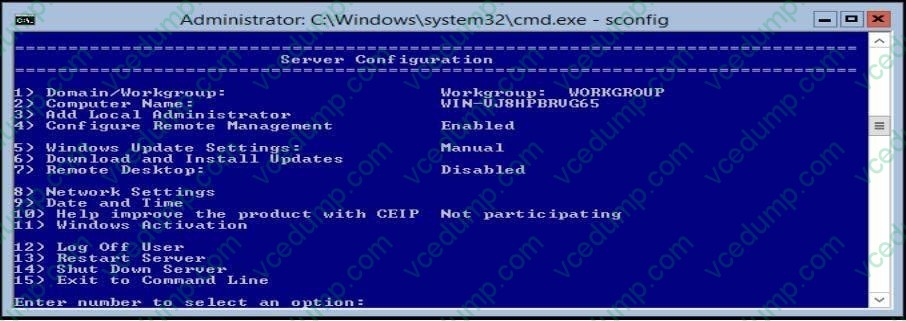
C. 4
D. 8 -
Question 197:
You have a server that runs Windows Server 2012 R2. The server contains the disks configured as shown in the following table.
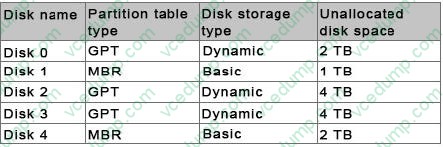
You need to create a volume that can store up to 3 TB of user files. The solution must ensure that the user files are available if one of the disks in the volume fails. What should you create?
A. a mirrored volume on Disk 1 and Disk 4
B. a mirrored volume on Disk 2 and Disk 3
C. a RAID-5 volume on Disk 1, Disk 2, and Disk 3
D. a spanned volume on Disk 0 and Disk 4 -
Question 198:
You plan to deploy a DHCP server that will support four subnets. The subnets will be configured as shown in the following table.
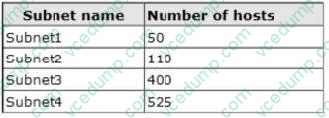
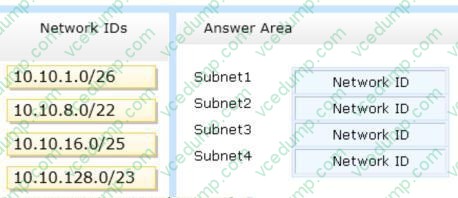
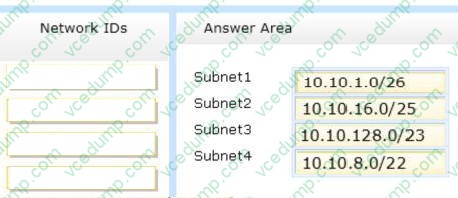
You need to identify which network ID you should use for each subnet.
What should you identify?
To answer, drag the appropriate network ID to the each subnet in the answer area.
Select and Place:
-
Question 199:
Your network contains a file server named Server1 that runs Windows Server 2012 R2. All client computers run Windows 8.1.
You need to ensure that when users are connected to the network, they always use local offline files that are cached from Server1.
Which Group Policy setting should you configure?
A. Configure slow-link mode.
B. Configure Slow link speed
C. Enable file synchronization on costed networks
D. Turn on economical application of administratively assigned Offline Files. -
Question 200:
You work as an administrator at Contoso.com. The Contoso.com network consists of a single domain named Contoso.com. All servers on the Contoso.com network have Windows Server 2012 R2 installed.
Contoso.com has a server, named ENSUREPASS-SR13, which is configured as the primary DNS server in the Contoso.com domain. Contoso.com has another server, named ENSUREPASS-SR14, which makes use of ENSUREPASSSR13 for DNS queries.
You want to make sure that running nslookup.exe from ENSUREPASS-SR14 produces a result that shows the proper name of the default server.
Which of the following actions should you take?
A. You should consider creating a reverse lookup zone on ENSUREPASS-SR14.
B. You should consider creating a forward lookup zone on ENSUREPASS-SR14.
C. You should consider creating a reverse lookup zone on ENSUREPASS-SR13.
D. You should consider creating a forward lookup zone on ENSUREPASS-SR13.
Related Exams:
-
62-193
Technology Literacy for Educators -
70-243
Administering and Deploying System Center 2012 Configuration Manager -
70-355
Universal Windows Platform – App Data, Services, and Coding Patterns -
77-420
Excel 2013 -
77-427
Excel 2013 Expert Part One -
77-725
Word 2016 Core Document Creation, Collaboration and Communication -
77-726
Word 2016 Expert Creating Documents for Effective Communication -
77-727
Excel 2016 Core Data Analysis, Manipulation, and Presentation -
77-728
Excel 2016 Expert: Interpreting Data for Insights -
77-731
Outlook 2016 Core Communication, Collaboration and Email Skills
Tips on How to Prepare for the Exams
Nowadays, the certification exams become more and more important and required by more and more enterprises when applying for a job. But how to prepare for the exam effectively? How to prepare for the exam in a short time with less efforts? How to get a ideal result and how to find the most reliable resources? Here on Vcedump.com, you will find all the answers. Vcedump.com provide not only Microsoft exam questions, answers and explanations but also complete assistance on your exam preparation and certification application. If you are confused on your 70-410 exam preparations and Microsoft certification application, do not hesitate to visit our Vcedump.com to find your solutions here.