Facebook 410-101 Online Practice
Questions and Exam Preparation
410-101 Exam Details
Exam Code
:410-101
Exam Name
:Facebook Certified media buying professional
Certification
:Facebook Certifications
Vendor
:Facebook
Total Questions
:150 Q&As
Last Updated
:Jul 07, 2026
Facebook 410-101 Online Questions &
Answers
Question 1:
What is not an action measured through Facebook attribution system?
Choose only ONE best answer.
A. Link Clicks B. Outbound links C. Phone call sales conversion D. Mobile app installs E. POS purchase conversion F. Third party (Google) link click
F. Third party (Google) link click
About Actions You Can Measure in Facebook Ads Reporting
An action is activity that happens on your ad (for example, someone watches your video ad) or as a result of your ad (for example, someone views your ad and then downloads an app).
Actions that occur on your ad include link clicks, outbound clicks, post engagement, video views, and more.
Actions that happen as a result of your ad include website conversions, website leads, mobile app installs, mobile app purchases and offline conversions. We attribute these actions to your ad if someone viewed or clicked on your ad within a
certain period of time, as defined by your attribution window.
Question 2:
An eCommerce recently installed the Facebook pixel on their website to better understand the ROAS of the online marketing efforts.
After two months, they've spent $3,500 in online conversion campaigns, and generated $6,000 in revenue.
You realize that the ratio for the ROAS is 1.71:1
What does this ratio mean?
Choose only ONE best answer.
A. For every $1 you spend on a campaign, you generate $3.5 of revenue. B. For every $1 you spend on a campaign, you generate $1.71 of revenue. C. For every $10 you spend on a campaign, you generate $1.71 of revenue. D. For every $1 of revenue, you spend $1.71 in advertising.
B. For every $1 you spend on a campaign, you generate $1.71 of revenue.
The return on ad spend (ROAS) for this campaign would be $1.71 or a ratio of 1.71:1 ($6,000 / $3,500). So for every 1 dollar that the company spends on its campaign, it generated $1.71 worth of revenue .
Question 3:
You have just gotten the results from a conversion campaign you ran for a membership site for 2 weeks:
There were 9 new customers acquired through the campaign.
Customers usually pay 6 months on average.
The monthly membership fee is $15.
The total amount you spent on the campaign was $400.
What is the ROAS for this campaign?
Choose only ONE best answer.
A. $102.50 B. $265 C. -$265 D. $410
D
Return on Ad Spend (ROAS) measures gross revenue generated directly for every dollar spent on the advertising campaign: ROAS = Revenue From Ad Campaign / Cost Of The Ad Campaign A more accurate way to calculate ROAS when you have recurring revenue is with the following formula: ROAS = (# of new customers acquired from Campaign x LTV of a New Customer) ?Cost of Ad Campaign In this case, you would need the following info: # of new customer => 9 LTV of new customers => 6 * $15 = $90 Cost of Ad Campaign => $400 ROAS = 9 * $90 - $400 = $410
Question 4:
You talk with your client and realize you need to automate the integration of offline events to properly measure the conversions.
What options do you have to automate the sales at the store with Facebook campaigns?
Choose ALL answers that apply.
A. Use a Point Of Sale provider to integrate offline conversions. B. Use digital receipts instead of printed receipts to enable offline conversions. C. Use website conversions to integrate with offline conversions. D. Integrate your CRM system with your offline conversions. E. Collaborate with another Facebook Marketing Partner in order to measure offline conversions.
A. Use a Point Of Sale provider to integrate offline conversions. B. Use digital receipts instead of printed receipts to enable offline conversions. D. Integrate your CRM system with your offline conversions. E. Collaborate with another Facebook Marketing Partner in order to measure offline conversions.
There are some ways you can automate the influx of data coming from offline sales.
The following options are currently available on Facebook's platform:
Use a Point Of Sale provider to integrate offline conversions.
Use digital receipts instead of printed receipts to enable offline conversions.
Integrate your CRM system with your offline conversions.
Collaborate with another Facebook Marketing Partner to measure offline conversions.
One of your customers has in-store, and online, high-end t-shirts retail stores in several cities throughout the east coast (specifically in Los Angeles, San Diego, and San Francisco).
In 4 months, the company is launching a new product line. They would like to cross-sell to their existing customer base and new potential customers that have similar characteristics as their current customers.
As you upload the customer database directly from your client's CRM, you realize the following:
-30% of the customers are between 18-24 years old.
-64% of the customers are between 25-34 years old.
-6% of the customers are between 35-44 years old.
-59% are women.
-41% are men.
-66% are college educated and above.
-78% are married.
Question 5:
You've spent over $8,000 the first month of running campaigns. You go to your data and realize you are getting close to 4,000 Lead Events on the main landing page of the product; 300 Add To Cart Events; 121 Initiate Checkout; and 48
Purchase Events.
You tell your client that you will start running optimization campaigns for the second month.
Select all strategies that you should follow for the second month.
Choose ALL answers that apply.
A. Run conversion campaign ads optimized for the "Initiate Checkout Event" to people who have visited the main landing page of the product. B. Run conversion ads optimized for the "Lead Event" to core/saved audiences and exclude everyone who has visited the main landing page in the past 30 days. C. Run traffic campaign ads to people who have initiated the checkout process but have not finalized the purchase. D. You run different conversion campaign ads for all events currently being measured on the website.
B. Run conversion ads optimized for the "Lead Event" to core/saved audiences and exclude everyone who has visited the main landing page in the past 30 days. C. Run traffic campaign ads to people who have initiated the checkout process but have not finalized the purchase.
You should never optimize conversion campaigns unless you have at least 500 events. The number of events you are getting at each stage of your funnel are key here:
4,000 Lead Events => you can run conversion campaigns to new audiences.
300 Add To Cart Events => you need to run traffic campaigns to custom audiences (web visitors).
121 Initiate Checkout Events => you need to run traffic campaigns to custom audiences (web visitors).
48 Purchase Events => you need to run traffic campaigns to custom audiences (web visitors).
Therefore, the only two strategies that apply in this case is to run conversion ads to new audiences to the "Lead Event" and traffic ads to people who have stayed at one of the other events to move them ahead in your client's online sales
funnel.
Question 6:
What are three ways Facebook IQ can help you understand, prepare and help you improve your Facebook strategies and branding?
Choose ALL answers that apply.
A. People Insights B. Advertising Insights C. Video Insights D. Instagram Insights E. Vertical Insights
A. People Insights B. Advertising Insights E. Vertical Insights
People Insights Takes a look at understanding consumer behavior across generations, locations, devices, and time.Examples of past studies include a look at spring/summer fashion trends on Instagram, shifts in food culture on Facebook, and how people move between mobile and TV. Advertising Insights Examines the role of measurement in campaigns, and its influence and value in developing effective marketing.Examples of past studies include how to craft effective stories in your campaigns, how to define your most important metrics, and how streaming services have affected traditional advertising.. Vertical Insights Analyzes consumer behavior in specific industries, including automotive, consumer packaged goods, entertainment and media, financial services, gaming, retail, technology and connectivity, and travel.Examples of past studies include the growth of auto buyers who prefer mobile shopping experiences, global mobile gaming trends, and examinations of the planning habits of international visitors to China.
Question 7:
You need to run an in-stream video campaign for a client. They have sent the following campaign requirements:
Maximize budget with two target audiences
Run a video on in-stream placement
Budget of $17,000
Frequency of 2 per week
Exclude dating and mature content categories from placement
What changes need to be made in order to comply with the client's brand safety requirements?
Choose only ONE best answer.
A. You can't block mature content from any Facebook placement platform. B. You need to change the in-stream video to Audience Network or Instant Articles. C. You should just block both mature and dating content categories from your in-stream video placement. D. You should run a campaign on reach and frequency buying in order to maximize your budget with both audiences. E. You should add more content categories such as gambling into the content categories blocked.
B. You need to change the in-stream video to Audience Network or Instant Articles.
The categories you can block on Facebook are:
Debatable social issues: Topics related to debated social issues, such as religion, politics, immigration and more. Does not apply to Audience Network mobile apps. Mature: Topics including violence, firearms, sexual content, profane language, and more. Does not apply to Audience Network mobile apps. Tragedy and conflict: Topics that contain emotional or physical suffering, such as crime, illness, bullying and more. Does not apply to Audience Network mobile apps. Dating: Websites and apps that have been categorized as dating. Ads may still appear alongside content about relationships and dating. Gambling: Websites and apps that have been categorized as gambling, where winners receive money or prizes. Ads may still appear on websites or apps where people play games just for fun. You can exclude the following content categories for each placement: In-Stream Video Mature Tragedy and Conflict Debatable Social Issues Audience Network Dating Gambling Mature Tragedy and Conflict Debatable Social Issues Instant Articles Dating Gambling Mature Tragedy and Conflict Debatable Social Issues
Question 8:
Your client owns an online nutrition membership program for women, where customers get tips, diets, and discounts on a weekly basis.
They now want to launch a new blog for content marketing purposes, and would like to categorize the content into three buckets:
Weight loss
Health
Mom
You've already installed the Facebook pixel on their website; however, you now need to add an additional event pixel code to the blog so that you can track content better.
Which pixel event do you install on the blog?
Choose only ONE best answer.
A. Generate Lead B. Complete Registration C. View Content
C. View Content
Facebook Pixel allows you to track events, or specific actions, people take on your website.
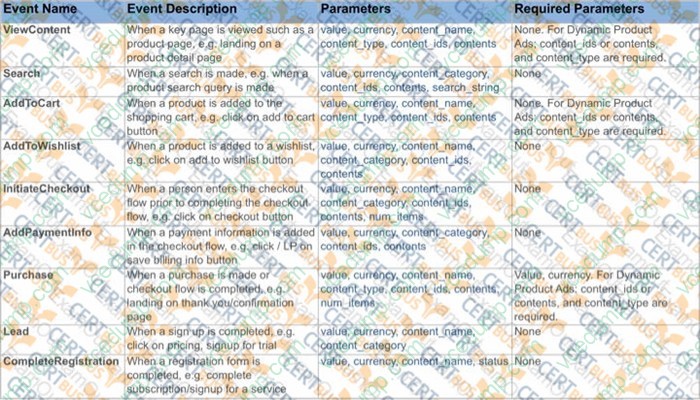
For this specific case, you should use the View Content Event pixel to track specific visits to the blog posts.
You can use URL's for your ads afterward as well; however, once you have +25 blog posts, using URL's becomes unpractical. Here is the list of the 9 standard events you can use:
For more detailed information you can view the following Facebook for developers post: https://developers.facebook.com/docs/ads-for-websites/pixel-events/v2.11
Question 9:
You've created a Facebook pixel for your client through Business Manager Account. You have a role of Ad Account admin and were added to your client's Business Manager accounts.
You need to give access to your Community Manager so that they can start running remarketing campaigns.
How do request access for your Community Manager to the pixel?
Select two that apply.
A. You create a new Facebook pixel on your Business Manager B. You add your Community Manager as Analyst to your client's Ad Account. C. You add your Community Manager as Admin to your client's Business Manager D. Your community manager should have access to all the tools since he is an analyst in your client's add account. E. You need to assign the ad account to your client's pixel. F. You need to make sure your community manager has the correct access level on your client's ad account.
E. You need to assign the ad account to your client's pixel. F. You need to make sure your community manager has the correct access level on your client's ad account.
Question 10:
Your client has been running a retail shop for the past 20 years.
In order to grow sales, they want to launch a new online store where people can buy products directly on their website. They can share with you a customer database of 20,000 customers who have bought a product in the past 2 years.
For the campaign, you need to reach out to existing customers, and people within a 10-mile radius from the stores.
What type of audiences should you build?
Choose only ONE best answer.
A. You should first do a custom audience with the database, and then, a similar audience optimized for similarity. B. You should first do a custom audience with the database, and then, a similar audience optimized for reach. C. You should do a similar audience with the customer database, and then, launch a reach campaign to people in a 10-mile radius. D. You should first, do a custom audience with the database, and a similar audience optimized for similarity. Then use the similar audience as a base for a new core/saved audience, and reduce the similar audience to a 10-mile radius from the stores.

D. You should first, do a custom audience with the database, and a similar audience optimized for similarity. Then use the similar audience as a base for a new core/saved audience, and reduce the similar audience to a 10-mile radius from the stores.
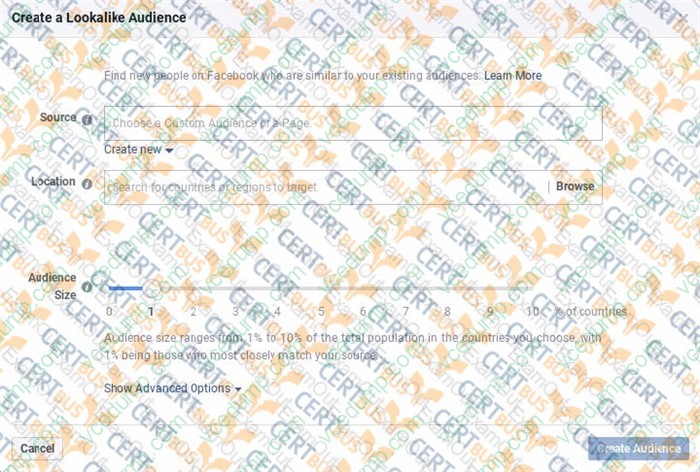
The first audience you need to build is the custom audience with the customer database. This audience will allow you to reach out to existing customers and run campaigns to the website.
The second audience you need to build is a similar audience with the customer database. Since you have a 20,000 baseline, you should be able to build a really good similar audience optimized for similarity.
Keep in mind that you are looking for quality over quantity in this particular case. You should select a 1% audience size.
Choose an audience size close to 1 to optimize for similarity. Your Lookalike Audience will likely be small, with a high resemblance to your seed.
Choose an audience size close to 10 to optimize for reach. Your Lookalike Audience will be larger, but less similar to your seed.
There is a third, very important, step that still needs to be done. You need to use the similar audience you've just built and then re-segment that for the 10-mile radius. This new saved/core audience based on a similar audience should be your best option for reaching out to new potential customers.
Nowadays, the certification exams become more and more important and required by more and more
enterprises when applying for a job. But how to prepare for the exam effectively? How to prepare
for the exam in a short time with less efforts? How to get a ideal result and how to find the
most reliable resources? Here on Vcedump.com, you will find all the answers.
Vcedump.com provide not only Facebook exam questions,
answers and explanations but also complete assistance on your exam preparation and certification
application. If you are confused on your 410-101 exam preparations
and Facebook certification application, do not hesitate to visit our
Vcedump.com to find your solutions here.