352-001 Exam Details
-
Exam Code
:352-001 -
Exam Name
:CCDE Written -
Certification
:Cisco Certifications -
Vendor
:Cisco -
Total Questions
:705 Q&As -
Last Updated
:Dec 07, 2025
Cisco 352-001 Online Questions & Answers
-
Question 71:
You are designing an IPv4 any source multicast redundancy solution. Which technology ensures the quickest RP convergence?
A. Auto-RP
B. Embedded RP
C. bootstrap router
D. MSDP anycast RP -
Question 72:
Which native mechanism does OSPF use to prevent loops in MPLS VPNs?
A. CE devices that run OSPF set the DN bit toward the PE router
B. PE devices that run OSPF clear the DN bit toward the CE router
C. CE devices that run OSPF clear the DN bit toward the PE router
D. Creation of PE to PE OSPF sham link across the MPLS-created super backbone
E. PE routers verify OSPF domain IDs used by CE OSPF processes
F. PE devices that run OSPF set the DN bit toward the CE router -
Question 73:
You are deploying a nationwide intranet solution for a company with 4 data centers and 400 remote branches connected via a provider-based solution. As part of the network design, you must ensure efficient content distribution of training material to remote sites. Which two VPN technologies leverage replication in the network core and provide for efficient bandwidth optimization? (Choose two.)
A. VPLS
B. EoMPLS
C. MPLS Layer 3 VPN
D. GRE
E. GET VPN -
Question 74:
Refer to the exhibit.
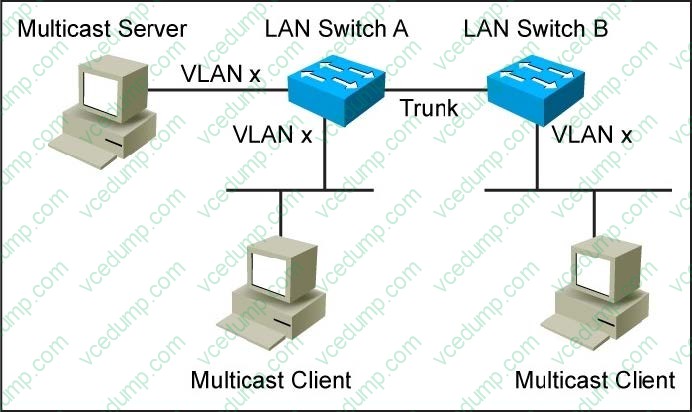
Assume that no multicast optimization is done on LAN switches A and B. Which two features can be used to optimize multicast traffic forwarding in this situation? (Choose two.)
A. Enable IGMP snooping querier on both switches.
B. Configure a static MAC entry for the multicast server.
C. Disable IGMP snooping on both switches.
D. Disable the IGMP query election process.
E. Enable PIM snooping on both switches. -
Question 75:
A network designer is redesigning an enterprise campus network to ensure that Ethernet switches proactively attempt to reconnect after a fiber cut. In the design, they will have to address areas where fiber cuts exist on campus from past troubleshooting, where a single fiber is disconnected in the fiber pair, leading to looping.
Which feature could be implemented in the design to allow the Spanning Tree Protocol on the switches to be protected?
A. loop guard
B. UniDirectional Link Detection
C. UniDirectional Link Detection aggressive mode
D. root guard -
Question 76:
You must design this network for IP Fast Reroute by enabling the OSPF Loop-Free Alternates feature (not Remote Loop-Free Alternates). Which two options are concerns about the proposed solution? (Choose 2)
A. OSPF Loop-Free Alternates is not supported on ring topologies.
B. OSPF Loop-Free Alternates on ring topologies are prone to routing loops.
C. Fast Reroute requires MPLS TE.
D. The solution is prone to microloops in case of congestion
E. OSPF Loop-Free Alternates is transport dependent. -
Question 77:
Which two options describe the advantages of using DWDM over traditional optical networks? (Choose two)
A. Inherent topology flexibility with intelligent chromatic dispersion
B. Inherent topology flexibility and service protection provided without penalty through intelligent oversubscription of bandwidth reservation
C. Inherent topology flexibility with built-in service protection
D. Inherent topology flexibility with a service protection provided through a direct integration with an upper layer protocol
E. Ability to expand bandwidth over existing optical infrastructure -
Question 78:
Refer to the exhibit.
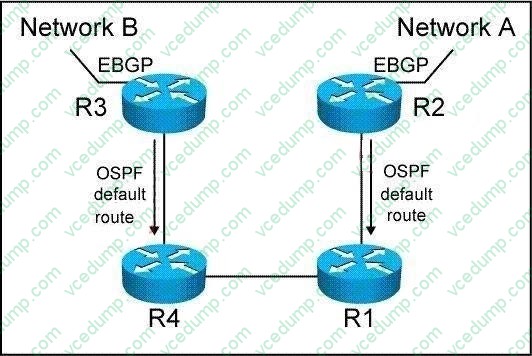
R2 and R3 are running EBGP and are learning Network A and Network B. R2 and R3 are also running IBGP to exchange Network A and Network B. OSPF is IGP. R2 and R3 are advertising default routes. R1 and R4 can send and receive
traffic from Network A and Network B respectively. However, Network A cannot send traffic to Network B.
How can you solve this problem?
A. create a tunnel between R2 and R3
B. create a tunnel between R2 and R4
C. create static default routes pointing from R1 and R4 to R2 and R3, respectively
D. convert R3 and R2 to ABRs so that R1 and R4 can choose the closest ABR to exit the network -
Question 79:
What is the best practice for tuning routing protocol hello and dead timers when deploying IGP non-stop forwarding (NSF)?
A. The hello and dead timers should be tuned to allow NSF to continue forwarding after an initial failure detection.
B. NSF-independent timers should be used so that routing protocol timers have no effect.
C. The hello and dead timers should be tuned so the link failure is detected before NSF has the chance to react to the failure.
D. The routing protocol hello and dead timers should be decreased to the minimum. -
Question 80:
Which three techniques can be used to improve fault isolation in an enterprise network design? (Choose three.)
A. aggregate routing information on an OSPF ABR
B. fully meshed distribution layer
C. Equal-Cost Multipath routing
D. EIGRP query boundaries
E. multiple IS-IS flooding domains
F. tuned Spanning Tree Protocol timers
Related Exams:
-
300-745
Designing Cisco Security Infrastructure (300-745 SDSI) v1.0 -
350-101
Implementing and Operating Cisco Wireless Core Technologies (350-101 WLCOR)v1.0 -
352-011
Cisco Certified Design Expert Practical -
500-052
Cisco Unified Contact Center Express -
500-173
Designing the FlexPod Solution (FPDESIGN) -
500-201
Deploying Cisco Service Provider Mobile Backhaul Solutions -
500-210
SP Optical Technology Field Engineer Representative -
500-220
Engineering Cisco Meraki Solutions (ECMS) v2.2 -
500-230
Cisco Service Provider Routing Field Engineer -
500-240
Cisco Mobile Backhaul for Field Engineers
Tips on How to Prepare for the Exams
Nowadays, the certification exams become more and more important and required by more and more enterprises when applying for a job. But how to prepare for the exam effectively? How to prepare for the exam in a short time with less efforts? How to get a ideal result and how to find the most reliable resources? Here on Vcedump.com, you will find all the answers. Vcedump.com provide not only Cisco exam questions, answers and explanations but also complete assistance on your exam preparation and certification application. If you are confused on your 352-001 exam preparations and Cisco certification application, do not hesitate to visit our Vcedump.com to find your solutions here.