350-001 Exam Details
-
Exam Code
:350-001 -
Exam Name
:CCIE Routing and Switching Written -
Certification
:Cisco Certifications -
Vendor
:Cisco -
Total Questions
:581 Q&As -
Last Updated
:Dec 16, 2021
Cisco 350-001 Online Questions & Answers
-
Question 141:
Refer to the exhibit. This exhibit shows the NAT configuration for Router A and the output for a ping issued from device 171.68.200.48 and destined to 172.16.47.142. Based on this information, what change must be made to Router A in order for the ping to work?
A. reload the router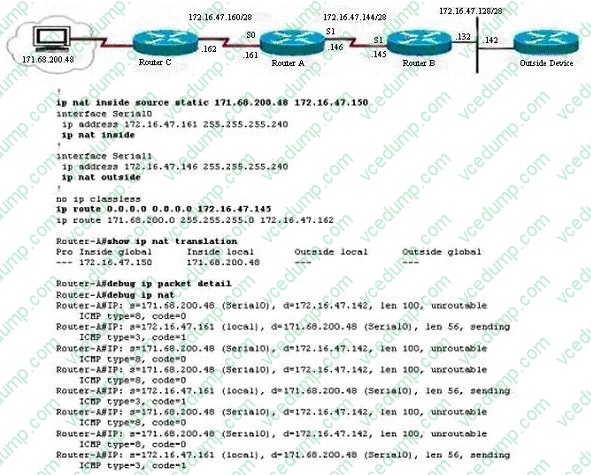
B. clear the route cache
C. add a static route
D. configure IP as classless
E. load a newer IOS image -
Question 142:
Look at the following exhibit carefully; there is no route to 10.1.4.0/24 in the local routing table. According to the output of R1 in the exhibit, can you tell me why 10.1.4.0/24 is not in R1's routing table?
A. The forwarding address, 10.1.3.2, is also redistributed into OSPF, and an OSPF external route cannot use another OSPF external as its next hop.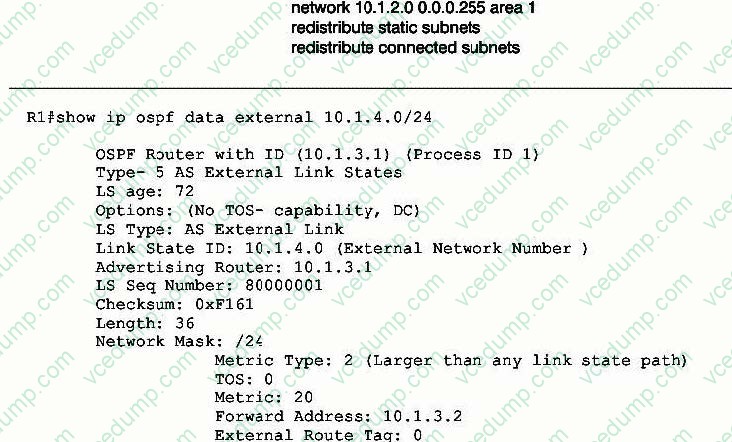
B. R3 is not redistributing 10.1.4.0/24 properly.
C. R2 is not properly configured as an Area Border Router.
D. Area 1 is a stub area, and external routes cannot be originated in a stub area. -
Question 143:
You are deploying two core switches, one in each building, 50 km away from each other. The cross- connection between them will be a Layer 2 2-gigabit EtherChannel with an 802.1Q trunk. You configured it correctly but the link does not come up. The port is in the "admin up" state, and the line protocol is in the "down" state. The fiber link is OK.
What would be the most likely reason for the link not to come up?
A. The switches are not the same model.
B. You are not using the correct SFP.
C. You are not using correct optical media converters.
D. Configuration should be modified, because the distance is longer. -
Question 144:
Refer to the exhibit. BGP-4 routing to the Internet, in normal behavior, may create asymmetrical routing for different prefixes. The BGP routing table indicates that traffic should follow the paths indicated in the exhibit, but packets are not going further than the border router in AS 4.
What could be the cause of this problem?
A. TCP Intercept is configured in AS 4.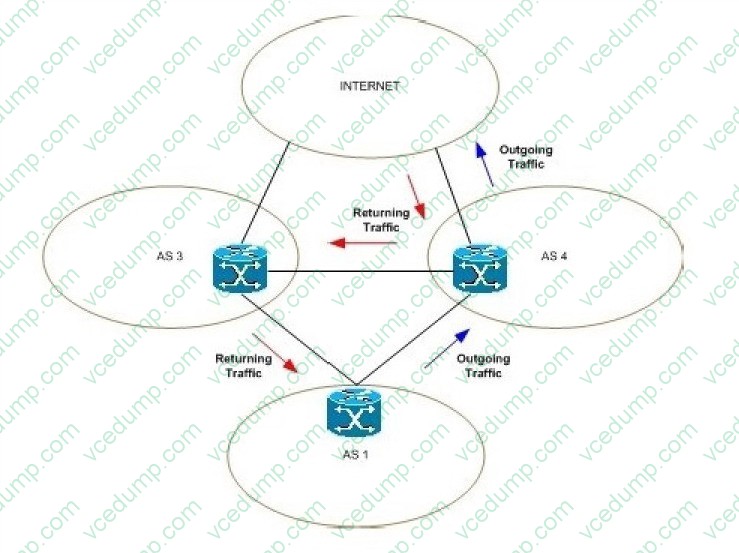
B. Unicast Reverse Path Forwarding is configured in loose mode in this router.
C. Packets may be leaving AS 1 without the BGP routing flag set to 1.
D. Unicast Reverse Path Forwarding is configured in strict mode in this router.
E. There is a missing Unicast Reverse Path Forwarding configuration. -
Question 145:
Refer to the exhibit. Users on the 199.155.24.0 network are unable to reach the 172.16.10.0 network.
What is the most likely solution?
A. Router ISP1 should be configured to peer with router B.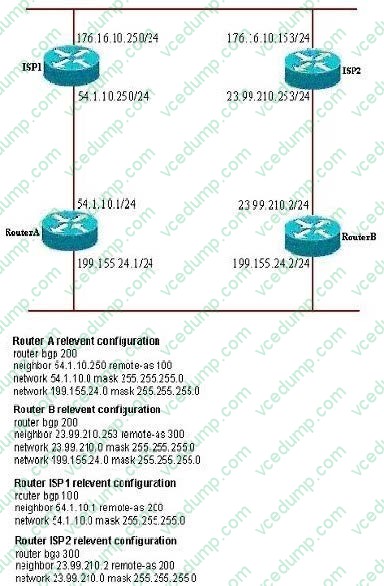
B. Router ISP2 should be configured with no synchronization.
C. Router ISP1 should be configured with no synchronization.
D. Router ISP2 should be configured with no auto-summary.
E. Router ISP1 or IPS2 should be configured with network 176.16.10.0 mask 255.255.255.0. -
Question 146:
Which two of these statements correctly describe classic PIM-SM? (Choose two.)
A. The lOS default is for a last-hop router to trigger a switch to the shortest path tree as soon as a new source is detected on the shared tree.
B. The lOS default is for every one of the routers on the shared tree to trigger a switch to the shortest path tree as soon as a new source is detected on the shared tree.
C. The default behavior of switching to the shortest path tree as soon as a new source is detected on the shared tree can be disabled by setting the value in the ip pirn spt-threshold command to "infinity.
D. The default behavior of switching to the shortest path tree as soon as a new source is detected on the shared tree can be disabled by setting the value in the ip pirn spt-threshold command to "zero." -
Question 147:
Refer to the exhibit. The static route to 150.189.131.6 on R3 is intended to serve as the gateway of last resort for the EIGRP network. However, while R3 installs the gateway of last resort, its EIGRP neighbor R4 does not. What might explain the problem?
A. R3 is missing the global command ip default-network 150.189.131.6.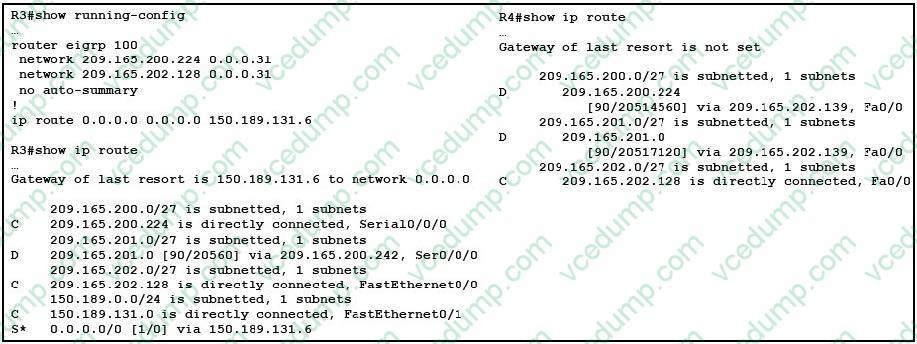
B. Autosummary must be enabled on R3 in order for default-routes to be propagated.
C. Default-networks must be configured individually on each EIGRP router.
D. The static route on R3 must be redistributed into EIGRP. -
Question 148:
What does the beginning of a multicast address look like, if it is used for embedded RP?
A. FF7
B. FF
C. FF3
D. Embedded RP does not use any special IPv6 address. -
Question 149:
Which two statements are true about 802.1s? (Choose two.)
A. 802.1s supports a reduced number of spanning-tree instances.
B. 802.1s has better convergence times than 802.1w.
C. 802.1s does not support load balancing over the same physical topology.
D. The CPU utilization for 802.1s is lower than the CPU utilization for 802.1w. -
Question 150:
What keywords do you need to the access-list to provide to the logging message like source address and source mac address?
A. Log
B. Log-input
C. Log-output
D. Logging
Related Exams:
-
300-745
Designing Cisco Security Infrastructure (300-745 SDSI) v1.0 -
350-101
Implementing and Operating Cisco Wireless Core Technologies (350-101 WLCOR)v1.0 -
352-011
Cisco Certified Design Expert Practical -
500-052
Cisco Unified Contact Center Express -
500-173
Designing the FlexPod Solution (FPDESIGN) -
500-201
Deploying Cisco Service Provider Mobile Backhaul Solutions -
500-210
SP Optical Technology Field Engineer Representative -
500-220
Engineering Cisco Meraki Solutions (ECMS) v2.2 -
500-230
Cisco Service Provider Routing Field Engineer -
500-240
Cisco Mobile Backhaul for Field Engineers
Tips on How to Prepare for the Exams
Nowadays, the certification exams become more and more important and required by more and more enterprises when applying for a job. But how to prepare for the exam effectively? How to prepare for the exam in a short time with less efforts? How to get a ideal result and how to find the most reliable resources? Here on Vcedump.com, you will find all the answers. Vcedump.com provide not only Cisco exam questions, answers and explanations but also complete assistance on your exam preparation and certification application. If you are confused on your 350-001 exam preparations and Cisco certification application, do not hesitate to visit our Vcedump.com to find your solutions here.