350-001 Exam Details
-
Exam Code
:350-001 -
Exam Name
:CCIE Routing and Switching Written -
Certification
:Cisco Certifications -
Vendor
:Cisco -
Total Questions
:581 Q&As -
Last Updated
:Dec 16, 2021
Cisco 350-001 Online Questions & Answers
-
Question 1:
Which command can be used to check the assignment of RPs to multicast groups?
A. show ip pim rendez-vous
B. show ip rpf rp mapping
C. show ip pim rp mapping
D. show ip pim rp info
E. show ip pim -
Question 2:
Which three configuration items are required to enable SSH on a router? (Choose three.)
A. a domain name
B. an RSA key
C. a hostname
D. a self-signed certificate
E. a RADIUS server
F. a username and password -
Question 3:
What are three causes for unicast flooding? (Choose three.)
A. asymmetric routing
B. duplex mismatch
C. unidirectional link
D. spanning-tree protocol topology changes
E. forwarding table overflow
F. hardware failure on a NIC
G. routing loop -
Question 4:
You work as a network engineer for a Company. Study the exhibit carefully. In this network, R1 is redistributing 10.1.5.0/24 into OSPF, and R2 is originating 10.1.4.0/24 as an internal route. R6 has received packets destined to 10.1.4.1 and
10.1.5.1.
Which statement is true about the path or paths these two packets will take?
A. The packet destined to 10.1.5.1 will follow the optimum path through the network, R4 to R1, while the packet destined to 10.1.4.1 will follow a suboptimal path through the network.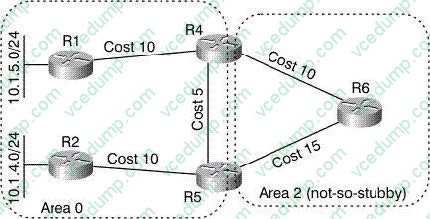
B. There is not enough information provided to determine which packet will take an optimal or suboptimal path through the network.
C. Both packets will follow optimal paths through the network to their destinations.
D. The packet destined to 10.1.4.1 will follow an optimal path through the network, while the packet destined to 10.1.5.1 will follow a suboptimal path through the network. -
Question 5:
Refer to the exhibit. You have just configured R5 and R6 to run EIGRPv6 as shown; the IPv6 ping from R5 to R6- loopback 0 is failing. Which statement could be the reason?
A. The loopback interfaces on R5 and R6 must be configured on an EIGRPv6 As number other than 56.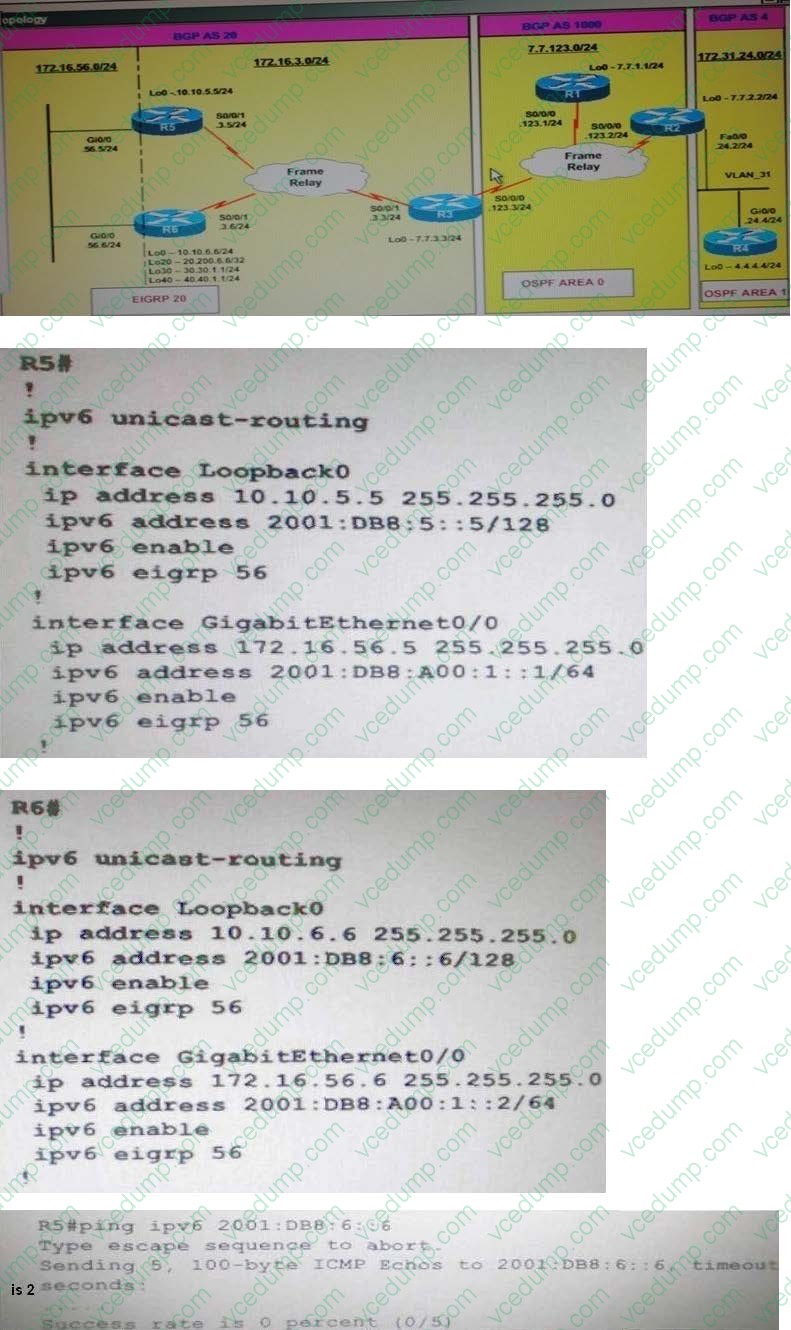
B. The loopback interfaces on R5 and R6 must be configured to EIGRPv6 As number 56.
C. You need to configure the EIGRPv6 router process on both routers.
D. You need to configure the EIGRPv6 router process in at least one of the routers
E. You should remove the ipv6 eigrp 56 from the loopback interfaces on both routers. -
Question 6:
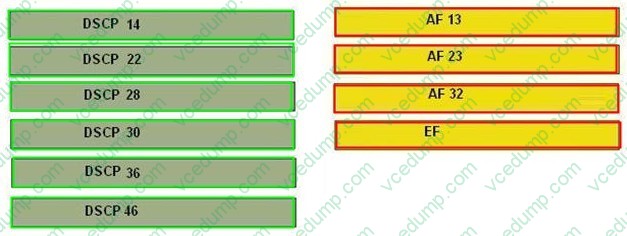
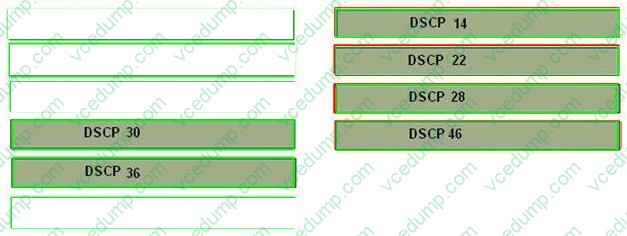
Drag the DSCP values on left to the correct classes on the right. Not all DSCP values will be used.
Select and Place:
-
Question 7:
What is the flooding scope of an OSPFv3 LSA, if the value of the S2 bit is set to 1 and the S1 bit is set to 0?
A. link local
B. area wide
C. AS wide
D. reserved -
Question 8:
On the basis of the network provided in the exhibit, R1 is injecting 10.1.5.0/24 by use of a network statement as a network (type 2) LSA. What LSAs will R6 have in its local database for 10.1.5.0/24?
A. R6 will not have any LSAs containing 10.1.5.0/24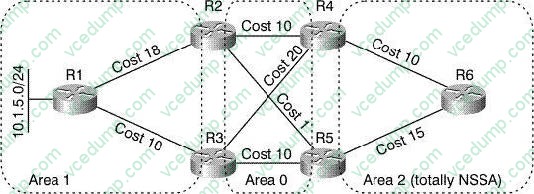
B. R6 will have a summary (type 3) LSA containing 10.1.5.0/24, generated by R4 or R5, the Area Border Routers for Area 2, its local area
C. R6 will have the network (type 2) LSA generated by R1 in Area 1 containing 10.1.5.0/24
D. R6 will have a summary (type 3) LSA containing 10.1.5.0/24, generated by either R2 or R3, the Area Border Routers for area 1. -
Question 9:
Which of the following describes the appropriate port assignment and message exchange in a standard TFTP transaction?
A. Server: 10.0.0.1:69 RRQ/WRQ Sent Client: 10.0.0.2:1888 RRQ/WRQ Received
B. Server: 10.0.0.1:1888 RRQ/WRQ Received Client: 10.0.0.2:69 RRQ/WRQ Received
C. Server: 10.0.0.1:69 RRQ/WRQ Received Client: 10.0.0.2:69 RRQ/WRQ Sent
D. Server: 10.0.0.1:69 RRQ/WRQ Received Client: 10.0.0.2:1888 RRQ/WRQ Sent
E. Server: 10.0.0.1:1888 RRQ/WRQ Sent Client: 10.0.0.2:69 RRQ/WRQ Sent
F. Server: 10.0.0.1:1888 RRQ/WRQ Received Client: 10.0.0.2:69 RRQ/WRQ Sent -
Question 10:
Which two statements about SA caching are true? (Choose two.)
A. Caching allows pacing of MSDP messages.
B. Caching reduces join latency.
C. Caching should not be done by an MSDP speaker.
D. Caching is used to update the BGP MDT address family.
Related Exams:
-
300-745
Designing Cisco Security Infrastructure (300-745 SDSI) v1.0 -
350-101
Implementing and Operating Cisco Wireless Core Technologies (350-101 WLCOR)v1.0 -
352-011
Cisco Certified Design Expert Practical -
500-052
Cisco Unified Contact Center Express -
500-173
Designing the FlexPod Solution (FPDESIGN) -
500-201
Deploying Cisco Service Provider Mobile Backhaul Solutions -
500-210
SP Optical Technology Field Engineer Representative -
500-220
Engineering Cisco Meraki Solutions (ECMS) v2.2 -
500-230
Cisco Service Provider Routing Field Engineer -
500-240
Cisco Mobile Backhaul for Field Engineers
Tips on How to Prepare for the Exams
Nowadays, the certification exams become more and more important and required by more and more enterprises when applying for a job. But how to prepare for the exam effectively? How to prepare for the exam in a short time with less efforts? How to get a ideal result and how to find the most reliable resources? Here on Vcedump.com, you will find all the answers. Vcedump.com provide not only Cisco exam questions, answers and explanations but also complete assistance on your exam preparation and certification application. If you are confused on your 350-001 exam preparations and Cisco certification application, do not hesitate to visit our Vcedump.com to find your solutions here.