350-001 Exam Details
-
Exam Code
:350-001 -
Exam Name
:CCIE Routing and Switching Written -
Certification
:Cisco Certifications -
Vendor
:Cisco -
Total Questions
:581 Q&As -
Last Updated
:Dec 16, 2021
Cisco 350-001 Online Questions & Answers
-
Question 111:
Refer to the exhibit. You have performed multiple changes to your OSPF configuration. After these changes, you receive a lot of calls from users in OSPF area 2 complaining about application performance issues when they access servers connected to area 3. When you check the routing table of router RTC, you notice that packets to network 10.3.3.0/24 are sent out via the slower path out of the Fa0/0 interface.
What can you do to solve this issue?
A. Change the OSPF configuration in OSPF area 1 to OSPF area 0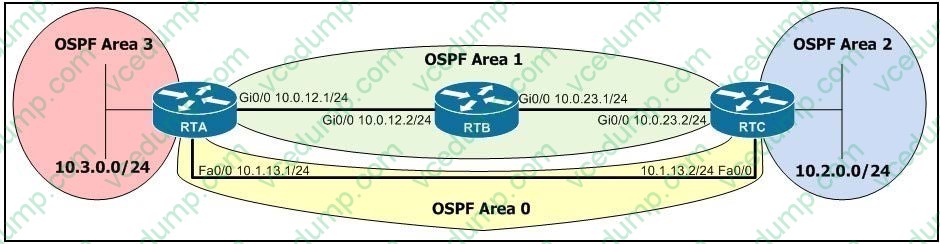
B. Change the OSPF configuration in OSPF area 0 to OSPF area 1
C. Change the OSPF configuration in OSPF area 2 to OSPF area 3
D. Change the OSPF configuration in OSPF area 3 to OSPF area 1 -
Question 112:
Refer to the exhibit. While performing an internal audit of your network, you come across this configuration in all of your routers.
Which three statements about this configuration are true? (Choose three.)
A. The Event Manager applet is configured incorrectly.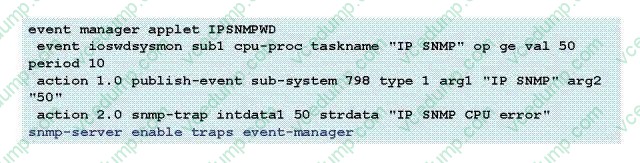
B. The IP SNMP process is monitored every 10 seconds.
C. The IP SNMP process is monitored every 10 minutes.
D. When CPU process exceeds 50%, an event is generated.
E. SNMP trap type 50 messages are sent to the event managers.
F. A publish event is sent to well-known user 798 with an SNMP trap message. -
Question 113:
Which two statements best describe CBWFQ? (Choose two.)
A. The CBWFQ scheduler provides a guaranteed minimum amount of bandwidth to each class.
B. CBWFQ services each class queue using a strict priority scheduler.
C. The class-default queue only supports WFQ.
D. Inside a class queue, processing is always FIFO, except for the class-default queue. -
Question 114:
Refer to the exhibit. If the router that produced the output in the exhibit fails, which virtual IP address will become active when the router recovers?
A. 10.1.1.1
B. 10.1.1.2
C. 10.1.1.101
D. All groups -
Question 115:
Refer to the exhibit. You have noticed that several users in the network are consuming a great deal of bandwidth for the peer-to-peer application Kazaa2. You would like to limit this traffic, and at the same time provide a guaranteed 100 kb/s bandwidth for one of your servers. After applying the configuration in the exhibit, you notice no change in the bandwidth utilization on the serial link; it is still heavily oversubscribing the interface.
What is the cause of this problem?
A. CEF needs to be enabled for NBAR.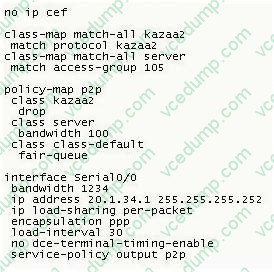
B. In class Kazaa2, you should configure a policer instead of a drop command.
C. The server class should have a priority of 100.
D. The bandwidth parameter on serial 0/0 is wrong.
E. Kazaa2 is not a valid protocol. -
Question 116:
What is true about Unicast RPF in strict mode?
A. It works well with a multihomed environment.
B. It will inspect IP packets that are encapsulated in tunnels, such as GRE, LT2P, or PPTP.
C. uRPF is performed within the CEF switching path.
D. There might be a problem with DHCP as Unicast RPF is blocking packets with a 0.0.0.0 source address. -
Question 117:
What two features in Cisco switches help prevent Layer 2 loops? (Choose two.)
A. Unidirectional Link Detection
B. Hot Standby Router Protocol
C. Virtual Router Redundancy Protocol
D. PortFast
E. root guard
F. loop guard -
Question 118:
Refer to the exhibit. When applying this hierarchical policy map on the on the tunnel1 interface, you measure high jitter for traffic going through class 1234. What is the most likely cause of this jitter?
A. The configuration of a hierarchical policy map on a tunnel interface is not supported.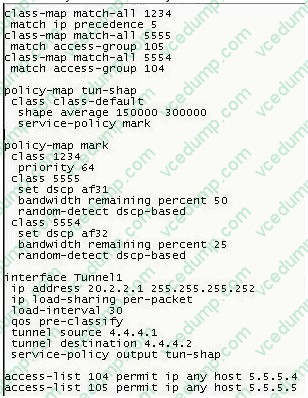
B. Class 5555 and class 5554 are both taking up 100% of the bandwidth, leaving nothing for class 1234.
C. The burst size for the traffic shaping is wrongly configured to 15000; this would require an interface capable of sending at 150Mb/s.
D. The burst size for the traffic shaping has been wrongly configured; it should be set as low as possible.
E. The burst size for the traffic shaping has been wrongly configured; it should be set as high as possible. -
Question 119:
Refer to the exhibit.
This is an MPLS VPN network with OSPF as the PE-CE routing protocol. Which statement is correct?
A. The routing inside the VPN RED will never work correctly.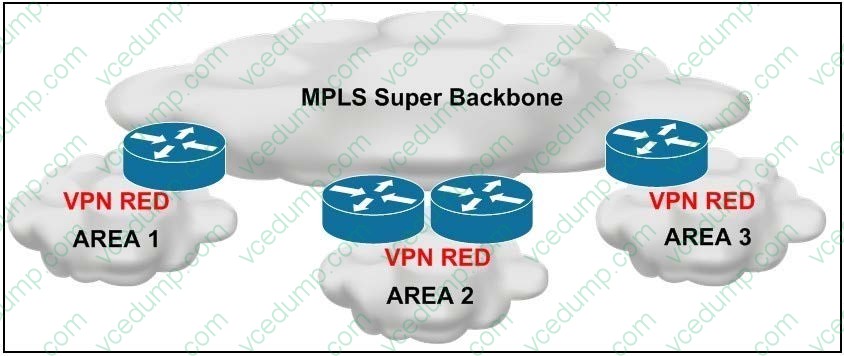
B. The routing inside the VPN RED can be enabled by configuring virtual links between the PE routers.
C. The routing inside the VPN RED can be enabled by configuring area 0 inside the VRF on the PE routers.
D. The routing inside the VPN RED will work without any special OSPF configuration.
E. The routing inside the VPN RED will work if the PE routers have a full mesh of sham-links configured for VRF RED. -
Question 120:
For the following items, what is the mathematical relationship between the committed information rate (CIR), committed burst (Bc), and committed rate measurement interval (Tc)?
A. CIR = TC / Bc
B. CIR = Be / Tc
C. Tc = CIR / Bc
D. Tc = Bc / CIR
Related Exams:
-
300-745
Designing Cisco Security Infrastructure (300-745 SDSI) v1.0 -
350-101
Implementing and Operating Cisco Wireless Core Technologies (350-101 WLCOR)v1.0 -
352-011
Cisco Certified Design Expert Practical -
500-052
Cisco Unified Contact Center Express -
500-173
Designing the FlexPod Solution (FPDESIGN) -
500-201
Deploying Cisco Service Provider Mobile Backhaul Solutions -
500-210
SP Optical Technology Field Engineer Representative -
500-220
Engineering Cisco Meraki Solutions (ECMS) v2.2 -
500-230
Cisco Service Provider Routing Field Engineer -
500-240
Cisco Mobile Backhaul for Field Engineers
Tips on How to Prepare for the Exams
Nowadays, the certification exams become more and more important and required by more and more enterprises when applying for a job. But how to prepare for the exam effectively? How to prepare for the exam in a short time with less efforts? How to get a ideal result and how to find the most reliable resources? Here on Vcedump.com, you will find all the answers. Vcedump.com provide not only Cisco exam questions, answers and explanations but also complete assistance on your exam preparation and certification application. If you are confused on your 350-001 exam preparations and Cisco certification application, do not hesitate to visit our Vcedump.com to find your solutions here.