300-175 Exam Details
-
Exam Code
:300-175 -
Exam Name
:Implementing Cisco Data Center Unified Computing -
Certification
:Cisco Certifications -
Vendor
:Cisco -
Total Questions
:442 Q&As -
Last Updated
:Dec 12, 2021
Cisco 300-175 Online Questions & Answers
-
Question 391:
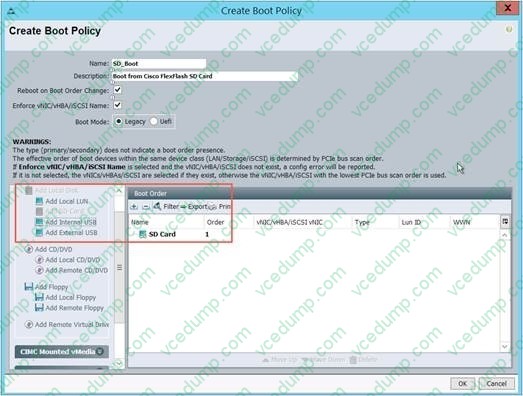
In order to manually boot from the FlexFlash SD card, which boot option must be in the boot policy used in the service profile?
A. FlexFlash state
B. remote virtual drive
C. remote boot
D. SD card -
Question 392:
You plan to implement FCoE on a Cisco UCS -Series server. Which option must you configure from the Cisco Integrated Management Controller GUI?
A. a vNIC failover
B. a boot table entry
C. NIV
D. FIP mode -
Question 393:
An administrator is testing the Cisco Nexus 1000v switch on top of a Cisco UCS Blade. They realize that the test VM traffic is not marked correctly after it leaves the Cisco UCS B-series blade. What is the reason for seeing this behavior?
A. The Cisco UCS does not support QoS marking
B. The Cisco UCS QoS policy applied to the blade has the host control set to "none."
C. The Cisco Nexus 1000V Series Switches do not support QoS marking.
D. The Cisco Nexus 1000V Series Switch QoS marking has not been enabled with "feature gos." -
Question 394:
Which two options are valid server pool policy qualifications? (Choose two.)
A. server model
B. description
C. user label
D. power group -
Question 395:
Refer to the exhibit.
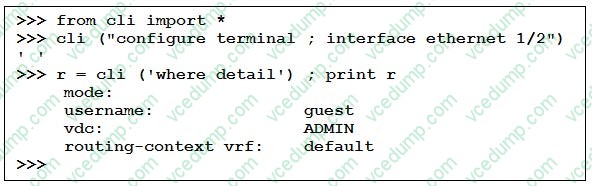
Which scripting tool do you use to create the script?
A. Bash
B. NX-API
C. Broadcom Shell
D. Python-API -
Question 396:
Which two are true concerning the role-based access control specifics of a Cisco Unified Computing System? (Choose two.)
A. Disabled local user accounts are deleted from the database.
B. A locally authenticated user account is any user account that is authenticated through LDAP, RADIUS, or TACACS+.
C. If a user maintains a local user account and a remote user account simultaneously, the roles that are defined in the local user account override those that are maintained in the remote user account.
D. By default, user accounts expire after 90 days; a warning message will be generated 10 days prior to expiration.
E. A user that is assigned one or more roles will be allowed the privileges that are consistent across all of the assigned roles.
F. All roles include read access to all configuration settings in the Cisco Unified Computing System domain. -
Question 397:
Which two policy resolution control options are available when registering a Cisco UCS domain in UCS Manager and UCS Central? (Choose Two)
A. Global
B. Universal
C. Server
D. Local
E. Host -
Question 398:
Cisco UCS Manager has deleted the VM object from its database, yet it still exists in vCenter. For which two reasons is the object removed from the Cisco UCS Manager database? (Choose two.)
A. The VM last passed traffic more than 5 minutes ago.
B. The VM is misconfigured.
C. The VM has been offline for more than 15 minutes.
D. vCenter is offline.
E. The VN link policy has been set for auto-deletion during a vMotion event.
F. The link between the fabric interconnect and IOM is offline.
G. The object was deleted in the Cisco UCS Manager, which also deletes it from vCenter.
H. The VM traffic is being sent to a SPAN -
Question 399:
Which option describes the possible result of a customer configuring a server pool that contains Cisco UCS B200 M2 and B250 M2 blades?
A. A service profile cannot migrate automatically from one blade to another blade within the server pool due to hardware failure.
B. You must decommission a blade server for the associated service profile to migrate to another blade in the server pool successfully.
C. You must uncheck the Restrict Migration box in the service profile to allow service profile migration between blades in the server pool.
D. After service profile migration, the server fails in boot from SAN due to differences in PCI device IDs. -
Question 400:
Which of the following is true concerning Fibre Channel communications on a Cisco Unified Computing System?
A. Each VSAN requires a dedicated VLAN to carry FCoE traffic.
B. FCoE VLANs are created like Ethernet VLANs on Cisco Unified Computing System Manager.
C. FCoE VLANs may overlap with Ethernet VLANs.
D. Cisco Unified Computing System Manager supports a maximum of 128 active VSANs.
Related Exams:
-
300-745
Designing Cisco Security Infrastructure (300-745 SDSI) v1.0 -
350-101
Implementing and Operating Cisco Wireless Core Technologies (350-101 WLCOR)v1.0 -
352-011
Cisco Certified Design Expert Practical -
500-052
Cisco Unified Contact Center Express -
500-173
Designing the FlexPod Solution (FPDESIGN) -
500-201
Deploying Cisco Service Provider Mobile Backhaul Solutions -
500-210
SP Optical Technology Field Engineer Representative -
500-220
Engineering Cisco Meraki Solutions (ECMS) v2.2 -
500-230
Cisco Service Provider Routing Field Engineer -
500-240
Cisco Mobile Backhaul for Field Engineers
Tips on How to Prepare for the Exams
Nowadays, the certification exams become more and more important and required by more and more enterprises when applying for a job. But how to prepare for the exam effectively? How to prepare for the exam in a short time with less efforts? How to get a ideal result and how to find the most reliable resources? Here on Vcedump.com, you will find all the answers. Vcedump.com provide not only Cisco exam questions, answers and explanations but also complete assistance on your exam preparation and certification application. If you are confused on your 300-175 exam preparations and Cisco certification application, do not hesitate to visit our Vcedump.com to find your solutions here.