200-301 Exam Details
-
Exam Code
:200-301 -
Exam Name
:Implementing and Administering Cisco Solutions (200-301 CCNA) v1.1 -
Certification
:CCNA -
Vendor
:Cisco -
Total Questions
:1716 Q&As -
Last Updated
:Jul 19, 2026
Cisco 200-301 Online Questions & Answers
-
Question 831:
A network architect is deciding whether to implement Cisco autonomous access points or lightweight access points. Which fact about firmware updates must the architect consider?
A. Unlike lightweight access points, which require redundant WLCs to support firmware upgrades, autonomous access points require only one WLC.
B. Unlike autonomous access points, lightweight access points require a WLC to implement remote firmware updates.
C. Unlike lightweight access points, autonomous access points can recover automatically from a corrupt firmware update.
D. Unlike autonomous access points, lightweight access points store a complete copy of the current firmware for backup. -
Question 832:
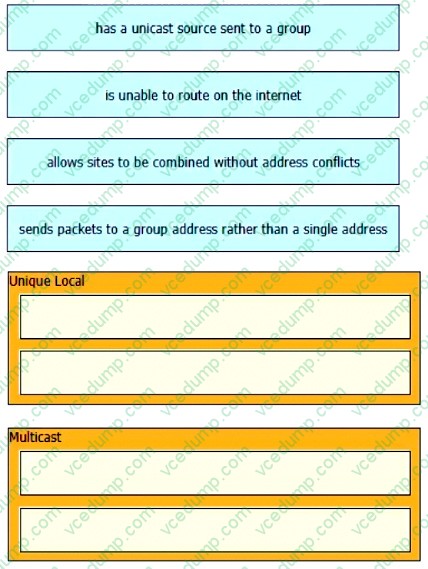
DRAG DROP
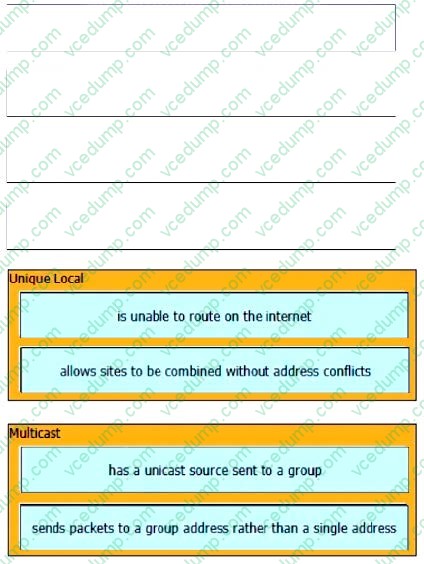
Drag and drop the characteristic from the left onto the IPv6 address type on the right.
Select and Place:
-
Question 833:
Which two statements are true about the command ip route 172.16.3.0 255.255.255.0 192.168.2.4? (Choose two.)
A. It establishes a static route to the 172.16.3.0 network.
B. It establishes a static route to the 192.168.2.0 network.
C. It configures the router to send any traffic for an unknown destination to the 172.16.3.0 network.
D. It configures the router to send any traffic for an unknown destination out the interface with the address 192.168.2.4.
E. It uses the default administrative distance.
F. It is a route that would be used last if other routes to the same destination exist. -
Question 834:
Refer to the exhibit.
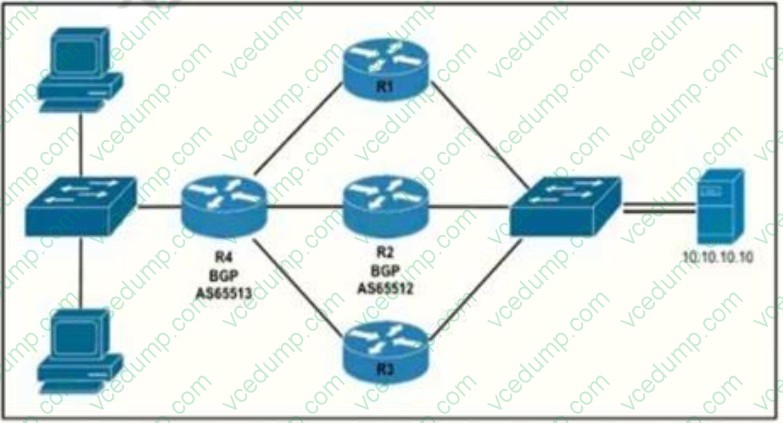
Router R4 is dynamically learning the path to the server. If R4 is connected to R1 via OSPF Area 20, to R2 via R2 BGP, and to R3 via EIGRP 777, which path is installed in the routing table of R4?
A. the path through R1, because the OSPF administrative distance is 110
B. the path through R2. because the IBGP administrative distance is 200
C. the path through R2 because the EBGP administrative distance is 20
D. the path through R3. because the EIGRP administrative distance is lower than OSPF and BGP -
Question 835:
Which advantage does machine learning offer for network security?
A. It improves real-time threat detection.
B. It manages firewall rule sets.
C. It enforces password complexity requirements.
D. It controls VPN access permissions. -
Question 836:
Refer to the exhibit.
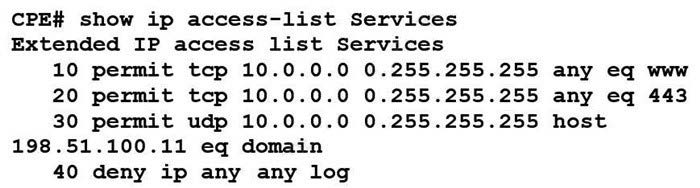
This ACL is configured to allow client access only to HTTP, HTTPS, and DNS services via UDP. The new administrator wants to add TCP access to the ONS service. Which configuration updates the ACL efficiently?
A. no ip access-list extended Services ip access-list extended Services 30 permit tcp 10.0.0.0 0.255.255.255 host 198.51.100.11 eq domain
B. ip access-list extended Services 35 permit tcp 10.0.0.0 0.255.255.255 host 198.51.100.11 eq domain
C. ip access-list extended Services permit tcp 10.0.0.0 0.255.255.255 host 198.51.100.11 eq domain
D. no ip access-list extended Services ip access-list extended Services permit udp 10.0.0.0 0.255.255.255 any eq 53 permit tcp 10.0.0.0 0.255.255.255 host 198.51.100.11 eq domain deny ip any any log -
Question 837:
Which goal is achieved by the implementation of private IPv4 addressing on a network?
A. allows servers and workstations to communicate across public network boundaries
B. provides a reduction in size of the forwarding table on network routers
C. allows communication across the Internet to other private networks
D. provides an added level of protection against Internet exposure -
Question 838:
What does an SDN controller use as a communication protocol to relay forwarding changes to a southbound API?
A. OpenFlow
B. Java
C. REST
D. XML -
Question 839:
Refer to the exhibit.
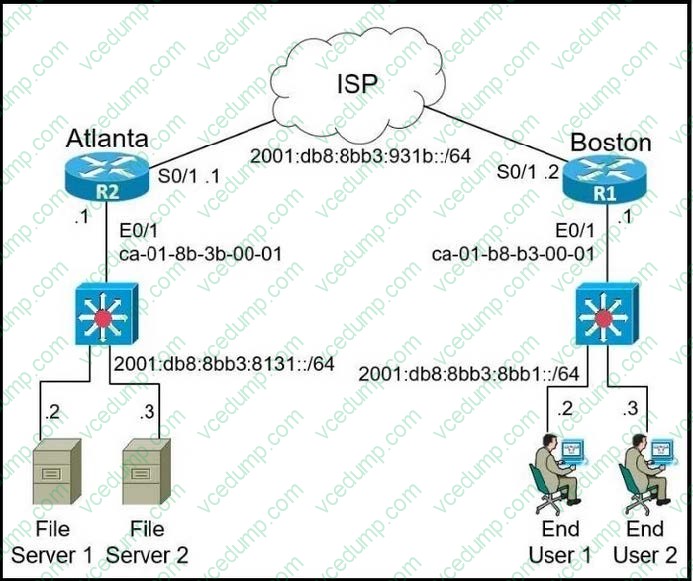
The IPv6 address for the LAN segment on router R1 must be configured using the EUI-64 format. When configured which Ipv6 address Is produced by the router?
A. 2001:db8:8bb3:8bb1:C001:8BFE:FF31:1
B. 2001:db8:8bb3:8bb1:C081:B8FF:FF3B:1
C. 2001:db8:8bb3:8bb1:C801:B8FF:FEB3:1
D. 2001:db8:8bb3:8bb4:7397:79FF:EF41:1 -
Question 840:
How does machine learning improve the detection of unauthorized network access?
A. It identifies patterns indicating intrusions.
B. It assigns security clearance levels.
C. It monitors for outdated software.
D. It dictates security policy updates.
Tips on How to Prepare for the Exams
Nowadays, the certification exams become more and more important and required by more and more enterprises when applying for a job. But how to prepare for the exam effectively? How to prepare for the exam in a short time with less efforts? How to get a ideal result and how to find the most reliable resources? Here on Vcedump.com, you will find all the answers. Vcedump.com provide not only Cisco exam questions, answers and explanations but also complete assistance on your exam preparation and certification application. If you are confused on your 200-301 exam preparations and Cisco certification application, do not hesitate to visit our Vcedump.com to find your solutions here.