200-301 Exam Details
-
Exam Code
:200-301 -
Exam Name
:Implementing and Administering Cisco Solutions (200-301 CCNA) v1.1 -
Certification
:CCNA -
Vendor
:Cisco -
Total Questions
:1716 Q&As -
Last Updated
:Jul 19, 2026
Cisco 200-301 Online Questions & Answers
-
Question 1331:
Refer to the exhibit.

An engineer configured NAT translations and has verified that the configuration is correct.
Which IP address is the source IP?
A. 10.4.4.4
B. 10.4.4.5
C. 172.23.103.10
D. 172.23.104.4 -
Question 1332:
Why was the RFC 1918 address space defined?
A. conserve public IPv4 addressing
B. preserve public IPv6 address space
C. reduce instances of overlapping IP addresses
D. support the NAT protocol -
Question 1333:
What is an advantage of using SDN versus traditional networking when it comes to security?
A. SDN security is managed near the perimeter of the network with firewalls, VPNs, and IPS, and traditional networking security policies are created based on telemetry data.
B. SDN exposes an API to configure locally per device for security policies, and traditional networking uses northbound API for network admin interface for configuring security policies.
C. SDN creates a unified control point making security policies consistent across all devices, and traditional networking must be configured device by device, leaving room for error.
D. SDN devices communicate with each other to establish a security policy, and in traditional networking, devices communicate upstream to a central location to establish a security policy. -
Question 1334:
What are two differences between WPA2 and WPA3 wireless security? (Choose two.)
A. WPA2 uses 192-bit key encryption, and WPA3 requires 256-bit key encryption.
B. WPA3 uses AES for stronger protection than WPA2, which uses SAE.
C. WPA2 uses 128-bit key encryption, and WPA3 supports 128-bit and 192-bit key encryption.
D. WPA3 uses SAE for stronger protection than WPA2, which uses AES.
E. WPA3 uses AES for stronger protection than WPA2, which uses TKIP. -
Question 1335:
Refer to the exhibit.
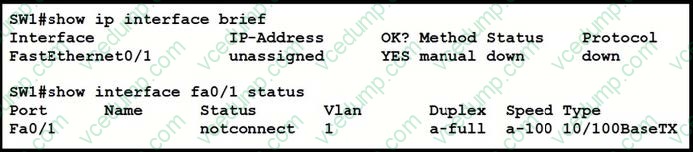
What is the cause of the issue?
A. shutdown command
B. wrong cable type
C. STP
D. port security -
Question 1336:
Refer to the exhibit.
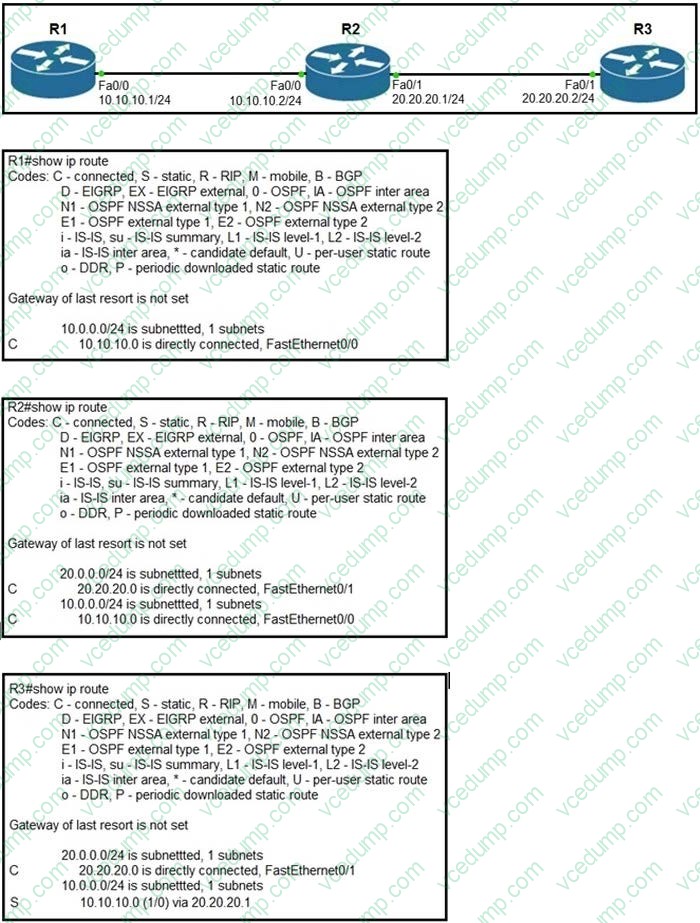
Router R1 Fa0/0 cannot ping router R3 Fa0/1. Which action must be taken in router R1 to help resolve the configuration issue?
A. set the default gateway as 20.20.20.2
B. configure a static route with Fa0/1 as the egress interface to reach the 20.20.2.0/24 network
C. configure a static route with 10.10.10.2 as the next hop to reach the 20.20.20.0/24 network
D. set the default network as 20.20.20.0/24 -
Question 1337:
What criteria is used first during me root port selection process?
A. local port ID
B. lowest path cost to the root bridge
C. lowest neighbor's bridge ID
D. lowest neighbor's port ID -
Question 1338:
DRAG DROP
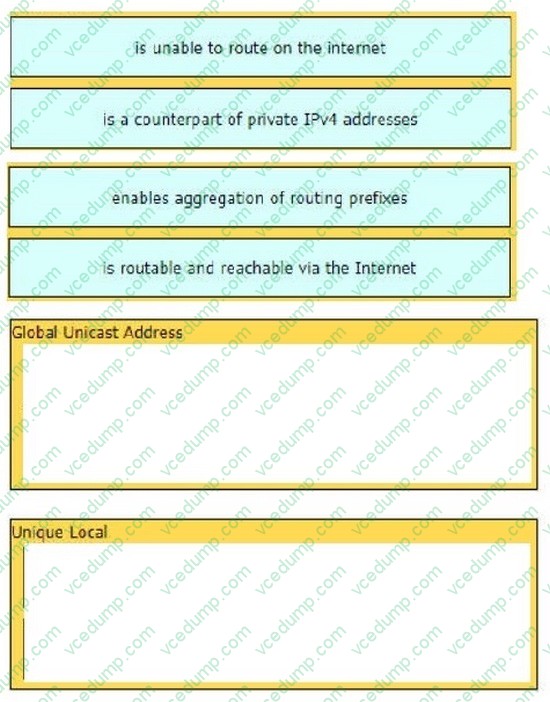
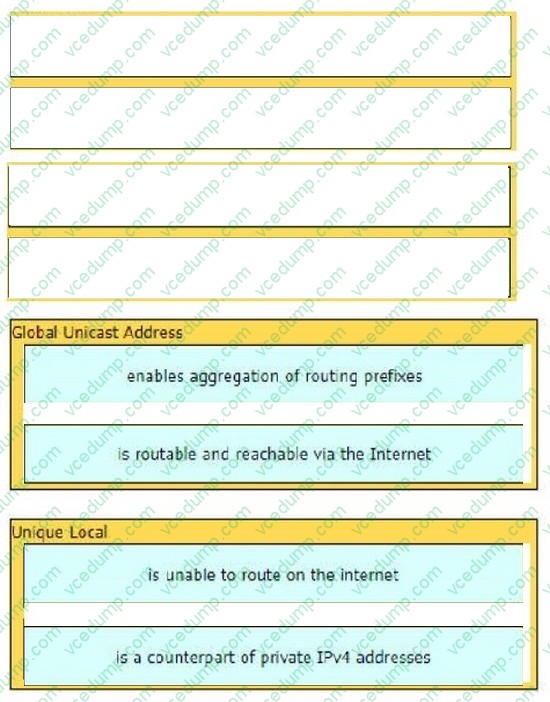
Drag and drop the characteristic from the left onto the IPv6 address type on the right.
Select and Place:
-
Question 1339:
Which spanning-tree feature immediately transitions a port to the forwarding state when enabled?
A. BPDU Guard
B. Root Guard
C. PortFast
D. Loop Guard -
Question 1340:
Which command must be entered to configure a DHCP relay?
A. ip helper-address
B. ip address dhcp
C. ip dhcp pool
D. ip dhcp relay
Tips on How to Prepare for the Exams
Nowadays, the certification exams become more and more important and required by more and more enterprises when applying for a job. But how to prepare for the exam effectively? How to prepare for the exam in a short time with less efforts? How to get a ideal result and how to find the most reliable resources? Here on Vcedump.com, you will find all the answers. Vcedump.com provide not only Cisco exam questions, answers and explanations but also complete assistance on your exam preparation and certification application. If you are confused on your 200-301 exam preparations and Cisco certification application, do not hesitate to visit our Vcedump.com to find your solutions here.