200-301 Exam Details
-
Exam Code
:200-301 -
Exam Name
:Implementing and Administering Cisco Solutions (200-301 CCNA) v1.1 -
Certification
:CCNA -
Vendor
:Cisco -
Total Questions
:1716 Q&As -
Last Updated
:Jul 11, 2026
Cisco 200-301 Online Questions & Answers
-
Question 121:
Refer to Exhibit.
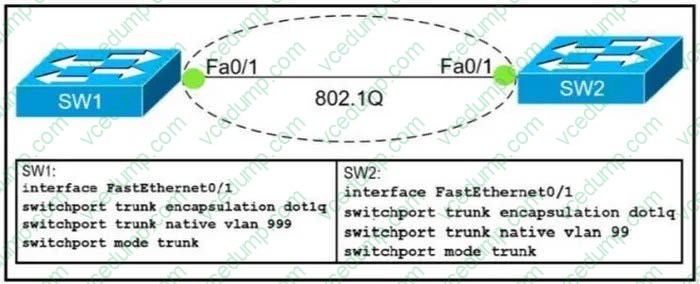
Which action do the switches take on the trunk link?
A. The trunk does not form and the ports go into an err-disabled status.
B. The trunk forms but the mismatched native VLANs are merged into a single broadcast domain.
C. The trunk does not form, but VLAN 99 and VLAN 999 are allowed to traverse the link.
D. The trunk forms but VLAN 99 and VLAN 999 are in a shutdown state. -
Question 122:
An engineer is configuring SSH version 2 exclusively on the R1 router. What is the minimum configuration required to permit remote management using the cryptographic protocol?
A. hostname R1 ip domain-name cisco crypto key generate rsa general-keys modulus 1024 username cisco privilege 15 password 0 cisco123 ip ssh version 2 line vty 0 15 transport input ssh login local
B. hostname R1 crypto key generate rsa general-keys modulus 1024 username cisco privilege 15 password 0 cisco123 ip ssh version 2 line vty 0 15 transport input all login local
C. hostname R1 service password-encryption crypto key generate rsa general-keys modulus 1024 username cisco privilege 15 password 0 cisco123 ip ssh version 2 line vty 0 15 transport input ssh login local
D. hostname R1 ip domain-name cisco crypto key generate rsa general-keys modulus 1024 username cisco privilege 15 password 0 cisco123 ip ssh version 2 line vty 0 15 transport input all login local -
Question 123:
A network administrator is setting up a new IPv6 network using the 64-bit address 2001 0EB8 00C1 2200:0001 0000 0000 0331/64 To simplify the configuration the administrator has decided to compress the address
Which IP address must the administrator configure?
A. ipv6 address 21:EB8:C1:2200:1::331/64
B. ipv6 address 2001:EB8:C1:22:1::331/64
C. ipv6 address 2001 :EB8:C 1:2200.1 ::331-64
D. ipv6 address 2001:EB8:C1:2200:1:0000:331/64 -
Question 124:
What is a characteristic of an SSID in wireless networks?
A. converts electrical current to radio waves
B. associates a name to a WLAN
C. uses a 4-way handshake for authentication
D. provides increased protection against spyware -
Question 125:
Refer to the exhibit.
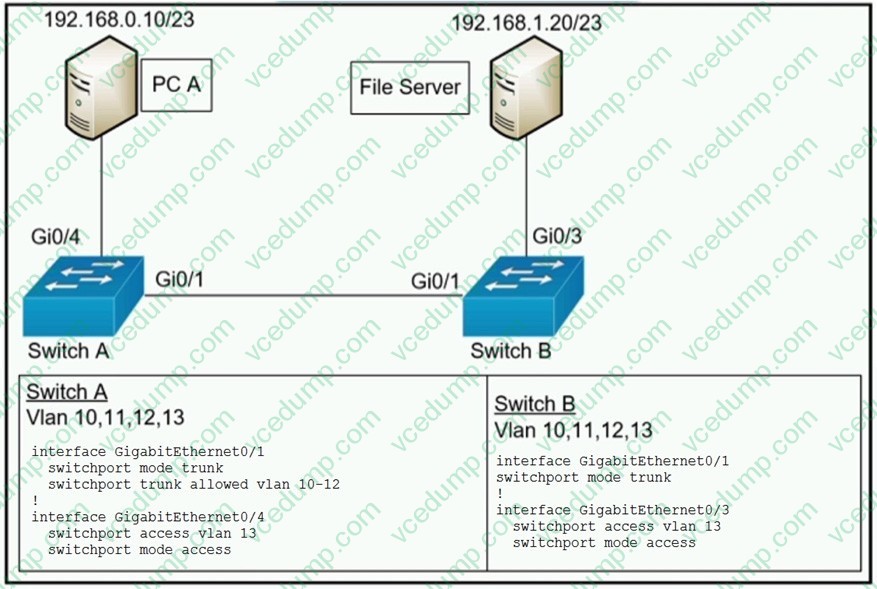
A network administrator assumes a task to complete the connectivity between PC A and the File Server. Switch A and Switch B have been partially configured with VLANs 10, 11, 12, and 13. What is the next step in the configuration?
A. Add PDA to VLAN 10 and the File Server to VLAN 11 for VLAN segmentation
B. Add VLAN 13 to the trunk links on Switch A and Switch B for VLAN propagation
C. Add a router on a stick between Switch A and Switch B allowing for Inter VLAN routing
D. Add PC A to the same subnet as the File Server allowing for intra-VLAN communication -
Question 126:
A network engineer starts to implement a new wireless LAN by configuring the authentication server and creating the dynamic interface. What must be performed next to complete the basic configuration?
A. Create the new WLAN and bind the dynamic interface to it.
B. Configure high availability and redundancy for the access points.
C. Enable Telnet and RADIUS access on the management interface.
D. Install the management interface and add the management IP. -
Question 127:
Which field within the access-request packet is encrypted by RADIUS?
A. authorized services
B. password
C. authenticator
D. username -
Question 128:
Refer to the exhibit. Web traffic is coming in from the WAN interface. Which route takes precedence when the router is processing traffic destined for the LAN network at 10.0.10.0/24?
A. via next-hop 10.0.1.5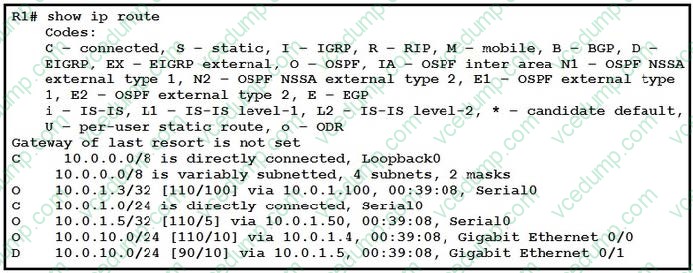
B. via next-hop 10 0 1.4
C. via next-hop 10.0 1.50
D. via next-hop 10.0 1 100 -
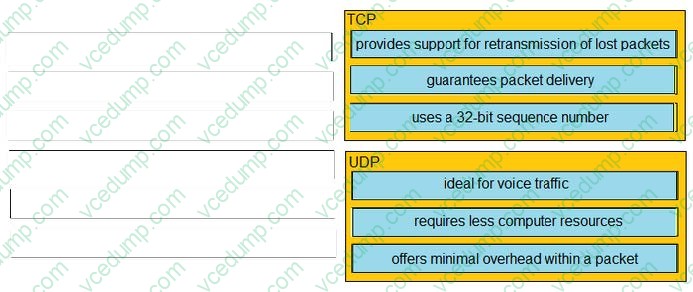
Question 129:
DRAG DROP
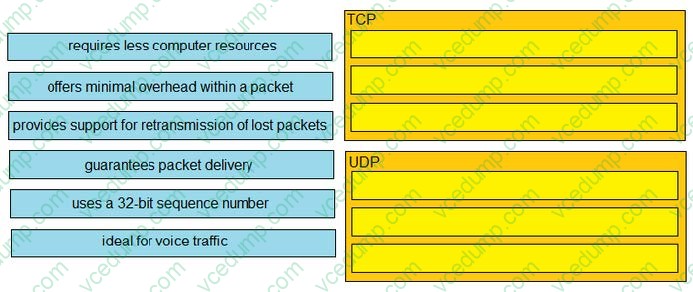
Drag and drop the characteristics of transport layer protocols from the left onto the corresponding protocols on the right.
Select and Place:
-
Question 130:
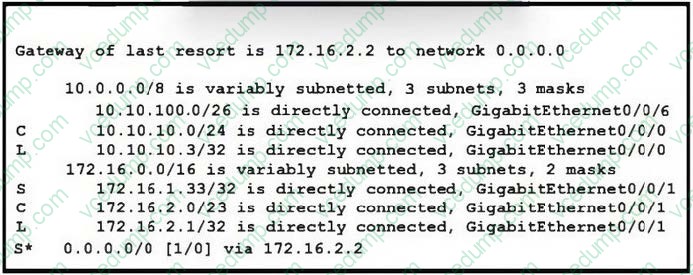
Refer to the exhibit.
A packet sourced from 10.10.10.32 is destined for the internet.
How many hops will the packet take before reaching the next-hop router?
B. 1
C. 2
D. 32
Tips on How to Prepare for the Exams
Nowadays, the certification exams become more and more important and required by more and more enterprises when applying for a job. But how to prepare for the exam effectively? How to prepare for the exam in a short time with less efforts? How to get a ideal result and how to find the most reliable resources? Here on Vcedump.com, you will find all the answers. Vcedump.com provide not only Cisco exam questions, answers and explanations but also complete assistance on your exam preparation and certification application. If you are confused on your 200-301 exam preparations and Cisco certification application, do not hesitate to visit our Vcedump.com to find your solutions here.