200-301 Exam Details
-
Exam Code
:200-301 -
Exam Name
:Implementing and Administering Cisco Solutions (200-301 CCNA) v1.1 -
Certification
:CCNA -
Vendor
:Cisco -
Total Questions
:1716 Q&As -
Last Updated
:Jul 11, 2026
Cisco 200-301 Online Questions & Answers
-
Question 141:
CCNA Lab simulation
Guidelines
This is a lab item in which tasks will be performed on virtual devices
1. Refer to the Tasks tab to view the tasks for this lab item.
2. Refer to the Topology tab to access the device console(s) and perform the tasks
3. Console access is available for all required devices by clicking the device icon or using the tab(s) above the console window
4. All necessary preconfigurations have been applied
5. Do not change the enable password or hostname for any device
6. Save your configurations to NVRAM before moving to the next item
7. Click Next at the bottom of the screen to submit this lab and move to the next question
8. When Next is clicked the lab closes and cannot be reopened
Topology Tasks
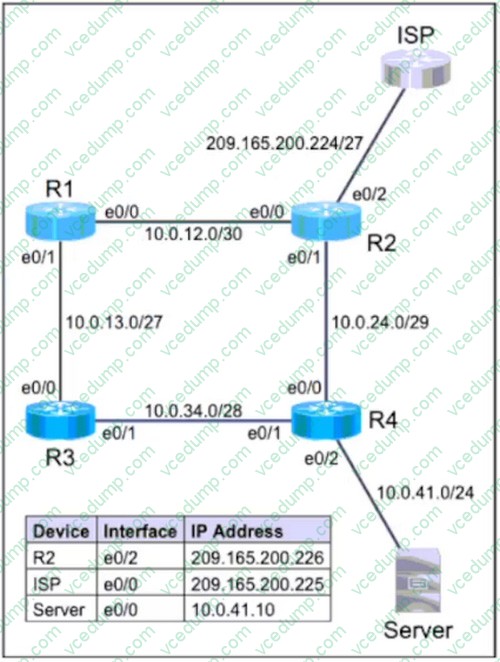
All physical cabling is in place. Routers R3 and R4 are fully configured and inaccessible. Configure static routes for various connectivity to the ISP and the LAN that resides on R4.
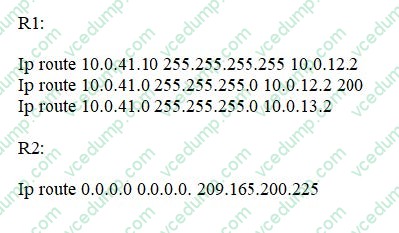
1.Configure a route on R1 to ensure that R1 prefers R2 when traffic is destined to the server only.
2.Configure a default route on R2 to the ISP
3.Configure a route on R1 to ensure that R1 will use R2 for the R4 LAN if the link fails between R3 and R4
4.Configure a route on R1 to ensure that R1 prefers R3 when traffic is destined to the R4 LAN at 10.0.41.0/24
A. Check the Explanation below
B. Place Holder
C. Place Holder
D. Place Holder -
Question 142:
What is a function of the Cisco DNA Center Overall Health Dashboard?
A. It provides a summary of the top 10 global issues.
B. It provides detailed activity logging for the 10 devices and users on the network.
C. It summarizes the operational status of each wireless devise on the network.
D. It summarizes daily and weekly CPU usage for servers and workstations in the network. -
Question 143:
Refer to the exhibit. Which configuration issue is preventing the OSPF neighbor from being established between the two routers?
A. R1 has an incorrect network command for interface Gi1/0.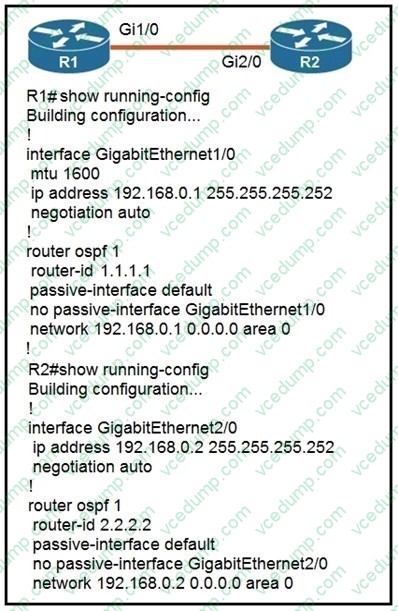
B. R2 should have its network command in area 1.
C. R1 interface Gi1/0 has a larger MTU size.
D. R2 is using the passive-interface default command. -
Question 144:
Which two actions influence the EIGRP route selection process? (Choose two.)
A. The advertised distance is calculated by a downstream neighbor to inform the local router of the bandwidth on the link.
B. The router calculates the feasible distance of all paths to the destination route.
C. The router must use the advertised distance as the metric for any given route.
D. The router calculates the best backup path to the destination route and assigns it as the feasible successor.
E. The router calculates the reported distance by multiplying the delay on the exiting interface by 256. -
Question 145:
What is a DNS lookup operation?
A. DNS server pings the destination to verify that it is available
B. serves requests over destination port 53
C. DNS server forwards the client to an alternate IP address when the primary IP is down
D. responds to a request for IP address to domain name resolution to the DNS server -
Question 146:
Refer to the exhibit.
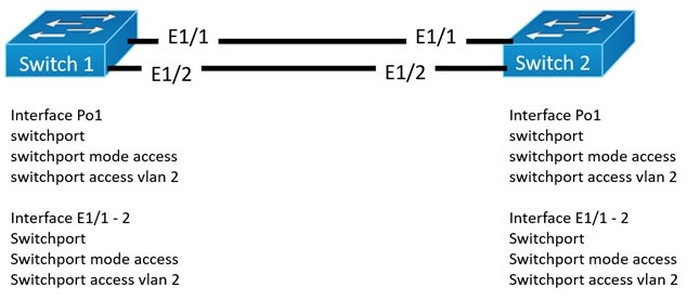
An engineer is configuring an EtherChannel using LACP between Switches 1 and 2. Which configuration must be applied so that only Switch 1 sends LACP initiation packets?
A. Switch1(config-if)#channel-group 1 mode on Switch2(config-if)#channel-group 1 mode passive
B. Switch1(config-if)#channel-group 1 mode passive Switch2(config-if)#channel-group 1 mode active
C. Switch1(config-if)#channel-group 1 mode active Switch2(config-if)#channel-group 1 mode passive
D. Switch1(config-if)#channel-group 1 mode active Switch2(config-if)#channel-group 1 mode passive -
Question 147:
What is the purpose of using First Hop Redundancy Protocol in a specific subnet?
A. Filter traffic based on destination IP addressing
B. Sends the default route to the hosts on a network
C. ensures a loop-free physical topology
D. forwards multicast hello messages between routers -
Question 148:
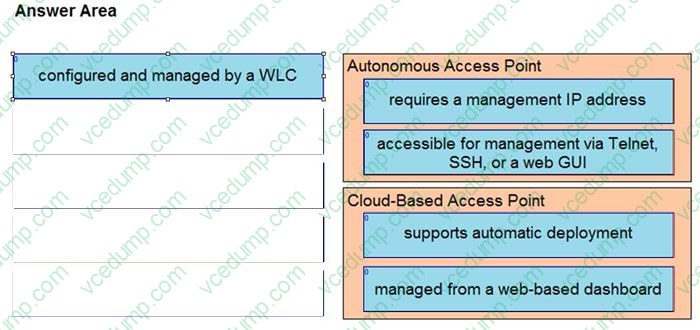
DRAG DROP
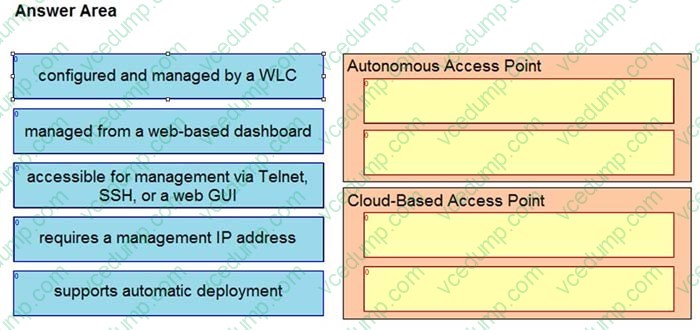
Drag and drop the facts about wireless architectures from the left onto the types of access point on the right. Not all options are used.
Select and Place:
-
Question 149:
Which type of protocol is VRRP?
A. allows two or more routers to act as a default gateway
B. uses Cisco-proprietary First Hop Redundancy Protocol
C. uses a destination IP address 224.0.0.102 for router-to-router communication
D. uses dynamic IP address assignment -
Question 150:
Refer to the exhibit.
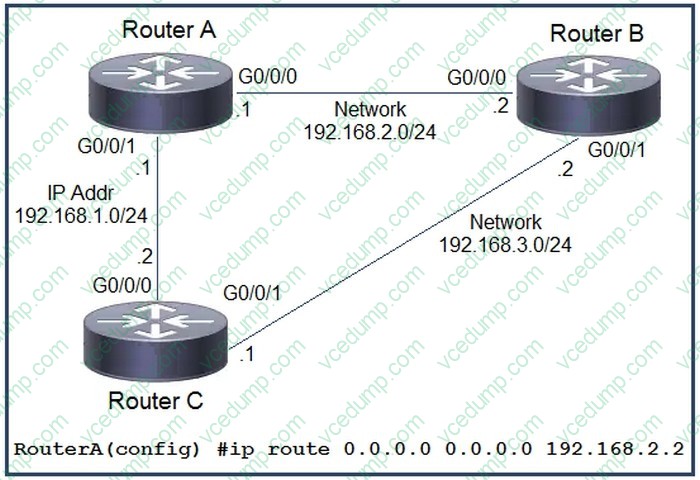
Which command must be issued to enable a floating static default route on router A?
A. lp route 0.0.0.0 0.0.0.0 192.168.1.2
B. ip default-gateway 192.168.2.1
C. ip route 0.0.0.0 0.0.0.0 192.168.2.1 10
D. ip route 0.0.0.0 0.0.0.0 192.168.1.2 10

Tips on How to Prepare for the Exams
Nowadays, the certification exams become more and more important and required by more and more enterprises when applying for a job. But how to prepare for the exam effectively? How to prepare for the exam in a short time with less efforts? How to get a ideal result and how to find the most reliable resources? Here on Vcedump.com, you will find all the answers. Vcedump.com provide not only Cisco exam questions, answers and explanations but also complete assistance on your exam preparation and certification application. If you are confused on your 200-301 exam preparations and Cisco certification application, do not hesitate to visit our Vcedump.com to find your solutions here.