200-105 Exam Details
-
Exam Code
:200-105 -
Exam Name
:Interconnecting Cisco Networking Devices Part 2 (ICND2) -
Certification
:Cisco Certifications -
Vendor
:Cisco -
Total Questions
:709 Q&As -
Last Updated
:Dec 12, 2021
Cisco 200-105 Online Questions & Answers
-
Question 601:
Refer to the exhibit. What does STATUS=ACTIVE refer to in the output of the show frame-relay pvc command?
A. The PVC is experiencing congestion.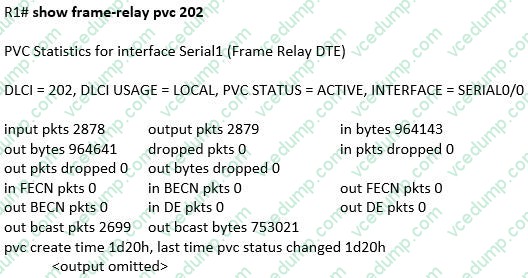
B. The Frame Relay switch is correctly programmed with the DLCI and is operational.
C. The router is actively broadcasting to establish a link to the Frame Relay switch.
D. The router is connected to the local Frame Relay switch, but not to the far end device. -
Question 602:
Scenario
Refer to the topology. Your company has decided to connect the main office with three other remote branch offices using point-to-point serial links. You are required to troubleshoot and resolve OSPF neighbor adjacency issues between the
main office and the routers located in the remote branch offices.
Use appropriate show commands to troubleshoot the issues and answer all four questions.
Instructions
Enter Cisco IOS commands on the device to verify network operation and answer the multiple-choice questions.
THIS TASK DOES NOT REQUIRE DEVICE CONFIGURATION.
Click on the device to gain access to the console of the device. No console or enable passwords are required.
To access the multiple-choice questions, click on the numbered boxes on the left of the top panel.
There are four multiple-choice questions with this task. Be sure to answer all four questions before clicking the Next button.
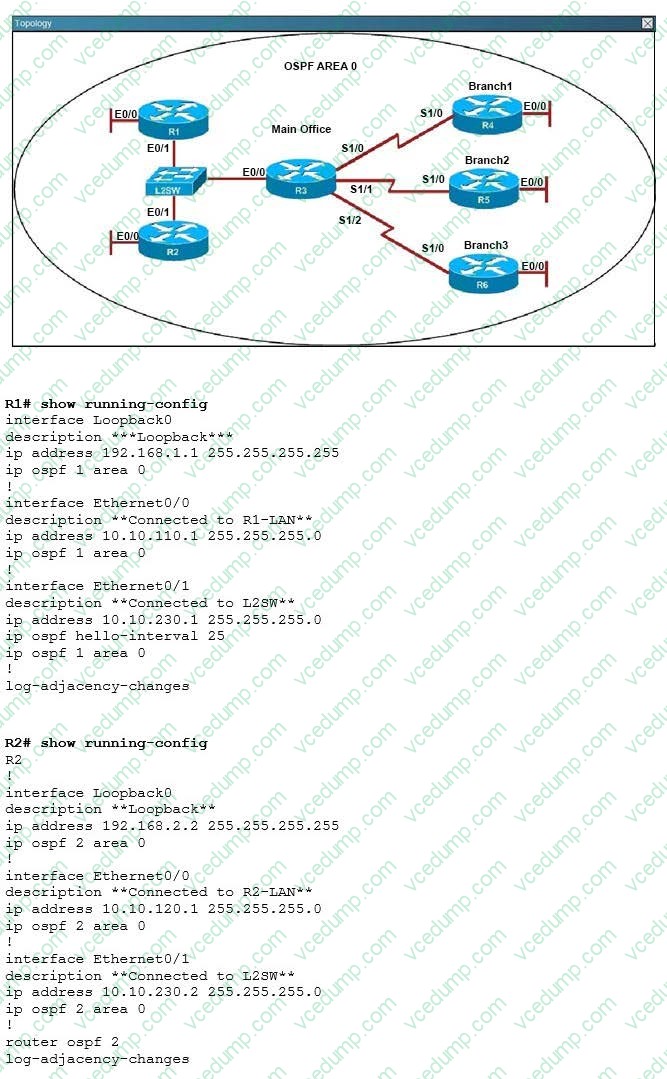
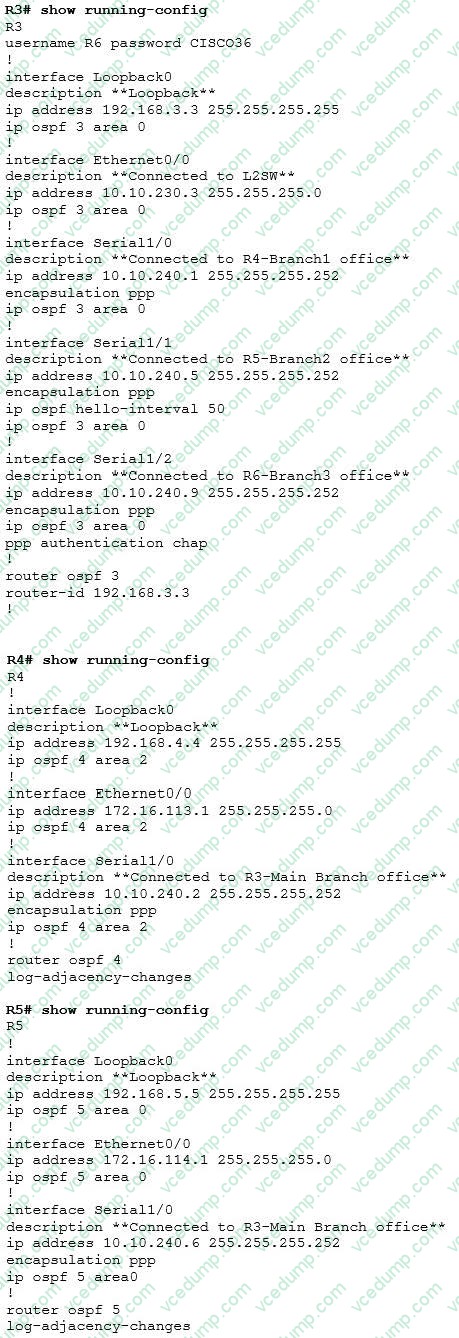
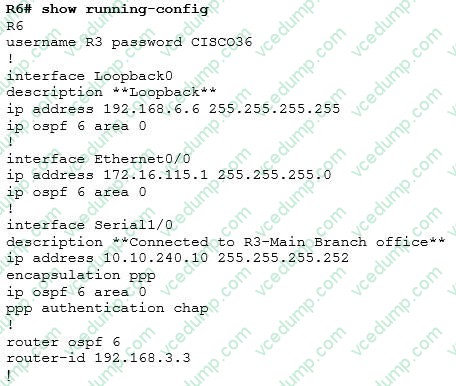
R1 does not form an OSPF neighbor adjacency with R2. Which option would fix the issue?
A. R1 ethernet0/1 is shutdown. Configure the no shutdown command.
B. R1 ethernet0/l configured with a non-default OSPF hello interval of 25; configure no ip ospf hello-interval 25.
C. R2 ethernet0/1 and R3 ethernet0/0 are configured with a non-default OSPF hello interval of 25; configure no ip ospf hello-interval 25.
D. Enable OSPF for R1 ethernet0/l; configure ip ospf 1 area 0 command under ethernet0/1. -
Question 603:
Which difference between PVST+ and RPVST+ is true?
A. RPVST+ is based on 802.1D and PVST+ is based on 802.1s.
B. RPVST+ is based on 802.1w and PVST+ is based on 802.1s.
C. RPVST+ has slower convergence than PVST+.
D. Only PVST+ includes Cisco proprietary standards. -
Question 604:
Refer to the exhibit. The ABC Company has the internetwork in the exhibit. The administrator would like to reduce the size of the routing table on the Central router. Which partial routing table entry in the Central router represents a route summary that represents the LANs in Phoenix but no additional subnets?
A. 10.0.0.0/22 is subnetted, 1 subnets D 10.0.0.0 [90/20514560] via 10.2.0.2, 6w0d, Serial0/1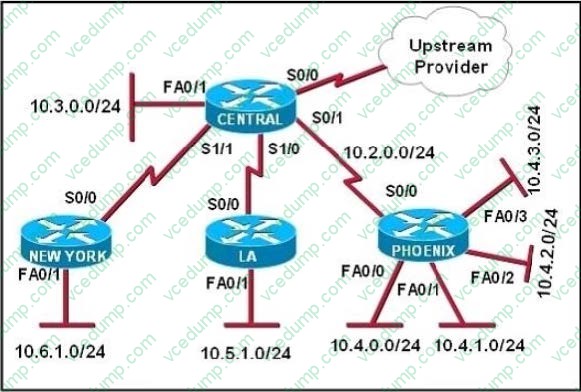
B. 10.0.0.0/28 is subnetted, 1 subnets D 10.2.0.0 [90/20514560] via 10.2.0.2, 6w0d, Serial0/1
C. 10.0.0.0/30 is subnetted, 1 subnets D 10.2.2.0 [90/20514560] via 10.2.0.2, 6w0d, Serial0/1
D. 10.0.0.0/22 is subnetted, 1 subnets D 10.4.0.0 [90/20514560] via 10.2.0.2, 6w0d, Serial0/1
E. 10.0.0.0/28 is subnetted, 1 subnets D 10.4.4.0 [90/20514560] via 10.2.0.2, 6w0d, Serial0/1
F. 10.0.0.0/30 is subnetted, 1 subnets D 10.4.4.4 [90/20514560] via 10.2.0.2, 6w0d, Serial0/1 -
Question 605:
Which QoS feature can change the value of the IPv4 Type of Service and the IPv6 Traffic Class header fields?
A. shaping
B. marking
C. prioritization
D. policing -
Question 606:
Which parameter or parameters are used to calculate OSPF cost in Cisco routers?
A. Bandwidth
B. Bandwidth and Delay
C. Bandwidth, Delay, and MTU
D. Bandwidth, MTU, Reliability, Delay, and Load -
Question 607:
What Netflow component can be applied to an interface to track IPv4 traffic?
A. flow monitor
B. flow record
C. flow sampler
D. flow exporter -
Question 608:
Scenario
Refer to the topology. Your company has connected the routers R1, R2, and R3 with serial links. R2 and R3 are connected to the switches SW1 and SW2, respectively. SW1 and SW2 are also connected to the routers R4 and R5.
The EIGRP routing protocol is configured.
You are required to troubleshoot and resolve the EIGRP issues between the various routers. Use the appropriate show commands to troubleshoot the issues.
Instructions
Enter the IOS commands on the device to verify the network operations and to find the answers for the multiple-choice questions.
THIS TASK DOES NOT REQUIRE DEVICE CONFIGURATION.
Click the device to gain access to the console of the device. No console or enable passwords are required.
To access the multiple-choice questions, click the numbered boxes on the left of the top panel.
There are four multiple-choice questions with this task. Be sure to answer all four questions before clicking the Next button.
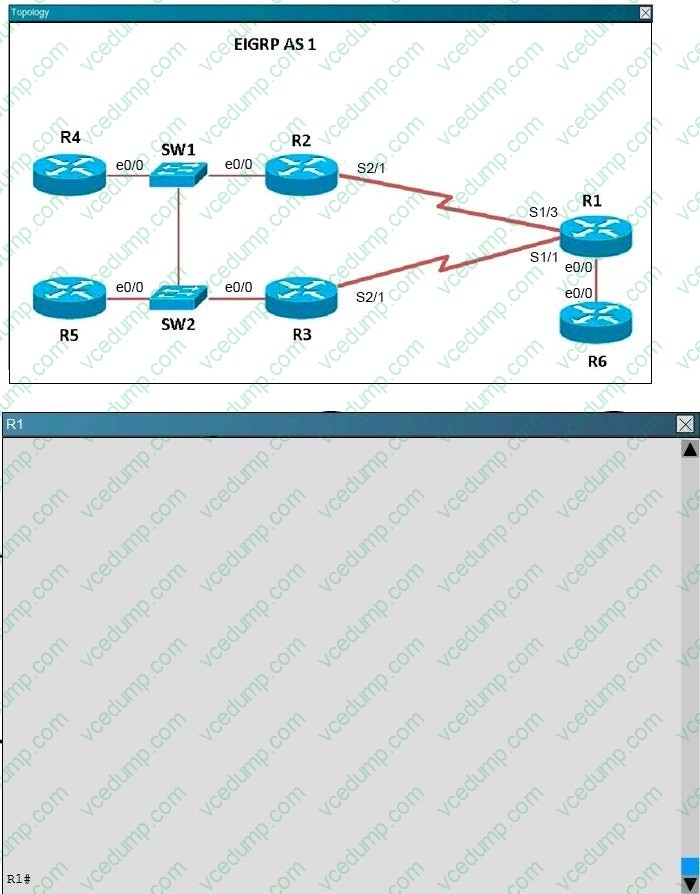


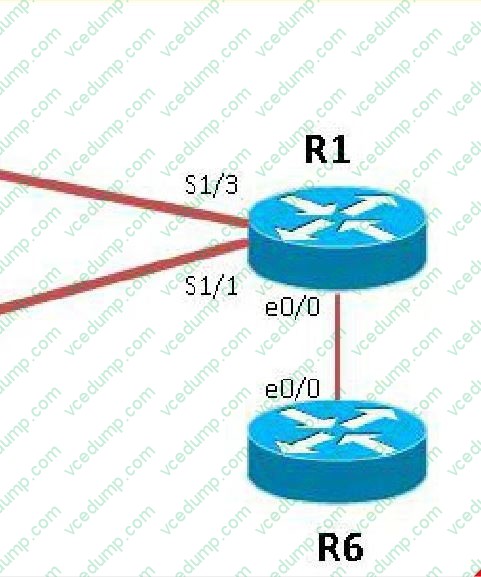
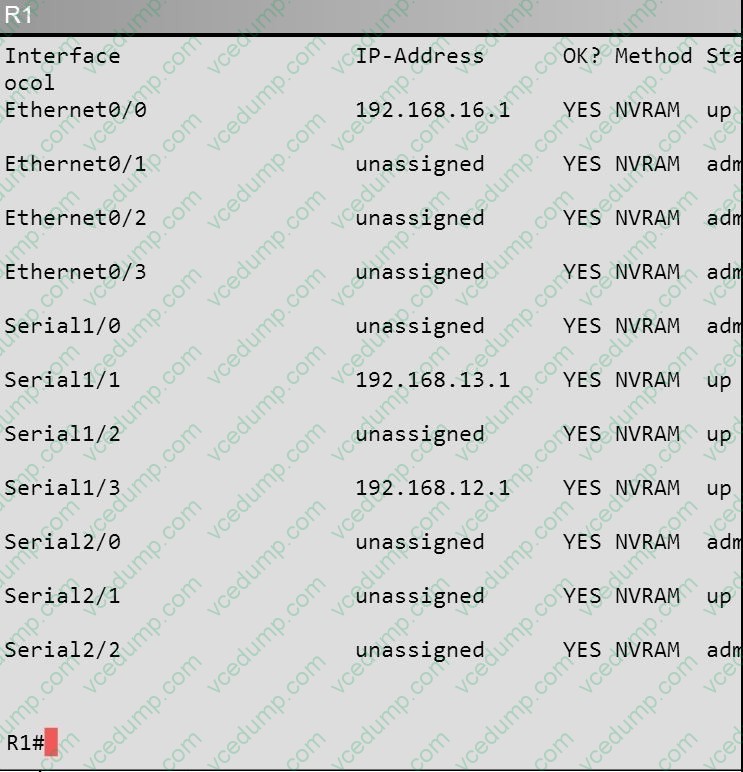
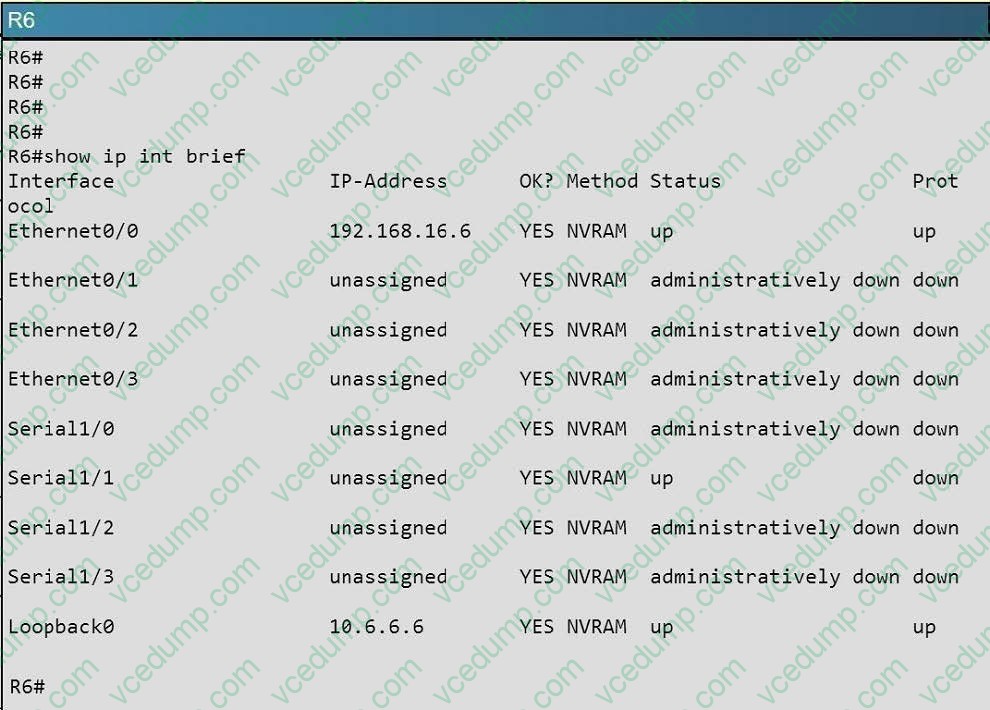
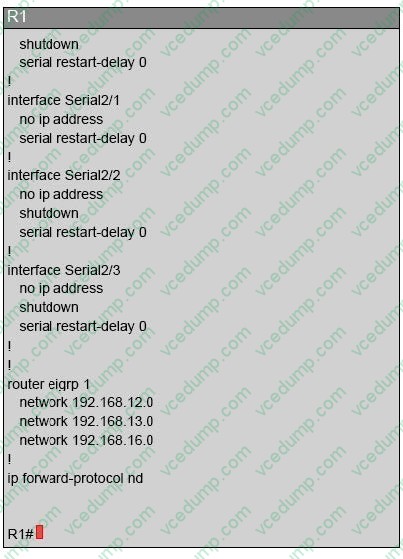
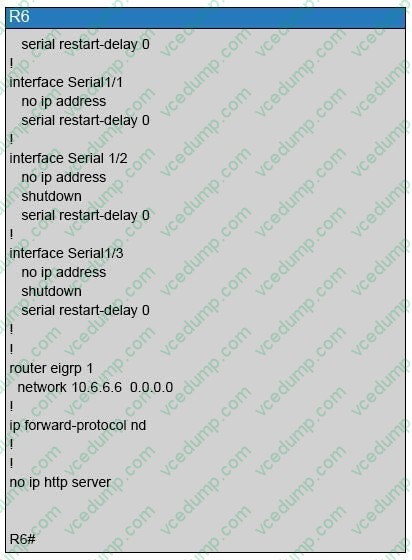
Router R6 does not form an EIGRP neighbor relationship correctly with router R1. What is the cause for this misconfiguration?
A. The values mismatch.
B. The AS does not match.
C. The network command is missing.
D. The passive-interface command is enabled. -
Question 609:
Which three effects of using local SPAN are true? (Choose three.)
A. It doubles the load on the forwarding engine.
B. It prevents SPAN destinations from using port security.
C. It doubles internal switch traffic.
D. It reduces the supervisor engine workload by half.
E. it reduces the load on the switch fabric. -
Question 610:
What is the default Syslog facility level?
A. local4
B. local5
C. local6
D. local7
Related Exams:
-
300-745
Designing Cisco Security Infrastructure (300-745 SDSI) v1.0 -
350-101
Implementing and Operating Cisco Wireless Core Technologies (350-101 WLCOR)v1.0 -
352-011
Cisco Certified Design Expert Practical -
500-052
Cisco Unified Contact Center Express -
500-173
Designing the FlexPod Solution (FPDESIGN) -
500-201
Deploying Cisco Service Provider Mobile Backhaul Solutions -
500-210
SP Optical Technology Field Engineer Representative -
500-220
Engineering Cisco Meraki Solutions (ECMS) v2.2 -
500-230
Cisco Service Provider Routing Field Engineer -
500-240
Cisco Mobile Backhaul for Field Engineers
Tips on How to Prepare for the Exams
Nowadays, the certification exams become more and more important and required by more and more enterprises when applying for a job. But how to prepare for the exam effectively? How to prepare for the exam in a short time with less efforts? How to get a ideal result and how to find the most reliable resources? Here on Vcedump.com, you will find all the answers. Vcedump.com provide not only Cisco exam questions, answers and explanations but also complete assistance on your exam preparation and certification application. If you are confused on your 200-105 exam preparations and Cisco certification application, do not hesitate to visit our Vcedump.com to find your solutions here.