USMLE USMLE-STEP-3 Online Practice
Questions and Exam Preparation
USMLE-STEP-3 Exam Details
Exam Code
:USMLE-STEP-3
Exam Name
:United States Medical Licensing Step 3
Certification
:USMLE Certifications
Vendor
:USMLE
Total Questions
:804 Q&As
Last Updated
:Jul 29, 2026
USMLE USMLE-STEP-3 Online Questions &
Answers
Question 521:
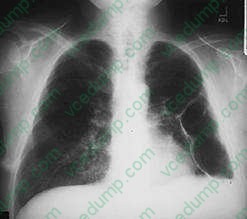
A 53-year-old insulin-dependent diabetic, who underwent a cadaveric renal transplant 1 year prior to admission, presents with fever and cough of 3 weeks duration. He works as a long-haul trucker, carting fruit from McAllen, Texas (on the Texas- Mexico border) to Fresno, California. He does not smoke. His PPD skin test prior to admission was positive. On physical examination, his respiratory rate is 25, his oral temperature is 101, his lungs have rhonchi and de creased breath sounds on the left. His CXR is shown in Figure.
What is the best diagnostic approach?
A. PPD skin testing B. urine histoplasma antigen testing C. serum cryptococcal antigen testing D. sputum for silver staining forP. jiroveci E. fiberoptic bronchoscopy with bronchial alveolar lavage
E. fiberoptic bronchoscopy with bronchial alveolar lavage
Explanation
The clinical picture is most consistent with disease caused by C. immitis. This is due both to the nature of the cavitary lesion on CXR and the endemic area. Figure 1-4 shows a peripheral, thinwalled cavitary lesion on CXR as well as a right lower lobe infiltrate. As a renal transplant recipient 1 year out, this patient is likely to have infections with tuberculosis and disseminated fungal infections. It is interesting that the route that he travels is through the lower Sonoran life zone where coccidiomycosis is endemic.
CMV produces a diffuse interstitial infiltrate pattern on CXR, as does Pneumocystis and H. capsulatum. Fiberoptic bronchoscopy with bronchial alveolar lavage should be performed in any patient with this clinical presentation who is immunocompromised because of the lack of ability to produce a good sputum specimen. We know that the patient is PPD positive, so skin testing is not useful. The patient is not mentioned to be in the endemic area for histoplasmosis. Serum cryptococcal antigen testing is a remote possibility. While Cryptococcus can produce a pulmonary disease with cavitary lesions, in immunocompromised hosts such as this, the patient more likely would present with meningitis.
Question 522:
A50-year old male presents to the office for prostate cancer screening because he saw a TV show recommending that men get tested. He has no significant medical history, takes no medications, and has no genitourinary symptoms. There is no family history of prostate cancer. How would you advise him regarding prostate cancer screening?
A. All men over the age of 50 should have a PSA test every year. B. As blood tests are very safe, there is no harm associated with PSA screening. C. Only men with symptoms of prostate enlargement should have PSA screening. D. A PSA level of less than 4.0 ng/mL rules out the diagnosis of prostate cancer. E. Certain medications may alter PSA level.
E. Certain medications may alter PSA level.
Explanation
Screening for prostate cancer with the PSA test is a controversial area. Some advocate routine screening of most men over the age of 50 while others recommend selective screening or no routine screening at all. The USPSTF gives prostate cancer screening an "I" recommendation, stating that there is insufficient evidence to recommend for or against this intervention. Prostate cancer is the second most common cause of cancer death in men (behind lung cancer). PSA screening does not help to prevent prostate cancer but it does increase the likelihood of detection of prostate cancer. However, many prostate cancers are slow growing and many with prostate cancer die of other causes. PSA screening has not been shown to reduce all cause mortality. While the mortality from prostate cancer has been decreasing over the years, the reason for this is not yet clear. PSA screening may play a role in this but improvements in the treatment of prostate cancer may also be responsible. The PSA also has significant rates of false positive and false negative readings. Benign conditions such as prostatic hyperplasia or prostatitis can elevate PSA readings and prostate cancer can exist in men with normal PSA readings. Another factor that can interfere with PSA readings is the presence of medications. Finasteride and dutasteride, which are widely used in the treatment of benign prostatic hyperplasia, can lower PSA readings, even in the presence of prostate cancer. If PSA screening is chosen by the patient and his physician, selection of appropriate patients for screening is important. The presence of symptoms related to the prostate may influence one's decision to perform a PSA test. However, many prostate cancers are asymptomatic, so the absence of symptoms may not be a reason to withhold testing. Most authorities would not recommend the routine screening of men with significant comorbidities that would result in them having a life expectancy of fewer than 10 years. One of the reasons for the controversy surrounding PSA screening is the risk of harm of testing. Elevated PSA levels frequently result in further--sometimes invasive--testing and may result in the detection of cancers that may or may not have become clinically significant.
Question 523:
A 70-year-old male is seen in the office for chest pain. He reports that he is getting substernal chest pain, without radiation, when he mows his lawn. The pain resolves with 1015 minutes of rest. He has never had pain at rest. He has no other cardiac complaints and his review of systems is otherwise negative. He has an unremarkable medical history and takes only a baby aspirin a day. On examination, his blood pressure is 160/70, pulse 85, and respiratory rate 16. His cardiac examination is notable for a harsh, 3/6 systolic ejection murmur along the sternal border that radiates to the carotid arteries. His carotid pulsation is noted to rise slowly and is small and sustained. His lungs are clear. The remainder of his examination is normal.
Which of the following would be most likely to be seen on an ECG?
A. S-T segment elevations in the precordial leads B. Q waves in the precordial leads C. low-voltage QRS complexes D. left ventricular hypertrophy pattern E. normal ECG
D. left ventricular hypertrophy pattern
Explanation
Aortic stenosis is one of the most common valvular abnormalities found in adults. It can be congenital -- such as a unicuspid or bicuspid valve--or acquired. In young adults, acquired aortic stenosis is often seen as a consequence of rheumatic fever. This is becoming less common in developed nations. In adults over the age of 65, the most common cause of aortic stenosis is age-related degenerative, calcific aortic stenosis. The valvular cusps are immobilized and the stenosis caused by calcium deposits along the flexion lines of the valves. Acquired aortic stenosis typically has a prolonged asymptomatic period. During this time the stenosis may be found incidentally by auscultation of the characteristic harsh, holosystolic murmur in the aortic valve area that radiates to the carotid arteries. There may also be a slow, small, and sustained arterial pulsation (pulsus parvus and tardus) due to the relative outflow obstruction. The cardinal symptoms of aortic stenosis that signal advancing disease, and increased risk of mortality, are angina, heart failure, and syncope. An ECG will show left ventricular hypertrophy in approximately 85% of symptomatic cases of aortic stenosis.
A normal ECG is possible but would be more likely in early, asymptomatic stages. S-T segment elevation would be more consistent with acute cardiac ischemia and Q waves would be more consistent with a completed MI. Low-voltage QRS complexes can be seen in several conditions, including pericardial effusion, COPD, or obesity. When considering the diagnosis of aortic stenosis, the initial diagnostic test of choice would be echocardiography. It would provide information on both the structure (bicuspid, tricuspid, and the like) and the function (valve area, pressures) of the valve. The size and function of the left ventricle can also be determined. If aortic stenosis is found on echocardiogram and the patient is symptomatic, the next test would be cardiac catheterization.
This would allow for direct measurement of the pressure gradient across the valve. It would also allow for evaluation of the status of the coronary arteries in order to determine whether CABG would need to be performed along with valve replacement. Exercise stress testing is relatively contraindicated in the setting of symptomatic aortic stenosis. Holter monitoring would only be useful if there were a concomitant arrhythmia. Electrophysiologic studies would not play a role in the typical evaluation of aortic stenosis.
Question 524:
A 16-year-old woman comes to see you for a yearly physical examination. Her only concern is that her periods are very irregular, and she desires oral contraceptives to regulate them. She relates that menarche was at 12 years, of age and that her periods have always been irregular. On examination, she is a markedly obese woman with a body mass index of 35 and with normal linear growth. She has some coarse facial hair down both of her checks as well as cystic acne along her hairline. On the nape of her neck she is noted to have acanthosis nigricans. She has tanner 4 breast development as well as tanner 4 pubic hair.
Her urinalysis in the office is normal.
What is the most likely cause of her irregular periods?
A. hypothyroidism B. polycystic ovarian syndrome (PCOS) C. late-onset congenital adrenal hyperplasia (CAH) D. Cushing syndrome E. testosterone insensitivity
B. polycystic ovarian syndrome (PCOS)
Explanation
This clinical vignette describes an adolescent female with PCOS. PCOS is commonly seen in obese adolescent females with anovulatory menstrual cycles, hirsutism, and generalized virilization (acne). Commonly, PCOS patients will have glucose insensitivity and manifest features of type II diabetes mellitus. The diagnosis of PCOS may be difficult to ascertain. A pelvic ultrasound demonstrating "polycystic ovaries" (the string of pearls sign) may be quite helpful. Girls with PCOS will typically have elevated triglycerides, low HDL cholesterol, and a suppressed prolactin. As indicated above, PCOS girls also often have glucose insensitivity and an abnormal glucose tolerance test. The most effective therapy in PCOS involves lifestyle alterations (weight loss and exercise) and hormonal regulation of ovulation. The hypoglycemic agent metformin is now being used to assist in the management of PCOS. Occasionally, subcutaneous insulin may be effective in controlling hyperglycemia, but this will not prevent diabetes mellitus.
Question 525:
A20-year-old male has had a recent wide local excision of a 1.5 mm melanoma from the right ankle. There is no evidence of metastatic disease. The most important prognostic factor for this patient is which of the following?
Which of the following interventions is most appropriate in addition to wide local excision of the patient's melanoma?
A. sentinel lymph node biopsy B. no further intervention is warranted C. adjuvant therapy with interferon alpha-2 for 1 year D. single-agent chemotherapy E. complete lymph node dissection
A. sentinel lymph node biopsy
Explanation
In patients who have melanoma that is confined to the skin (i.e., no evidence of metastatic disease), the most important prognostic factor is the Breslow histologic depth of the tumor. The age of the patient and location of the tumor also play a role in prognosis, but to a lesser degree. The forearm and leg tend to have a better prognosis; scalp, hands, feet, and mucous membranes have a worse prognosis. Older persons tend to have poorer prognoses, as well. Standard treatment for melanoma involves surgical excision. Sentinel lymph node biopsy should also be performed in any patient who has a melanoma that is at least 1 mm thick. This aids in determining whether melanoma cells have metastasized to the local lymph node basin. If the sentinel lymph node biopsy is negative for melanoma cells, no further lymph node studies are necessary. However, a positive biopsy warrants complete lymph node dissection. In addition to this situation, complete lymph node dissection is indicated in the setting of clinical lymphadenopathy regardless of evident distant metastasis. High dose interferon alpha-2 therapy is aviable option for use as adjuvant therapy in patients at high risk for disease recurrence, having been shown to prolong periods of remission and possibly improve mortality. Single-agent chemotherapy is generally used in patients with stage IV melanoma and is considered more for palliative purposes.
Question 526:
A 9-year-old boy comes to the clinic for evaluation of a rash. The boy says that he began developing some blisters on his cheek the night prior. He says that over the past few days he has spent time outside with his friends "down by the creek." The rash appears to be a linear crop of vesicles beginning in front of his left ear and extending to the corner of his mouth. There is no erythema, and he describes them as quite pruritic. He has not had any fever, vomiting, or changes in his hearing.
What does this rash most likely represent?
A. HSV infection of the facial nerve (Ramsey-Hunt syndrome) B. bullous impetigo C. allergic contact dermatitis (Rhus dermatitis) D. erythema chronica migrans E. cutaneous larval migrans
C. allergic contact dermatitis (Rhus dermatitis)
Explanation
This represents an allergic contact dermatitis. The allergen is the oil on the leaf of certain plants (poison ivy). The reaction is a delayedtype hypersensitivity reaction (type 4) and may take up to 7296 hours after exposure to fully manifest. Limited allergic contact dermatitis will usually warrant limited therapy. Oral antihistamines, taken on an as-needed basis, can provide effective symptomatic relief. Topical antihistamines are usually not effective and, if added to oral antihistamines, can result in toxic effects.
Steroids should be used sparingly on the face, and high-potency steroid should not be used at all on the face. Secondary infection is unlikely if good skin hygiene is used.
Question 527:
An 80-year-old woman is admitted to the medical service for treatment of a UTI. While she is hospitalized, she is evaluated for confusion. On her mental status examination (MSE), she appears somnolent at times, fluctuating with an alert state. She is not cooperative, is hostile, and clearly is hallucinating at times. Her insight and memory are poor. The differential diagnosis includes both delirium and dementia.
Which of the following signs/symptoms is the most specific for delirium?
A. aggressiveness B. fluctuating consciousness C. poor memory D. psychosis E. uncooperativeness
B. fluctuating consciousness
Explanation
This case demonstrates a classic presentationfor delirium. Delirium can present with many symptoms, including aggressiveness, hostility, memory impairment, psychotic symptoms (especially visual hallucinations), and overall uncooperativeness, such as pulling out IVs and getting out of bed. While these symptoms are common in delirious patients, they are not specific for delirium and can be seen in many psychiatric illnesses, including dementias, psychotic disorders, substance use disorders, personality disorders, and others.
The hallmark of delirium is a fluctuating level of consciousness over time, ranging from sedation to agitation. Diphenhydramine can be sedating but, due to its anticholinergic side effects, can also worsen delirium and cause urinary retention and constipation, especially in the elderly. Anticholinesterase inhibitors such as donepezil may be indicated for mild-tomoderate dementias, especially Alzheimer dementia. It is not indicated for the treatment of delirium and it would be difficult to diagnose a dementing illness in the context of a delirious state. Giving benzodiazepines such as lorazepam may be useful for agitation caused by a delirium, but they can also disinhibit a patient and cause further agitation, especially in older individuals. A benzodiazepine would be the preferred treatment of alcohol withdrawal delirium (delirium tremens [DTs]), however. A low dose of antipsychotic would be the best choice to decrease the agitation in a delirious patient. While a high-potency medication such as haloperidol can be used, it is more likely to cause extrapyramidal side effects than a second-generation (or atypical) antipsychotic such as risperidone.
Question 528:
A 28-year-old White G1 woman presents to your office for an initial obstetric visit. Her LMP is certain and allows you to estimate a 9-week gestational age today. She denies bleeding, cramping, or other symptoms of concern. She is excited about being pregnant. She has already started taking her prenatal vitamins with folic acid. She reports no significant past medical history. In fact, she states that she has not been to a doctor in many years because she has not had any problems. She has had no surgeries.
She does not smoke. She drank alcohol socially prior to pregnancy but has not consumed any alcohol since she became pregnant. She has family history of hypertension, but no other significant history is elicited. On physical examination, her blood pressure is 110/60. She is healthy appearing, and there are no significant findings on examination. Your pelvic examination confirms uterine size consistent with stated dates. As part of a routine laboratory evaluation, you decide to check a thyroid-stimulating hormone (TSH). The TSH is 0.4 IU/ mL (normal range 0.55.5) and a free T4 of 1.8 ng/dL (normal range 0.72.0).
What is the most likely cause of this patient's hyperthyroidism?
A. toxic adenoma B. multinodular goiter C. hyperemesis gravidarum D. lymphocytic thyroiditis E. Grave's disease
E. Grave's disease
Explanation
This patient likely does not have thyroid disease. She is asymptomatic, has a normal physical examination, and her free T4 is normal. hCG shares a chemical subunit with TSH. The circulating hCG can cause suppression of the thyroid. This is a transient change and does not represent true thyroid disease. Graves' disease is the most common cause of hyperthyroidism in pregnancy. It is the cause of 90- 95% of such cases. Patients may complain of rapid heartbeat, weight loss, and GI symptoms such as nausea and vomiting. On examination, you may palpate diffuse thyromegaly and may note exophthalmos. The other listed causes of thyrotoxicosis are much less common in pregnancy, accounting for the remaining 510% of cases. Treatment of this problem is necessary because thyrotoxic women are at increased risk of perinatal mortality, preterm delivery, and maternal heart failure.
Treatment is typically with PTU or methimazole. Propranolol can be used initially to reduce symptoms but does not address the underlying problem. Surgery should be reserved for women who do not respond to medical therapy. Radioactive iodine is contraindicated during pregnancy as it can ablate fetal thyroid tissue, leading to the possibility of congenital hypothyroidism.
Question 529:
A mildly mentally retarded 9-year-old girl is brought to your office for acne. On examination, she does not actually have acne but has small flesh colored papules along her nasolabial fold. Her past history is significant for having had a first (afebrile) seizure last year. The mother reminds you that she has a faint birthmark on her hip that is pale and becomes more prominent in the summer, when the child's skin tans. Examination of this area reveals a 5-cm oval patch that is hypopigmented. Which condition would she most likely have?
A. Sturge-Weber syndrome B. neurofibromatosis, type 1 (von Recklinghausen disease) C. tuberous sclerosis D. CHARGE association E. Beckwith-Wiedemann syndrome
C. tuberous sclerosis
Explanation
Children with tuberous sclerosis (tuberous sclerosis complex, TSC) can develop nasolabial fold angiofibromas (commonly referred to adenoma sebaceum). These can be mistaken for acne in an adolescent and is seen in over 80% of adolescents with TSC. Other cutaneous findings include peri- and subungual fibromas, ash leaf spots (hypomelanocytic macules), and shagreen patches. Skin findings are seen in 75% of cases of tuberous sclerosis. Tuberous sclerosis can also have CNS cortical defects and "tubers," which may be foci of seizure activity. The "tubers" have a classic periventricular distribution. Mental retardation is very common in varying degrees. Sturge-Weber syndrome (also known as leptomeningeal angiomatosis) is a port wine stain, typically with V1 or V2 distribution, with an underlying leptomeningeal blood vessel dysplasia. These dysplastic vessels will typically result in an underlying cortical atrophy. This cortical atrophy can be a nidus for seizures and can be seen on a CT scan of the head. Neurofibromatosis, type 1 is polymorphous neurocutaneous syndrome. The most common findings are caf?au lait spots, which may be present at birth and worsen during puberty. Beckwith-Wiedemann syndrome and CHARGE association are discussed further in explanations 44 and 45.
Question 530:
A young White female, age unknown, is brought into the emergency room after being found unresponsive at the bus station. She is obtunded and her vitals signs are temperature 97.8, blood pressure (BP) 9 4/60, pulse 55, and respirations 8. Her physical examination is notable for a markedly underweight, poorly groomed woman. She appears pale with cold, dry skin and mucous membranes. She is uncooperative with the examination. Her pupils are pinpoint and minimally reactive to light. Her cardiac examination demonstrates bradycardia without murmurs or rubs. Her lungs are clear with shallow breathing. Her abdomen appears to be slightly distended.
Administration of which of the following would be most appropriate?
A. disulfiram (Antabuse) B. flumazenil (Romazicon) C. naloxone (Narcan) D. physostigmine E. thiamine
C. naloxone (Narcan)
Explanation
Alcohol and benzodiazepine intoxication commonly present with disinhibited behavior, slurred speech, poor coordination, and nystagmus, but not typically with dry mucous membranes or constricted pupils. Patients with anticholinergic overdose classically demonstrate psychotic symptoms and dry skin, similar to the above case. However, physical examination usually shows dilated pupils, warm skin, and tachycardia. PCP intoxication also manifests itself with vertical or horizontal nystagmus, dysarthria, and even coma, but it will usually cause hypertension or tachycardia (DSM IV-TR). This case is a typical presentation of opiate (such as heroin) overdose. The clinical triad is coma/unresponsiveness, pinpoint pupils, and respiratory depression. Other signs may include hypothermia, hypotension, and bradycardia. Disulfiram is an oral, nonemergent medication that blocks aldehyde dehydrogenase to cause a noxious reaction in those who consume alcohol while taking it. It is useful as a deterrent to drinking alcohol but not indicated for alcohol or opiate overdose.
Flumazenil is a benzodiazepine receptor antagonist used to reverse the symptoms of overdose with benzodiazepines, especially the sedation and respiratory depression. It would have no effect on overdose on opiates unless benzodiazepines have been ingested concurrently. Intravenous thiamine is indicated for the treatment of Wernicke's encephalopathy, due to the thiamine deficiency seen in alcoholics. The classic triad seen in Wernicke encephalopathy consists of oculomotor disturbances, ataxia, and delirium. Although individuals with chronic opiate dependence are often malnourished, thiamine would not prevent complications seen with overdose. Physostigmine is an anticholinesterase inhibitor used in the emergent treatment of anticholinergic toxicity, but it could be dangerous in opiate overdose since it can cause further hypotension. Intravenous naloxone, an opiate antagonist, is the treatment of choice for the urgent management of heroin overdose, as it rapidly reverses the sedation, respiratory depression, hypotension, and bradycardia seen in cases similar to the patient above.
Nowadays, the certification exams become more and more important and required by more and more
enterprises when applying for a job. But how to prepare for the exam effectively? How to prepare
for the exam in a short time with less efforts? How to get a ideal result and how to find the
most reliable resources? Here on Vcedump.com, you will find all the answers.
Vcedump.com provide not only USMLE exam questions,
answers and explanations but also complete assistance on your exam preparation and certification
application. If you are confused on your USMLE-STEP-3 exam preparations
and USMLE certification application, do not hesitate to visit our
Vcedump.com to find your solutions here.