USMLE USMLE-STEP-2 Online Practice
Questions and Exam Preparation
USMLE-STEP-2 Exam Details
Exam Code
:USMLE-STEP-2
Exam Name
:United States Medical Licensing Step 2
Certification
:USMLE Certifications
Vendor
:USMLE
Total Questions
:738 Q&As
Last Updated
:May 25, 2026
USMLE USMLE-STEP-2 Online Questions &
Answers
Question 591:
A 34-year-old woman just delivered a 4100-g boy after a 15-hour labor, including a 21/2-hour second stage. During the repair of a midline episiotomy, there is a marked increase in the amount of vaginal bleeding.
Which of the following is the best immediate management of the probable cause of this postpartum hemorrhage?
A. massage and compression of the uterine fundus B. intravenous administration of 20 units of oxytocin C. abdominal hysterectomy D. uterine artery embolization E. hypogastric artery ligation
A. massage and compression of the uterine fundus
Explanation
Immediate management is bimanual massage and compression of the uterine fundus by placing one fist into the anterior vaginal fornix and the other hand abdominally posterior to the uterus. The uterine massage is often enough to cause myometrial contractions and slowing of the bleeding. Oxytocin or an ergot alkaloid (e.g., methylergonovine) should then be administered if bimanual massage of the uterus is ineffective. Insertion of a gauze pack is never indicated because it is rarely effective. It may actually worsen the bleeding by preventing contraction of the myometrium. Persistent bleeding from the uterus despite these measures may indicate uterine rupture, retained placental fragments, or placenta accreta. If a careful curettage of the uterine lining fails to remove any placental fragments and decrease uterine bleeding, hypogastric artery ligation or a hysterectomy must be considered.
Question 592:
A 30-year-old woman complains that she has had sleep disturbances since the start of her depression 2 months ago. Which of the following is an accurate description of typical sleep abnormalities in depression?
A. Sleep latency (the period of time between going to bed and falling asleep) is shortened. B. REM latency (the period of time from the onset of sleep to the first REM period) is shortened. C. Wakefulness is decreased. D. The arousal threshold is increased. E. Stage 3 and stage 4 sleep are increased.
B. REM latency (the period of time from the onset of sleep to the first REM period) is shortened.
Explanation
One of the earliest findings in biological psychiatry was the abnormal sleep pattern of depressed patients. Electroencephalographic monitoring of sleep divides sleep into REM and non-REM sleep. Sleep latency is generally prolonged in depression, while REM latency is shortened. General wakefulness is increased, with a decreased arousal threshold. There tends to be a reduction in stage 3 and stage 4 sleep in depression.
Question 593:
After an appropriate diagnostic evaluation, a 59-year-old woman with postmenopausal bleeding had a total abdominal hysterectomy and bilateral salpingo-oophorectomy (TAH-BSO). The pathologic diagnosis is adenocarcinoma of the endometrium. An endometrial adenocarcinoma that is confined to the uterus and extends more than 50% through the myometrium is at which stage?
A. IC B. IIA C. IIB D. IIIA E. IVA
A. IC
Explanation
In general, gynecologic cancers confined to the organ of origin are stage I. Thus, this patient has a stage I cancer. In 1988, FIGO revised the staging of endometrial cancer from a clinical staging to surgical staging. Cancer limited to the endometrium is stage IA. Myometrial invasion less than 50% is stage IB, and myometrial invasion more than 50%, but not involving the serosa, is stage IC.
Question 594:
You are asked by a company predominantly employing women to design an educational program to reduce morbidity and mortality due to cardiovascular disease. Which of the following statements should you include in this program to describe women's risk of cardiovascular disease?
A. Men have fewer heart attacks than women. B. The underlying cause of heart disease in women is now well understood. C. The gender difference in vascular disease is greater in cerebral, aortic, and peripheral vessels than it is in the coronary arteries. D. Postmenopausal hormone replacement therapy (HRT) is beneficial in reducing the risk of cardiovascular disease. E. In women, cardiovascular disease is more likely to present as angina than in men.
E. In women, cardiovascular disease is more likely to present as angina than in men.
Explanation
Researchers have reported significant disparities between men and women in heart disease. An excess risk is documented in Western society through studies such as the Framingham study and studies in Finland. There appears to be relative protection from estrogens among younger women. However, the Women's Health Initiative demonstrated an increase in risk for heart disease in women using exogenous postmenopausal HRT. Cardiac disease is more likely to present as angina in women. Older women carry more cholesterol as high-density lipoprotein (HDL) than low-density lipoprotein (LDL) compared to younger women. The gender difference in vascular disease is less apparent in the aorta, cerebral, and peripheral arteries than in the coronary arteries. In Eastern Europe, cardiovascular disease is increasing rapidly in women, while in the United States, the agespecific increase in cardiovascular disease is greater among women than men.
Question 595:
You are examining the relationship between hypertension and myocardial infarction (MI) in your community. In order to do so, you send a questionnaire to the whole population in your community (1000 persons). All 1000 persons responded. The results obtained from that questionnaire are presented below in table.
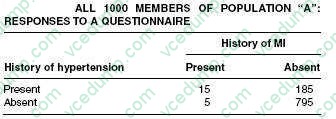
What is the reported prevalence of hypertension in the population per 1000?
A. 150 B. 185 C. 200 D. 220 E. 250
C. 200
Explanation
Prevalence is the number of existing cases of a disease occurring in the total population at a given period of time. In this study, the prevalence rate is calculated based on reported figures (15 + 185 = 200 persons per 1000 persons surveyed report having hypertension). The actual figure, as demonstrated by the investigation of the sample, is likely to be higher.
Question 596:
A 72-year-old man has the sudden onset of suprapubic pain and oliguria. His temperature is 38.0°C (100.4°F), pulse is 100/min, respiration rate is 12 /min, and BP is 110/72 mmHg. Abdominal examination is remarkable only for a tender, distended urinary bladder.
Which of the following is the most likely cause of this condition?
A. urinary tract infection B. prostatic hypertrophy C. posterior urethral valves D. renal carcinoma E. renal arterial occlusion
B. prostatic hypertrophy
Explanation
Acute oliguria is a medical emergency requiring the immediate identification of any correctable cause. Distention of the urinary bladder indicates bladder outlet obstruction. Immediate management should be the passage of a urethral catheter to relieve the obstruction and provide urine for examination. An abdominal flat plate, ultrasonography, or IVP may yield a diagnosis but delay the relief of obstruction. Furosemide may be harmful if given while the bladder is obstructed. Bladder outlet obstruction may be caused by prostatic hypertrophy or prostatitis, stones, clots, malignancy, or urethral stricture; it may also be neurogenic. Posterior urethral valves are a congenital defect that could cause obstruction in children but rarely in adults. Renal carcinoma would not cause outlet obstruction. Renal arterial occlusion can cause acute renal failure but not obstructive uropathy. If urethral catheterization fails to relieve the obstruction, further evaluation, including radiographic or ultrasound studies, is in order. Suprapubic cystostomy may be necessary to empty the bladder.
Question 597:
You are seeing a 38-year-old woman for her annual gynecologic examination. She asks you for some information regarding the HPV vaccine and whether you think it would be appropriate for her 17-year- old daughter. Which of the following statements regarding the quadrivalent human papillomavirus vaccine and HPV is true?
A. The vaccine is recommended for women ages 1126 but can be given as young as age 9. B. After vaccination, women no longer need routine Pap smears. C. The vaccine is given every month for 3 months. D. The vaccine is prepared from the proteins of four oncogenic (e.g., high-risk for cervical cancer) strains of HPV. E. Women with a prior history of abnormal Pap smears are not candidates for vaccination.
A. The vaccine is recommended for women ages 1126 but can be given as young as age 9.
Explanation
The quadrivalent human papillomavirus (under the name Gardasil) was licensed for use in June 2006. It is currently recommended for routine vaccination of young women ages 1112 with "catch-up" vaccination for women 1326. It can be given as young as age 9. The vaccine is three separate 0.5-mL doses, given at 0, 2 and 6 months apart. If one dose is delayed, there is no need to restart the schedule. Rather, the doses should be given as soon as possible. The vaccine is targeted against the L1 proteins of HPV types 6, 11, 16, and 18. HPV 6 and 11 are "low-risk" strains causing genital condylomata, and HPV 16 and 18 are "high-risk" oncogenic strains responsible for 70% of all cervical cancer. Guidelines for screening for cervical cancer have not changed--patients should still be advised to have routine Pap smear screening and HPV screening as indicated. Women with a prior history of abnormal Pap smears are still candidates for the vaccine, as it is unlikely that they have been exposed to all four strains.
Question 598:
A 25-year-old man was admitted to the intensive care unit with a severe head injury, with fracture of the base of the skull. Approximately 18 hours after the injury, he developed polyuria. Urine osmolality was 150 mOsm/L and serum osmolality was 350 mOsm/L. IV fluids were stopped, and 3 hours later, urine output and urine osmolality remained unchanged. Five units of vasopressin were intravenously administered. Urine osmolality increased to 300 mOsm/L. Which of the following is the most likely diagnosis?
A. central diabetes insipidus B. nephrogenic diabetes insipidus C. water intoxication D. solute overload E. syndrome of inappropriate antidiuretic hormone secretion (SIADH)
A. central diabetes insipidus
Explanation
Diabetes insipidus, a deficiency of pituitary antidiuretic hormone (ADH) (arginine vasopressin), causes water loss because of failure to facilitate reabsorption of water in the distal tubules and collecting ducts of the kidneys. In central diabetes insipidus, there is impaired production of vasopressin, and in nephrogenic diabetes insipidus, the distal renal tubules are refractory to vasopressin. In central diabetes insipidus, urine osmolality remains unchanged. If water intoxication were present, stopping IV fluids should have increased urine osmolality. With solute overload, serum osmolality would have been higher. In SIADH, urine osmolality is usually higher than serum osmolality.
Question 599:
A 34-year-old woman just delivered a 4100-g boy after a 15-hour labor, including a 21/2-hour second stage. During the repair of a midline episiotomy, there is a marked increase in the amount of vaginal bleeding.
Which of the following is the most common cause of immediate postpartum hemorrhage?
A. retained placental fragments B. uterine atony C. cervical laceration D. vaginal laceration E. disseminated intravascular coagulation
B. uterine atony
Explanation
The main mechanism by which hemostasis is achieved following delivery is contraction of the myometrium to compress the uterine vessels that had been supplying the placenta. Lack of effective myometrial contraction (i.e., uterine atony) is the major cause of postpartum hemorrhage. If the uterus is found to be firmly contracted, then other factors, such as cervical or vaginal lacerations or a coagulopathy, must be sought.
Question 600:
A 45-year-old homeless schizophrenic patient presents to you with suicidal ideation. You interview him and find out he is a divorced Roman Catholic. He recently lost his job after being caught a second time drinking on the job. He had attempted suicide impulsively 5 years previous by overdosing. He is not currently psychotic. He bought a handgun and ammunition recently and has been thinking about shooting himself in the head. He has gotten as close to acting on it as having loaded the gun and held it up to his head this morning. Someone walking by stopped him and convinced him to come and see you.
He is ambivalent about seeking help.
Which of the following is not associated with an increased suicide risk?
A. Roman Catholic religion B. male C. divorced D. previous suicide attempt E. schizophrenia
A. Roman Catholic religion
Explanation
Historically, suicide rates among Roman Catholics have been lower than among Jews and Protestants. Being divorced, being male, and having a previous suicide attempt all increase the risk for suicide. Up to 10% of schizophrenics die from suicide.
Nowadays, the certification exams become more and more important and required by more and more
enterprises when applying for a job. But how to prepare for the exam effectively? How to prepare
for the exam in a short time with less efforts? How to get a ideal result and how to find the
most reliable resources? Here on Vcedump.com, you will find all the answers.
Vcedump.com provide not only USMLE exam questions,
answers and explanations but also complete assistance on your exam preparation and certification
application. If you are confused on your USMLE-STEP-2 exam preparations
and USMLE certification application, do not hesitate to visit our
Vcedump.com to find your solutions here.