USMLE USMLE-STEP-2 Online Practice
Questions and Exam Preparation
USMLE-STEP-2 Exam Details
Exam Code
:USMLE-STEP-2
Exam Name
:United States Medical Licensing Step 2
Certification
:USMLE Certifications
Vendor
:USMLE
Total Questions
:738 Q&As
Last Updated
:May 25, 2026
USMLE USMLE-STEP-2 Online Questions &
Answers
Question 601:
In the adult neutropenic patient, which of the following is the most likely organism to cause bacterial meningitis?
A. group B Streptococcus B. S. aureus D. S. pneumoniae E. L. monocytogenes H. influenzae
E. L. monocytogenes
Explanation
Although Listeria still represents only a fraction of total cases (about 10%) of meningitis, it is seen in diabetes and cancer patients, alcoholic, elderly, and immunocompromised patients.
Question 602:
A55-year-old man presents to the physician's office complaining of upper abdominal pain of 2 months' duration. The pain is described as gnawing, localized to the upper midline, and associated with nausea. The pain is exacerbated by food, and there is an associated 20-lb weight loss over 2 months. His past history is pertinent for a 30 pack-year smoking history, occasional alcohol intake, and a prior history of a benign gastric ulcer 5 years ago. Physical examination reveals normal vital signs, mild epigastric pain with deep palpation, and mildly hemepositive stool. An evaluation for recurrence of a gastric ulcer is recommended.
Which of the following tests is the most reliable method for diagnosing a gastric ulcer?
A. UGI barium x-rays B. fiberoptic upper endoscopy C. CT scan D. endoscopic ultrasound E. MRI
B. fiberoptic upper endoscopy
Explanation
Gastric ulcers present with symptoms of abdominal pain, aggravated by food, and associated with nausea, vomiting, anorexia, and weight loss. The two principal means of diagnosing a gastric ulcer are UGI radiographs and fiberoptic endoscopy, the latter being the most reliable method. CT scan and endoscopic ultrasound may be helpful in staging gastric cancer, but are not routinely used with benign disease. The failure to respond to 12 weeks of medical management is an indication for surgical therapy to avoid potential complications and to exclude malignancy, despite biopsies obtained by endoscopy that show benign disease.
Question 603:
A 65-year-old woman with a history of cardiac problems complains that she has lost her appetite, she cries frequently, and has lost interest in her grandchildren, her gardening, and her craft making. She thinks maybe it is time to die. According to the patient's psychiatric symptoms, select the most appropriate medication. Presume no medical problems other than those mentioned.
A. amitriptyline B. clozapine C. divalproex D. fluoxetine E. hypericum perforatum F. olanzapine G. lorazepam H. propranolol I. temazepam J. thiothixene
D. fluoxetine
Explanation
This woman is exhibiting signs of severe depression. Because of her cardiac condition, avoiding an antidepressant with negative cardiac effect is important; therefore, amitriptyline would be eliminated.
Fluoxetine, an SSRI, would be an appropriate choice.
Question 604:
Six hundred asymptomatic men with prostatic nodules are given a PSA test to screen for prostate cancer. With a cutoff of 5 ng/mL, the PSA results are positive in 200 cases. Of these, 100 persons are confirmed on biopsy and follow-up testing to have the disease; however, 50 of the individuals who had negative test results are also shown to have the disease based on biopsy. You have been asked to screen another similar group of 50 men using the PSA test.
What proportion of persons with no prostatic cancer will you correctly identify in the new group?
A. 16.7% B. 22.2% C. 66.7% D. 77.8% E. 87.5%
D. 77.8%
Explanation
The percentage specificity of a test is the percentage of those persons without the disease (true negatives [TN]) who were correctly labeled by the test as not diseased. The false positives (FP) are those who were incorrectly labeled by the test as having the disease. The specificity is thus expressed as TN/(TN + FP) . 100. In the example given in the question, the calculation is 350/(350 + 100) x 100 = 77.8%
Question 605:
A 2-year-old boy presents with refusal to use his right arm for 1 day. He is otherwise well.His mother states she pulled upward on his arm the previous evening to keep him from tripping down the stairs.
Which of the following is the most likely diagnosis?
A. Colles fracture B. fractured clavicle C. greenstick fracture of the humerus D. rotator cuff injury E. subluxation of the radial head
E. subluxation of the radial head
Explanation
Nursemaid's elbow, or subluxation of the radial head, occurs in children following longitudinal traction on a pronated extended elbow. When attempting to restrain a child, an uninformed caretaker may jerk on a child's upper extremity. The result is a painful subluxed elbow that is easily reduced by simultaneous flexion and supination of the forearm.
Question 606:
Among the conditions that cause edema of the eyelids is orbital cellulitis. This is a serious infection that must be recognized early and treated aggressively if complications are to be avoided. Which of the following features is useful in differentiating orbital cellulitis from periorbital (preseptal) cellulitis?
A. proptosis B. elevated WBC count C. fever D. lid swelling E. conjunctival inflammation
A. proptosis
Explanation
Proptosis and limitation of extraocular motility distinguish orbital cellulitis from periorbital cellulitis. Fever, lid swelling, redness of the eye, and leukocytosis generally are present in either condition. Orbital cellulitis (infection within the orbit) may follow directly from a wound near the orbit or may result from bacteremia, but the most common source involves extension from the paranasal sinuses. The organisms most frequently implicated as pathogens are H. influenzae, S. aureus, group A beta- hemolytic Streptococci, and S. pneumoniae. The risk of complication is great, with extension resulting in cavernous sinus thrombosis, meningitis, or brain abscess. Prompt hospitalization and parenteral antibiotic therapy are indicated
Question 607:
A 30-year-old woman who has been human immunodeficiency virus (HIV) positive for 4 years was recently diagnosed with AIDS. Which of the following meets the criteria for the case definition?
A. oral thrush B. herpes zoster C. persistent lymphadenopathy D. peripheral neuropathy E. pulmonary tuberculosis
E. pulmonary tuberculosis
Explanation
The new case definition for AIDS in 1993 added pulmonary tuberculosis, invasive cervical cancer, and recurrent pneumonia. This CDC classification system is divided into three categories: category A is symptomatic infection with HIV and includes acute illness and persistent lymphadenopathy; category B includes conditions attributed to HIV infection, such as oral thrush, herpes zoster, and peripheral neuropathy; category C is the AIDS surveillance cases. Anergy to common skin test antigens is a common finding with HIV infection. There is a decline in CD4 cell numbers, a relative increase in the number of T8 cells, which results in a decreased T4:T8 ratio of less than 1. Functional abnormalities occur in both B cells and natural killer cells, which accounts for the increase in certain bacterial infections seen in advanced HIV disease. Elevation of beta2 submicroglobulin, a serologic finding reflecting immunologic dysfunction, is a fairly reliable marker of progressive immunologic decline and the subsequent development of AIDS.
Question 608:
A 1-year-old child in a large nursery school develops fever, irritability, confusion, a possible stiff neck, and a petechial rash, over the course of several hours. Which of the following agents is recommended for others in the nursery school who have had contact with the child, to control a possible outbreak?
A. rifampin, ciprofloxacin or ceftriaxone B. gamma globulin C. group Ameningococcal vaccine D. group C meningococcal vaccine E. quadrivalent meningococcal vaccine
A. rifampin, ciprofloxacin or ceftriaxone
Explanation
Rifampin, ciprofloxacin, and ceftriaxone have been recommended for the chemoprophylaxis of close contacts of cases of meningococcal meningitis. Gamma globulin has not been shown to be effective for the prevention of meningococcal disease. Most outbreaks are caused by strains of groups A, B, C, Y, and W- 135. Most outbreaks in children less than 1 year old are caused by group B (for which there is no vaccine). Avaccine for groups A, C, Y, and W-135 is available but is used only when the source has been isolated and typed, which is rarely the case when prophylaxis must be started immediately. The immunogenicity of vaccines for groups Aand C is poor, especially in children. Meningococcal vaccine has been recommended for high-risk groups, including military troops and students living in dormitories. The search continues for a widely applicable vaccine.
Question 609:
A wet smear of a vaginal discharge is illustrated in Figure.Which of the following is the most likely cause of the discharge?
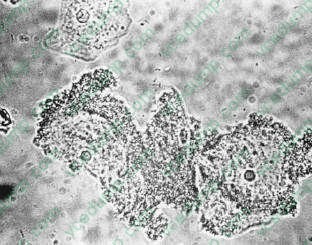
Which of the following is the most appropriate treatment for the discharge illustrated in Figure?
A. clindamycin B. erythromycin C. metronidazole D. miconazole E. doxycycline
C. metronidazole
Explanation
The treatment of choice for bacterial vaginosis is metronidazole, also an effective treatment for trichomonas vaginitis. The dose is 375500 mg orally twice daily for 1 week. A single daily dose of 750 mg was recently approved. Vaginal metronidazole gel or clindamycin cream are also approved forms of treatment. Concurrent therapy of the male partner is controversial. Treatment in pregnancy is recommended, because there is a potential association of bacterial vaginosis and preterm labor and delivery.
Question 610:
Which of the following is the most likely diagnosis for the ulcerated lesion on the person's cheek shown in figure below?
A. squamous cell carcinoma B. malignant melanoma C. benign ulcerated nevus D. basal cell carcinoma E. hemangioma
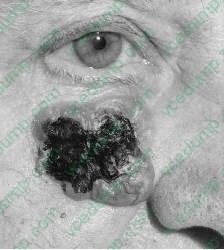
D. basal cell carcinoma
Explanation
Basal cell carcinoma is the most common form of skin cancer and can present as an isolated papule or nodule or with ulceration. Although locally aggressive and destructive, they rarely metastasize. Figure shows a large ulcer with a rodent-like appearance with nodules at the border. Squamous cell carcinoma would be in the differential, but it does not ulcerate as often and is characterized by being hard nodules. Malignant melanomas are usually nodular and pigmented. It would be highly unusual for a benign nevus to ulcerate and have this appearance. A hemangioma is a red vascular lesion.
Nowadays, the certification exams become more and more important and required by more and more
enterprises when applying for a job. But how to prepare for the exam effectively? How to prepare
for the exam in a short time with less efforts? How to get a ideal result and how to find the
most reliable resources? Here on Vcedump.com, you will find all the answers.
Vcedump.com provide not only USMLE exam questions,
answers and explanations but also complete assistance on your exam preparation and certification
application. If you are confused on your USMLE-STEP-2 exam preparations
and USMLE certification application, do not hesitate to visit our
Vcedump.com to find your solutions here.