USMLE USMLE-STEP-2 Online Practice
Questions and Exam Preparation
USMLE-STEP-2 Exam Details
Exam Code
:USMLE-STEP-2
Exam Name
:United States Medical Licensing Step 2
Certification
:USMLE Certifications
Vendor
:USMLE
Total Questions
:738 Q&As
Last Updated
:May 25, 2026
USMLE USMLE-STEP-2 Online Questions &
Answers
Question 581:
A28-year-old woman with a 7-year history of chronic undifferentiated schizophrenia is hospitalized for an exacerbation of her schizophrenia, with an increase in auditory hallucinations. She has also developed the delusion that she is controlled by aliens from Mars. She has always been very sensitive to the extrapyramidal side effects (EPS) of antipsychotic medications.
She developed an acute restlessness in her legs and arms which her psychiatrist diagnosed as akathisia.
Which of the following is the preferred treatment option?
A. benztropine B. propranolol C. haldoperidol D. dantrolene E. fluoxetine
B. propranolol
Explanation
Typical neuroleptic antipsychotic medications frequently cause unpleasant side effects, which occur at various times during treatment. The extrapyramidal side effect most likely to occur in the first few days of treatment is an acute dystonia, such as a muscle spasm in the neck. A pill-rolling tremor of the hands and masked facies are signs of Parkinsonian EPS, which tend to have their onset several weeks after treatment is begun; whereas severe restlessness of the arms and legs is caused by an unpleasant sensation called "akathisia," which also tends to have its onset several weeks after treatment is begun. Involuntary lip smacking is a sign of tardive dyskinesia, a sometimes irreversible motor syndrome that tends to occur after months or years of treatment with typical antipsychotics. Anticholinergic medications such as benztropine are effective in treating dystonias and pill-rolling tremors. Propranolol is effective in treating akathisia. Haldoperidol would worsen EPS. Dantrolene uncouples muscle contractions and is used occasionally in severe NMS. L-Dopa would decrease the Parkinsonian EPS, but would worsen the psychosis and therefore is not used. Fluoxetine is an SSRI.
Question 582:
As a health officer, you have identified blindness among the elderly in your state as a cause of falls and resultant inability to perform activities of daily living. You try to prevent this by improving access to which of the following?
A. residence in nursing homes B. corneal surgery for near vision C. cataract surgery D. treatment of glaucoma E. refractive correction
C. cataract surgery
Explanation
There is a markedly higher frequency of impaired vision of the elderly in nursing homes than in the community. While it is not frequently recorded as a reason for nursing home admission, people with impaired vision experience any other limitations. Cataract is the leading cause of blindness in both communities. Maximizing visual acuity by appropriate refraction obviously improves mobility and ability to function but is not effective if the patient has cataracts.
Question 583:
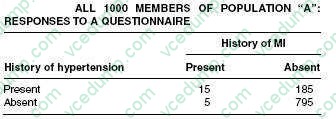
You are examining the relationship between hypertension and myocardial infarction (MI) in your community. In order to do so, you send a questionnaire to the whole population in your community (1000 persons). All 1000 persons responded. The results obtained from that questionnaire are presented below in table.
What is the prevalence of MI per 1000 persons in the community?
A. 5 B. 10 C. 15 D. 20 E. 25
D. 20
Explanation
In the study described in the question, the prevalence rate is the total number of cases occurring in the community, divided by the number of members in the community, multiplied by 1000. This is a point prevalence rate: the number of individuals who have had an MI at the time the questionnaire is administered. Thus, the prevalence is (20/1000). 1000 = 20.
Question 584:
A 6-year-old girl has a low-grade fever, headache, and nasal congestion. She has a flushed face and has developed a lacy reticular rash on the trunk and extensor surface of her arms and legs. Palms and soles are spared. Her mother has been ill with a low-grade fever and some joint stiffness and pain. Which of the following is the most likely diagnosis?
A. rubella B. measles C. scarlet fever D. roseola infantum E. erythema infectiosum (fifth disease)
E. erythema infectiosum (fifth disease)
Explanation
Erythema infectiosum is a common childhood viral exanthem caused by parvovirus B19. It was the fifth in a classification system of childhood exanthems; the others were rubella, measles, scarlet fever, atypical scarlet fever, and roseola infantum. The rash classically presents early with flushed cheeks or a "slapped cheek" appearance. It is followed by development of a macular erythematous rash on trunk and extremities, which then shows central clearing, developing a lacy, reticulated appearance. The infection is often not clinically apparent. Adult and older adolescents, especially females, may develop arthropathy. The symptoms are usually self-limited. Parvovirus B19 is clinically significant in people with hemolytic anemias because it may induce a transient aplastic crisis. Immunocompromised individuals are also at risk for chronic infections accompanied by anemia, neutropenia, and thrombocytopenia. It may also induce fetal demise in case of primary infection of pregnant women.
Question 585:
From the below clinical indications, choose an option for use of immune globulin (IG) in Rubella prophylaxis
A. indicated B. not proven effective C. not routinely indicated D. contraindicated E. compulsory
C. not routinely indicated
Explanation
IG given before exposure or within 14 days of exposure is 7585% effective in preventing symptomatic illness from hepatitis A. IG is produced from the plasma of normal adults and does not contain sufficient antibody to prevent hepatitis B infection. Hepatitis B immune globulin (HBIG) is prepared from plasma known to contain high antibody titers for hepatitis B surface antigen (HBsAg) and is specific for hepatitis B. Given immediately postexposure, and again 1 month later, it has a combined efficacy of about 75% in the prevention of hepatitis B. Postexposure IG has not been found effective in the prevention of hepatitis C infection; on the other hand, treatment of early hepatitis C infection is possible, and thus it is important to monitor exposed individuals to determine whether infection occurs. IG administered to individuals exposed to measles infection who are susceptible to the disease has been shown to be effective if given within 6 days of exposure.
Recent use of IG is a contraindication to immunization with rubella vaccine. IG is not very effective at preventing in utero infection with rubella, and infants with congenital rubella syndrome have been born to women given IG shortly after exposure. IG is not routinely indicated, as it is indicated only if abortion is not elected.
Question 586:
On a routine annual examination, a 43-yearold woman is found to have a 2-cm mass in the lateral aspect of her right breast. Which of the following is the most appropriate next step in management?
A. repeat the breast examination after her next menses B. mammography C. fine-needle aspiration D. open biopsy E. segmental resection
C. fine-needle aspiration
Explanation
The presence of a dominant mass requires immediate evaluation. While all women with a dominant mass should have a mammogram, this is a screening test. Afine-needle aspiration is a diagnostic tool that will resolve whether the mass is cystic or solid. Any fluid or tissue obtained should be sent for cytologic evaluation to further aid in the diagnosis. If clear or cloudy fluid is aspirated, and the mass disappears, the woman should have a repeat breast examination in 1 month. If the mass remains after aspiration, if the fluid is bloody, or if there is a residual mass on a follow-up visit in 1 month, an open biopsy should be done. A segmental resection is a therapeutic option for a circumscribed carcinoma, but is not an appropriate diagnostic tool.
Question 587:
A 65-year-old man presents to the physician's office for his yearly examination. His past history is pertinent for a 40 pack-year smoking history and colon cancer 3 years ago for which he underwent a sigmoid colectomy. The most recent colonoscopic follow-up 3 months ago was negative. His physical examination is normal. Laboratory results show a normal CBC and electrolytes, markedly elevated cholesterol, and a CEA of 12 compared to values of less than 5 obtained every 6 months since colectomy. A repeat CEA 4 weeks later was 15, and liver function tests revealed a minimally elevated alkaline phosphatase, with normal transaminases and bilirubin. Which of the following is the most appropriate next diagnostic test in this patient?
A. positron emission tomography (PET) scan B. radionuclide liver scan C. ultrasound D. CT scan E. MRI scan
D. CT scan
Explanation
In a patient who has undergone surgical resection for colon cancer, elevated CEA, and liver function tests must be followed by an evaluation for metastatic disease, including the possibility of extrahepatic disease. The CT scan is the most useful examination to evaluate both intra- and extrahepatic disease. Various CT scans have been advocated for liver tumors, including dynamic and portography scans. PET scans may detect occult extrahepatic disease and studies are underway to define the role of this modality in metastatic colon cancer. MRI shows promise as a useful examination and can be useful to characterize lesions of uncertain significance. Radionuclide liver scans have been supplanted by more accurate scans. Surgical resection, if possible, is the treatment of choice for metastatic colorectal cancer to the liver. Chemotherapy is reserved for patients who are not surgical candidates or refuse surgical treatment. Radiation therapy is not usually used in these patients. Observation and repeat imaging delays the treatment for patients who may be respectable. The expected 5-year survival has been shown in multiple studies to be greater than 20%, usually in the range of 25 and 35%.
Question 588:
Astudy that has been stratified for age finds a statistically significant association between alcohol use and socioeconomic status (SES). In reviewing the data, the investigators find that the relationship between alcohol and SES is greatest for those in the 40- to 50-year age group. In this scenario, age plays which of the following roles in the relationship between alcohol use and SES?
A. bias B. confounder C. effect modifier D. chance E. distractor
C. effect modifier
Explanation
An effect modifier changes the relationship between a risk factor and an outcome. In this example, the overall relationship between alcohol and SES has not changed, but its effects are greatest in a particular age group, and thus age is modifying the effect of the association between alcohol and SES. In this example, the study was stratified based on age, which would control for confounding effect based on age. Bias is seen when there is a systematic error in the manner in which age is distributed between the risk factor and outcome categories. Bias occurs when there is a systematic error in the design or conduct of a study. There is not enough information provided to determine whether bias may be present. Because the findings have been stratified and have been found to be statistically significant at each stratum, there is less of a possibility that chance is playing a role in the relationship between age and the exposure or outcome. Distractor is not a term commonly used to describe a variable's relationship to an outcome.
Question 589:
A 49-year-old woman presents to her physician with dysphagia, regurgitation of undigested food eaten hours earlier, and coughing over the last 6 months. She was hospitalized 1 month ago for aspiration pneumonia and successfully treated with antibiotics. Examination reveals a thin-appearing woman with normal vital signs and unremarkable chest, heart, and abdominal examination. A UGI contrast study is performed and reveals a pharyngoesophageal (Zenker's) diverticulum. Which of the following is the most important aspect of treatment?
A. resection of the diverticulum B. cricopharyngeal muscle myotomy C. H2 blockers D. elevation of the head of the bed E. diverticulopexy
B. cricopharyngeal muscle myotomy
Explanation
Pharyngoesophageal (Zenker's) diverticulum is the most common esophageal diverticulum and typically occurs in the 3050 age group and, therefore, is believed to be acquired. Its symptoms include cervical dysphagia, regurgitation of undigested food, and recurrent aspiration. It is categorized as a pulsion type, creating protrusion of mucosa, resulting in a false diverticulum. An underlying neuromotor abnormality exists, which is responsible for increased pharyngeal pressure. The most important aspect of treatment is a cricopharyngeal muscle myotomy, which can be combined with resection or diverticulopexy.
Question 590:
A 55-year-old man complains of severe headaches over the past few weeks. Similar episodes have occurred in past years. Which of the following supports the diagnosis of cluster headaches?
A. Pain-free intervals can last for days and then recur. B. Attacks of daily pain last for 48 weeks. C. The most common location of pain is occipital. D. Women are affected twice as commonly as men. E. Caffeine is the most effective treatment for an acute attack.
B. Attacks of daily pain last for 48 weeks.
Explanation
Men are affected by cluster headaches seven to eight times more often than women. Attacks are typically periorbital and may involve the temporal area. Cluster headaches typically occur daily over a 4- to 8-week period followed by pain-free intervals averaging 1 year. The periodicity of the attacks is often striking, with daily recurrences of pain often at the same hour. Pathogenesis is thought to be due to abnormal serotonergic neurotransmission. One hundred percent oxygen inhalation is most effective acutely. Drugs used to prevent cluster attacks include lithium, ergotamine, sodium valproate, and prednisone.
Nowadays, the certification exams become more and more important and required by more and more
enterprises when applying for a job. But how to prepare for the exam effectively? How to prepare
for the exam in a short time with less efforts? How to get a ideal result and how to find the
most reliable resources? Here on Vcedump.com, you will find all the answers.
Vcedump.com provide not only USMLE exam questions,
answers and explanations but also complete assistance on your exam preparation and certification
application. If you are confused on your USMLE-STEP-2 exam preparations
and USMLE certification application, do not hesitate to visit our
Vcedump.com to find your solutions here.